
Surrey Branch Belgian Battlefield Tour
This year’s WFA Surrey branch battlefield tour held during the last week in September took us to an area of the Western Front that very few of us knew much about, let alone had visited. Based for three nights in the familiar surroundings of Ypres, we were able to drive the relatively short distance north to explore the section up towards the Belgian coast, and to discover the important role the Belgian army played during the Great War. Given the proximity of this area to Dunkirk, it also enabled us to include events from both World Wars.
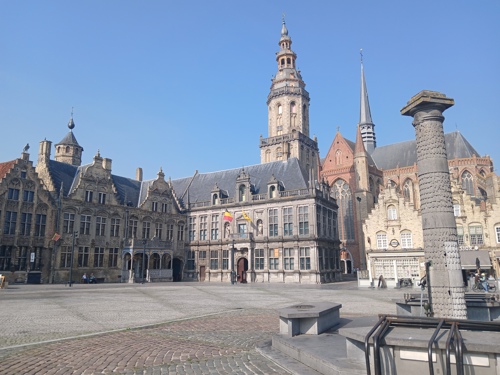
Having just crossed the French border into Belgium, our group of seventeen met up for some lunch in the Vauban-style fortified town of Veurne, once the headquarters of the Belgian Army during the 1914 Battle of the Yser. With its surrounding canals Veurne also formed an important part of the eastern end of the Dunkirk outer defences in 1940.
Our first stop took us to the nearby seaside town of De Panne where the statue of Leopold I, the first King of Belgium, is located and this gave us the opportunity to discuss how Belgium was formed in 1831 and its strategy of neutrality surrounded by powerful neighbours. Standing on the promenade and overlooking the beach we were able to see the art deco Kursaal Hotel, a beacon for the Dunkirk small boats approaching the makeshift pontoons from which many soldiers were evacuated in late May / early June 1940. Just behind the promenade the chapel used by Albert I and his family during the Great War was visited, the last of the buildings and villas used by the King and his General Staff as their forward operating base in 1914.
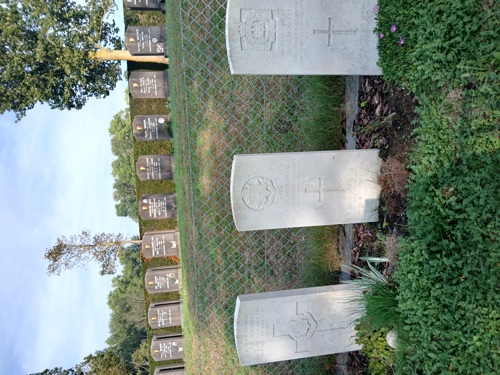
Situated some 10-15 kms behind the frontline De Panne was a major centre for hospitals and casualty clearing stations during the First World War, so unsurprisingly there are several large cemeteries in the area. Our final stops on our first day took us to the largest Belgian military cemetery at De Panne and then to Adinkerke CWGC military cemetery. At De Panne there are also second world war casualties, including Major HEN Bousfield who served in both world wars with the East Surrey Regiment, and was killed in action during the retreat to Dunkirk in May 1940. At Adinkerke many of the casualties were from the second half of 1917 when the British XV Corps held this area. There are also WWII British casualties as well as 142 Czech and German war graves.
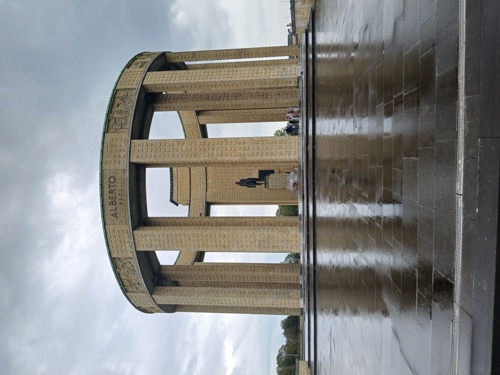
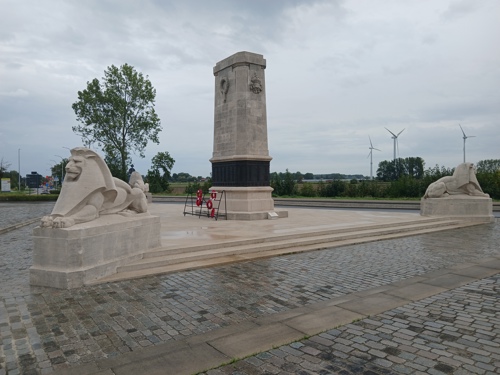
Having enjoyed a group dinner at Captain Cook’s in Ypres, the following day took us up to the coastal town and port of Nieuwpoort. Our tour started at the ‘Soldier King’ Albert I Memorial where we discussed Belgian military strategy, their strength and role in defending this most northerly section during the ‘Race to the Sea’ of September to October 1914. Nearby stands the British Memorial to the Missing that lists 566 British Officers and Men killed in operations on the Belgian coast during WWI and who have no known grave. Here we were able to discuss the role of the Royal Naval Division during the Siege of Antwerp, plus the newly formed Dover Patrol under the command of Rear Admiral Horace Hood as the German Army pressed southwards following the fall of Antwerp, Zeebrugge and Ostend.
The focal point of the day was walking around the Goose Foot lock and sluice system where six rivers and canal waterways, including the River Yser, converge before entering the North Sea. It was here that in late October 1914 and with the German Army starting to cross the Yser that the decision was taken to flood the interior through a series of complex and dangerous opening and shutting of the sluice gates. We learnt how two unlikely civilians, waterways engineer Karel Cogge and tugboat man Hendrik Geeraert, began the inundation that brought the German Army to a standstill and saved this vulnerable section of the Western Front. Standing on this same ground, it was here that the 1/6th Battalion of the Queens Regiment, West Surrey, held the Dunkirk outer perimeter in May 1940.
|
|
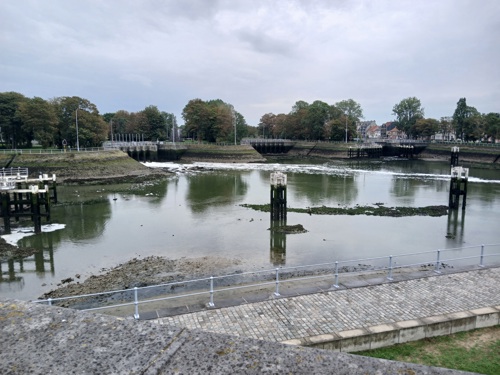
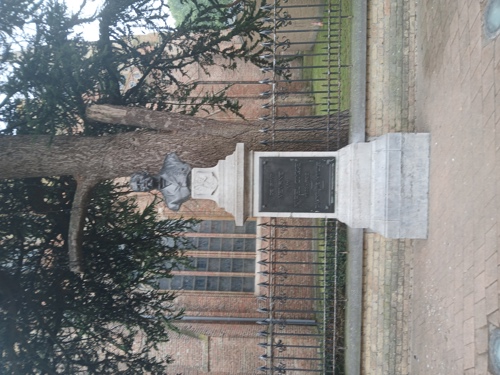
From the Goose Foot, we made the short drive across the Yser estuary to what was the old east-bank dune landscaped Allied bridgehead at Lombardsjide. With the introduction of the British XV Corps into this area in June 1917, Dickie Green presented to the group the devastating pre-emptive strike by the German Marine Corps in July 1917 against the British, known as Operation Strandfest. Dickie then described the planning and strategy behind the risky amphibious assault by British troops to the rear of the German lines in the ultimately cancelled mission known as Operation Hush.
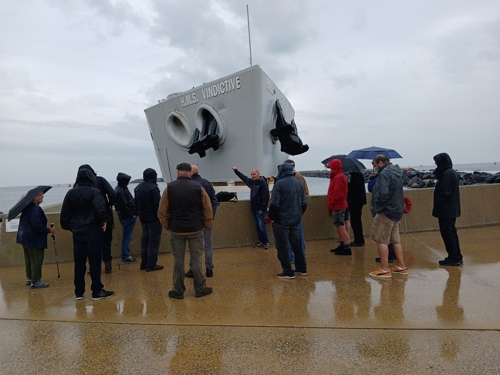
Leaving Lombardsjide we drove northwards up the coast to the Atlantikwall museum at Raversyde for some lunch and where we saw some of the exterior exhibits before heading up to Ostend for our final destination of the day, the salvaged bow of HMS Vindictive Memorial located on the seawall entrance to Ostend harbour. Here Frank Etheridge talked to us about the role of Royal Navy and the Royal Marines in the Zeebrugge and Ostend raids of April and May 1918, in the partially successful attempt to block the German U-boats operating out of Bruges. In particular Frank talked about the role of the 4th Bn Royal Marines at Zeebrugge, and would like to credit Dom Walsh who helped by providing photographs of those involved, Pte's Watson and Fenner, 12 Platoon, 4th Bn RM.
|
|
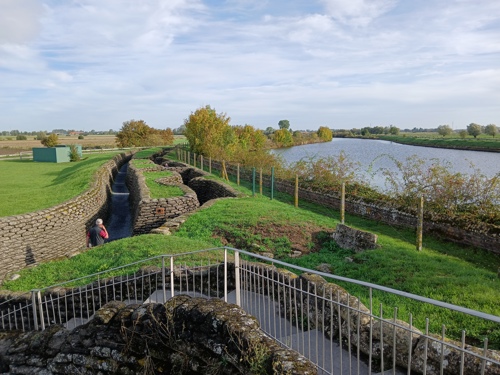

Our next day focused on the area between Diksmuide and Nieuwpoort flooded by the inundations of October 1914, and the role played by the Belgian army. Our first stop was the preserved Belgian trench system known as Dodengang or the ‘Trench of Death’. Running along the west bank of the Yser it was easy to see the precarious nature of this position from enfilade fire due to the meandering nature of the river, as well as the German positions that were also on the west bank. We then drove a short way to Oud-Stuivekenskerke, a small slightly raised hamlet which during the inundation became a defended island that was used as a forward observation post by the Belgian army. A good view of the flat surrounding countryside was obtained by those that climbed the tower. Next to the tower the small ‘Our Lady of Victory’ chapel in memory of the Belgian army was visited, surrounded by 41 memorials to the units that held the Yser sector.
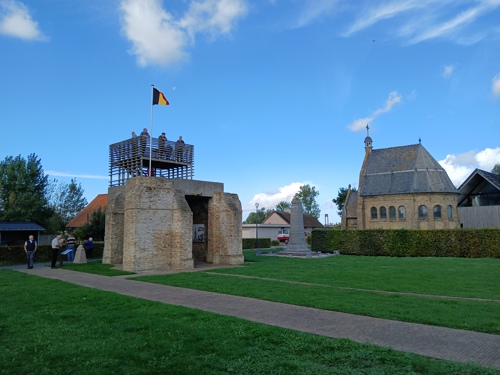
A loop was made following the Yser river northwards, passing the defended and ultimately destroyed bridges at Tervate and Schoorbakke, crossing the old Diksmuide-Nieuwpoort railway line whose embarkment formed the western edge of the inundations and subsequently Belgian front line, past the destroyed frontline town of Pervijve and southwards to Diksmuide. This historic town was of central importance during the fighting of 1914 where the retreating Belgian army was assisted by the newly arrived French Marines in the heroic defence of the town. By the time the ruined town fell in mid-November, the inundations covering an area of 32kms by 3kms were in a full effect on the battlefield, thus halting the advance of the German army.
|
|

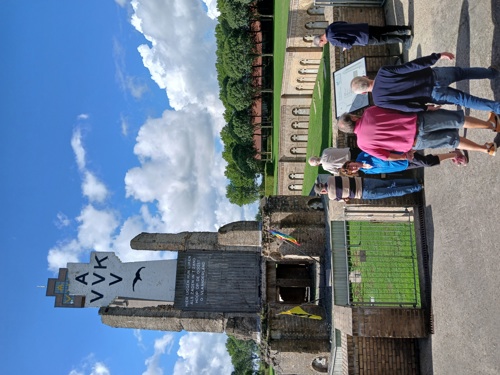
Dominating the skyline for many a mile around Diksmuide is the imposing Yser Tower, built as a memorial to the war dead and now housing a museum. Standing next to the Yser river opposite the site of the old German redoubt at the Minoterie flour mill and in front of the Yser Tower, we were able to discuss the complex story of remembrance interlaced with nationalism in this Flemish part of Belgium, with the first remembrance tower having been destroyed and subsequently replaced by the Peace Gate, and the old tower surrounded by the unique Celtic-style military headstones for the heroes of Flanders.
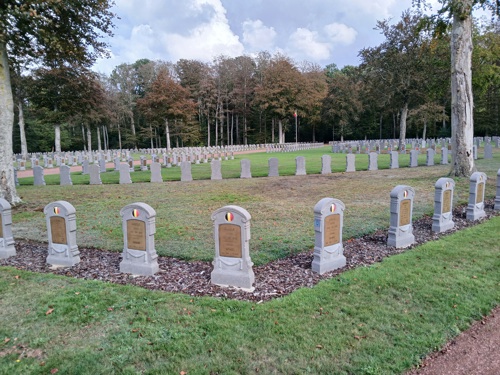
After lunch we headed out of Diksmuide passing through the nearby town of Esen, scene of heavy fighting in October 1914 and one of numerous sites of atrocities made against the Belgian civilian population during the initial stages of the war. Our final destination that day was the second largest Belgian military cemetery located at Houthulst, in the forest of that name that saw some of the heaviest fighting during the successful 28th September 1918 Belgian led offensive that saw the eventual recapture of the wasteland that was formerly Passchendaele. An unusual star-shaped design, the cemetery was also notable for the large number of Italian POW war dead.
That evening the group attended the 8pm Menin Gate Last Post Ceremony, where Ben McMillan and Mark Kent laid a wreath on behalf of the WFA Surrey branch.

The first stop on our last day was to Talbot House in Poperinghe where there is currently an exhibition entitled ‘1919’ containing the fascinating photographs taken by Ivan Bawtree immediately in the aftermath of the Great War, and as the IWGC began the process of searching for and burying the war dead. The photographs also show a region and population beginning the slow process of reconstruction. Coincidentally the exhibition was jointly created by WFA Surrey branch member Jeremy Gordon-Smith, a great-great-nephew to Bawtree, and is a fine piece of work and tribute to his relative.
Poperinghe was an important military hub for the British holding the Ypres Salient, but in addition to having the relative tranquillity of places like Toc H, the town was also well known for its military courts and capital punishments. As we exited the town, we made a brief stop at the Poperinghe New Military Cemetery which amongst the 953 military graves are seventeen shot at dawn, now marked with their national flag tribute.
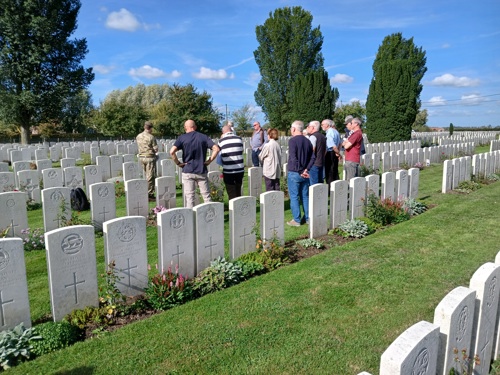
Our final stop on the tour was the Nine Elms British Cemetery, a request by Surrey member Mark Kent to honour and pay tribute to his great uncle 10824 Sjt Edward Charles Kent, 18th Battalion Middlesex Regiment, who died 24th March 1918. As we prepared to head back up to the coast for home, and coming full circle in our story of this region, we stopped to pay our respects by the grave of Pte JA Budd of the 1/6th Battalion of the Queens, killed in action during the retreat to Dunkirk in May 1940.
This was undoubtedly an interesting and informative tour, discovering parts of the Western Front battlefield that we would normally bypass or have simply overlooked. A big thanks goes to the tour planning and logistics team Nick Yellop, Frank Etherington and Paul Iversen for organising an enjoyable few days exploring the battlefields of Belgian Flanders.
Greg Stephens, battlefield guide and tour co-organiser


