
Feb 2026 meeting
21 February 2026
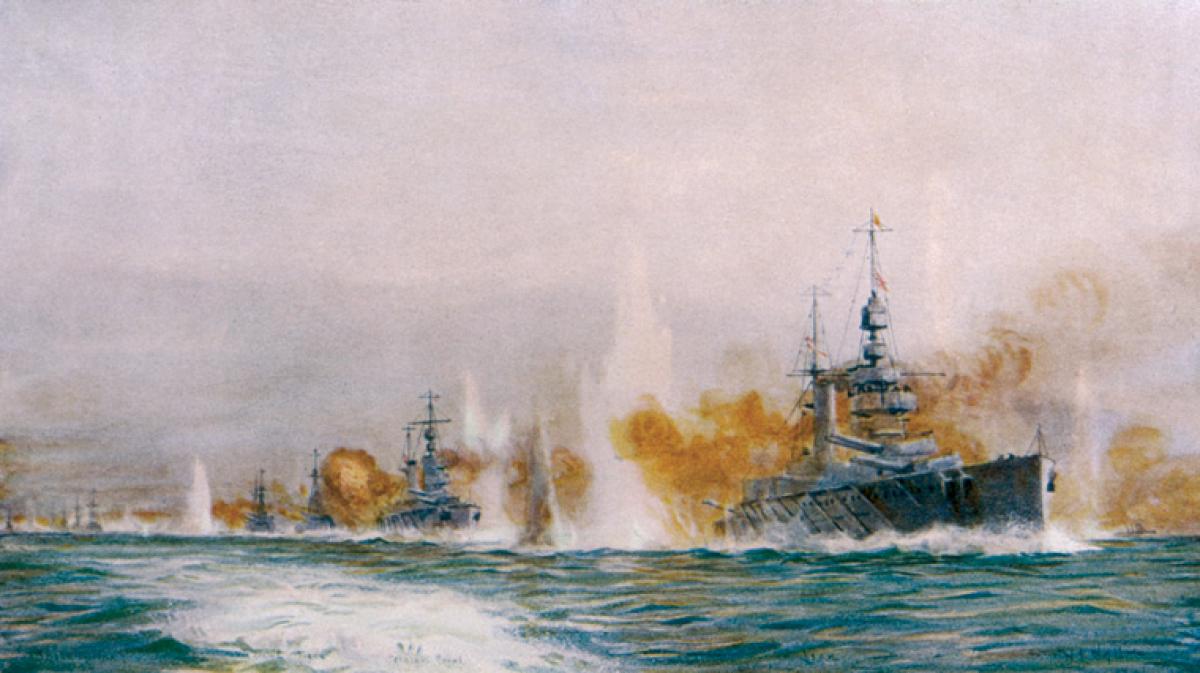
At our branch meeting on February 21st, author Peter Hart gave us a talk on the battle of Jutland.
Peter's talk was based on research that he did some years ago for his book about the battle. He explained that it was a controversial battle in respect of which side won, but also that he wished to convey some of the experiences of those who took part.
Before the battle, Admiral Jellicoe was in command of the Grand Fleet, stationed at Scapa Flow with Admiral Beatty and the Battle Cruiser Fleet based at Rosyth. So essentially, the Royal Navy ceded full control of the North Sea but was in control of the seas in the rest of the world. The German High Seas Fleet was staying in port. Thanks to the Russians, Room 40 at the Admiralty was able to decode German Naval wireless messages and then use trigonometry to locate the ships.
On 24th January 1916, Vice Admiral Reinhard Scheer took over command of the High Seas Fleet and wanted to do something, but without direct conflict with the Grand Fleet, which included tip-and-run raids on Sunderland, for example.
Thanks to the work in Room 40, Jellicoe and Beatty were able to put to sea 3½ hours before the Germans left port on 30th May 1916. Beatty, who was intelligent but made mistakes and had a lack of attention to detail, was at sea with two battle cruiser squadrons, 2 miles apart from each other. The 5th Battle Squadron was too far away at five miles, and did not receive a signal to change direction and ended up 10 miles away as the Germans tried to lure Beatty into the High Seas Fleet.
The Germans opened fire first and at 16:02, the Van der Tam shelled HMS Indefatigable, hitting X Turret and causing a flash down to the magazine and an explosion. 1,017 men were killed, but Signalman Sidney Farmer was at the top of the gunnery mast but was thrown clear and survived. He described seeing 12” guns tossed like matchsticks.
The Germans in Seydlitz and Derflinger attacked and hit HMS Queen Mary. PO Edward Francis described the floor of his turret bulging and the aft 4” battery being smashed. With a list to port the turret was cleared and Francis got into the water before the ship exploded, with debris flying everywhere. He survived by grabbing a rolled-up hammock.
This was the time that prompted Beatty’s well known comment that there was “something wrong with our ships”. The cruisers had been built with the philosophy that speed would be their armour, so they were not armoured and were not compartmentalised. By contrast, the Germans had made improvements to their ships and working practices after there was a flash in a turret of the Seydlitz at the Battle of Dogger Bank in 1915. As an example of this, Seydlitz was hit by a torpedo at Jutland but did not sink.
Beatty saw the main German fleet and ordered a 180º change of course, but poor signalling led to the 5th Battle Squadron carrying on as before, straight at the German destroyers. One of the squadrons ships, HMS Malaya was hit at 17:30 but had her watertight doors closed and survived.
The Grand Fleet itself was in six columns abreast and saw a series of actions, made more complicated by Jellicoe receiving no information from Beatty. The engineer officer on HMS Warrior described when she was hit: there was a tremendous explosion and most of the lights went out. There was a heavy roar of water. Despite getting a blast of steam in his face, he got the men out as fast as he could and then followed. They could not lift the armoured hatch to the deck, but climbed through a shell hole, instead.
HMS Invincible managed to fatally damage the Lützow, but was herself hit and sunk with the loss of 1,032 men, including Rear-Admiral Hood. Only six survived, including Commander Dannreuther who stepped from the top of a mast onto debris floating on the sea.
Admiral Scheer disengaged, turned to starboard and disappeared into the mist with Jellicoe trying to cut him off from home. However Scheer ran into the Grand Fleet again whilst trying to rescue the Wiesbaden. Jellicoe turned away when German destroyers attacked with torpedoes, so as to save his ships. Scheer then decided to take the quickest way back to port as he had ships that were sinking. There was some confused fighting as ships from both sides became mixed up and the Royal Navy suffered from lack of modern searchlights – they took time to switch on fully whereas the Germans left theirs on but hid them behind screens until needed.
In HMS Tiger’s medical station AB Victor Heyward described the scene as looking like the picture of HMS Victory’s cockpit at Trafalgar. The Rev Bradley described looking for survivors whilst ankle deep in water and parts of bodies.
The Battle of Jutland saw more deaths from military action than the whole of the Second Anglo-Boer War. The Germans claimed victory as more British ships were sunk than German ships. However, the British losses were quickly replaced. Also, the High Seas fleet was never a serious threat again and the Royal Navy continued to control the world’s seaways.
Latest Ox & Bucks branch news

15 February 2026
Soldiers of Oxfordshire Museum tells the story of the county’s military heritage through 50 objects in new exhibition
Read more
17 January 2026
Report of Meeting of 17th January : Andy Stuart “The Allied Intervention in Russia and the North Russian Relief Force”
Read more
15 November 2025


