
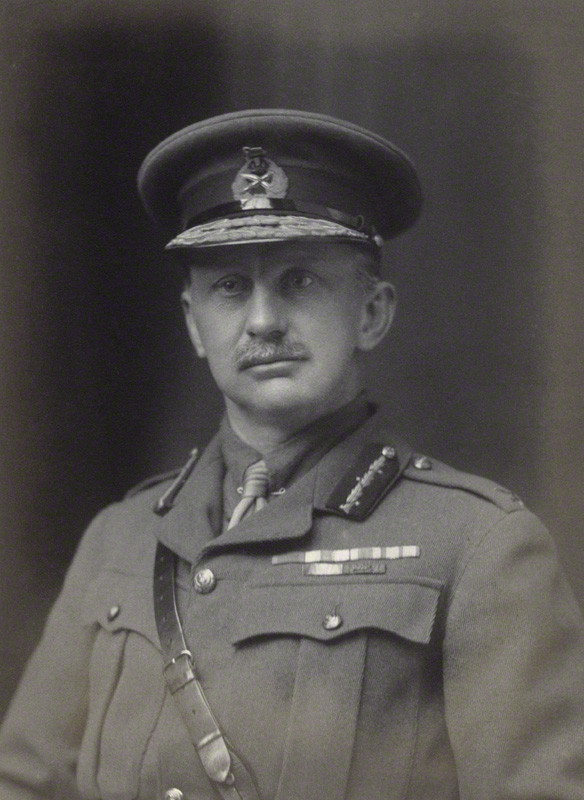
Anthony 'Giles' Courage
Anthony ‘Giles’ Courage belonged to the famous brewing family. He was commissioned in the 15th Hussars on 9 December 1896. During an otherwise largely unremarkable pre-war career his chief regimental achievements were sporting rather than military. He was devoted to all the ‘typical pursuits’ of a regimental officer: hunting, fishing, shooting, horse racing and polo. And, like John Hardress-Lloyd and Sydney Charrington, future fellow tank brigade commanders, he was a keen player. Indeed, whilst with his regiment in India he played in the same regimental team as Charrington and a future tank battalion commander, the Hon J D Y Bingham. Amongst his regimental peers was Frederick Sykes, destined to command the RFC in France and to become Chief of the Air Staff.
Like many regimental officers, his career seemed stalled in 1914. He was 38 years of age and still only a captain. War changed that. Courage responded vigorously to the challenge. He was an energetic squadron CO during the Retreat from Mons, on the Marne and the Aisne and during First Ypres. His command was frequently detached from the rest of the regiment and he appears to have revelled in the resulting independence.
His luck ran out, however, on 13 May 1915 during Second Ypres, when he was severely wounded by a shell burst that mortally wounded a fellow squadron CO. This wound necessitated an early form of reconstructive surgery to rebuild his lower jaw and he was subsequently often in severe pain from the wound, leading one subordinate to state: ‘Courage was his name, and his nature’. He also became very talkative – a fact another subordinate ascribed to the necessity of frequently exercising the wounded area.
In October 1915 he was promoted to major and, having received treatment from a noted dental surgeon at Boulogne, he became part of the base commandant’s staff there. In April 1916 he was promoted to the staff of the Adjutant-General at GHQ, where he remained until January 1917, when he applied to join the Heavy Branch, Machine Gun Corps. Hugh Elles appointed him to command ‘B’ Battalion, HBMGC, and shortly afterwards, 2nd Tank Brigade – a command he held until January 1918 when he was invalided sick on account of his old wounds.
During this period under Courage’s command, 2nd Tank Brigade took part in the battle of Messines, Third Ypres and the battle of Cambrai. Whilst commanding 2nd Tank Brigade, he was described as ‘a little grizzled man of about fifty years’. The stress of war and his wounds had aged him.
Courage’s Brigade-Major was Stephen Foot; whose book Three Lives – and Now, provides some interesting insights into Courage’s command style. Foot believed Courage had the ‘knack’ of leadership, describing how he had seen Courage:
At the end of a most exhausting day when he must have been quite fagged out, stop suddenly and start talking to a junior NCO exactly as if this was the moment he had been waiting for all day. The conversation might last for only three minutes, but in that time the NCO would have acquired the conviction that the Brigade-Commander was really interested in him, with the result that later on he would be prepared to do anything at his command.
In return, Courage displayed complete confidence in Foot, which inspired Foot’s confidence in himself. Courage was undoubtedly a conscientious officer, being described by J F C Fuller as ‘amazingly hard-working and painstaking’. No detail escaped his notice.
Courage returned to command in February 1918 and became GOC 5th Tank Brigade in the following month. He was given the rank of Brigadier-General in April 1918. 5th Tank Brigade took part in the battles of Amiens and the Hundred Days.
Perhaps Courage’s greatest achievement, however, was at the battle of Hamel on 4 July 1918. For weeks before, he worked hard at planning the battle and at developing a mutual understanding between the tank crews and the Australian infantry with whom they were to attack. The attack’s success was, according to one source, ‘a case of sheer personality, plus a shrewd knowledge of human nature, achieving its purpose’.
Courage was awarded the DSO, MC and French Croix de Guerre with palm, and was six times mentioned in despatches for his services in the war. In November 1918 he was appointed to command No. 2 Tank Group, being succeeded as GOC, 5th Tank Brigade by Sydney Charrington.
Anthony Courage retired in 1921, subsequently becoming chairman of Courage Ltd. He was also a director of White Horse Distillers and the Hyderabad (Deccan) Company.