
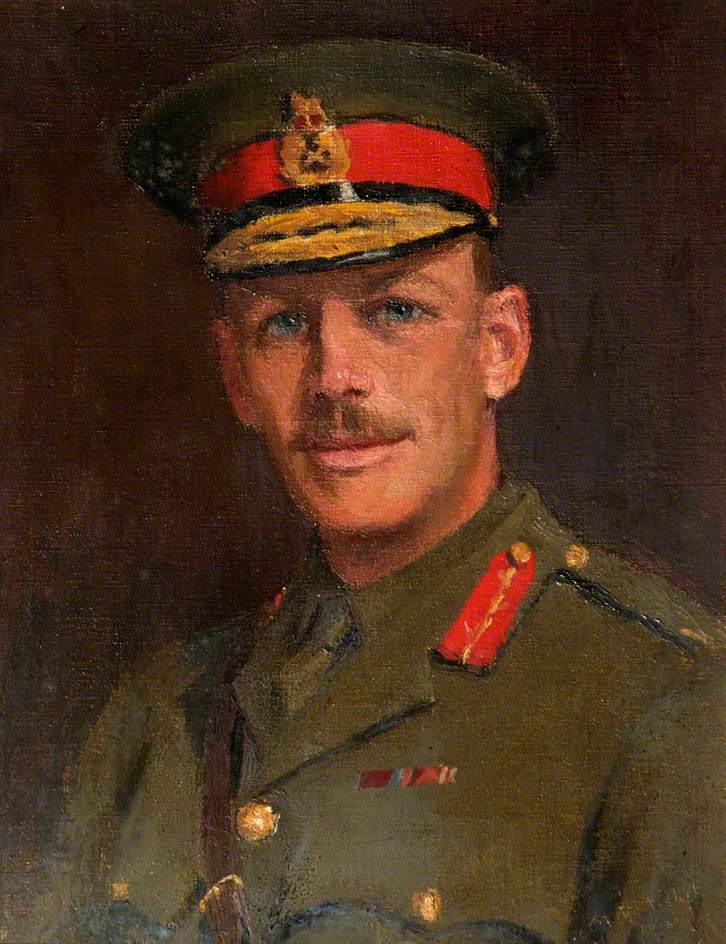
Anthony Julian Reddie
Anthony Julian Reddie was the youngest son of Captain J G Reddie, of Redhouse, Fife. He was commissioned in the South Wales Borderers on 19 November 1892. His pre-war career was unusual in having no periods of active service. He was Adjutant 1st Battalion South Wales Borderers (1901-4) and Adjutant Territorial Force (1909-13). When the war broke out he was serving with 1st Battalion South Wales Borderers in the rank of major.
Reddie’s rather mundane pre-war career did not, however, prove an obstacle to his relatively swift wartime rise. He assumed command of his battalion on 1 November 1914 after its CO, Lieutenant-Colonel H E B Leach, was wounded. He was 41. After eight months in command of 1st South Wales Borderers, Reddie was promoted to brigade command as GOC 1st Brigade, 1st Division. His tenure was a long one, more than two years. He returned home in November 1917 as GOC Welsh Reserve Brigade. This looks suspiciously like the application of the six months’ rest rule for long-serving front-line combat commanders. Reddie duly returned to action on 3 April 1918 as GOC 187th Brigade, 62nd (2nd West Riding) Division, an excellent second line Territorial formation. He commanded it until the Armistice and beyond.
While GOC 1st Brigade, Reddie was one of the officers invited to attend the tank trials at Hatfield Park on 2 February 1916. Reddie’s report, ‘Remarks on Experiment of 2nd Feb’, dated 8 February 1916, was possibly the first report on the new weapon seen by Douglas Haig [1]. Haig was certainly impressed by it. Reddie’s general conclusion was favourable. He immediately recognised the potential of the tank without being starry-eyed about its chances of success. He was also fruitful in suggestions for the employment of tanks. These included the use of smoke and of camouflage, their use in ‘extended order’, the role of counter batteries, the use of previously reconnoitred routes and of signal lights if tanks were to be used by night, and the desirability of developing faster machines. Reddie believed that ‘Even if 50% were knocked out I consider this employment justifiable’.
When the war ended Reddie was still only 45, slightly on the young side for a pre-war battalion commander, and he duly reverted to battalion command as CO 1st South Wales Borderers (April-August 1919). He commanded the Black Watch and Gordon Brigade TA from January 1924 until his retirement on 5 January 1928. During the Second World War Brigadier-General Reddie was Area Organiser Home Guard Highland (later South Highland) Area (1940-1).
References:
1: PRO: WO 158/833.