
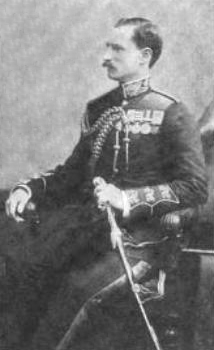
Arthur Edmund Sandbach
Arthur Edmund Sandbach (‘Minimus’) was the third son of Henry Robertson Sandbach of Hafodunos, Denbighshire. His unusual smartness as a Woolwich cadet also earned him the nickname ‘the Lordly Stag’. He graduated only 11th out of 12 in his batch on 6 April 1879. He soon saw active service in the Egyptian War (1882), including the battle of Tel-el-Kebir, the Sudan (1885) and Burma (1886-7), where he had a horse shot from under him, in the Sikkim (1888) and Hazara (1891) expeditions and the Nile (1898), where he was AAG of the Egyptian Army.
He was at the Staff College from 1896 to 1897, in the same class as Allenby and Haig. He was Military Secretary to Lord Curzon, Viceroy of India, January 1898-November 1899, a period described as ‘unhappy’ in his RE Journal obituary. His unhappiness was terminated by the war in South Africa, where he served from December 1899 to the end, winning a DSO. He was Commandant 1st Sappers and Miners, Indian Army (1904-7), CRE Troops Aldershot (1908-10) and Chief Engineer in Ireland (October 1910-August 1914).
Sandbach went to war as CE II Corps, but he spent the first few weeks of the war as Temporary Commandant of Havre (No 1 Base) after the Commandant, Colonel J F Parker, collapsed. Sandbach was responsible for salvaging 60-70,000 tons of stores threatened by the German advance. Although he became the first CE Second Army, the appointment was not made immediately on the Army’s formation in December 1914 but only in February 1915. Sir Horace Smith-Dorrien’s description of Sandbach as a ‘competent Chief Engineer’ was not the most ringing of endorsements. He remained with Second Army only until May 1915, when he returned home to be Inspector of Engineers, a classic appointment for someone not thought up to active service or to be in need of a ‘rest’.
On 15 November 1915 he was given command of the 68th (2nd Welsh) Division, TF. On 14 February 1916 he assumed command of 59th (2nd North Midland) Division, the first Territorial Division to be deployed in Ireland in the aftermath of the Easter Rising. In February 1917 he took the division to France. He was 58.
Sandbach did not survive for long in France. Sir Henry Rawlinson visited the division following the reverses it had suffered at Le Verguier on 2,4,5, 6 April 1917. He was shocked by what he found. He recommended that Sandbach and his GSO1, Lieutenant-Colonel R St G Gorton, be sent home. Sandbach went the next day, Gorton a few days later.
Only a few days earlier, Sandbach had ‘degummed’ one of his brigade commanders, E W S K Maconchy (GOC 178th Brigade). Shortly before his own dismissal, Maconchy had ‘degummed’ one of his battalion commanders, Lieutenant-Colonel F Rayner (CO 8th Sherwoods). All three travelled back to England on the same boat!