
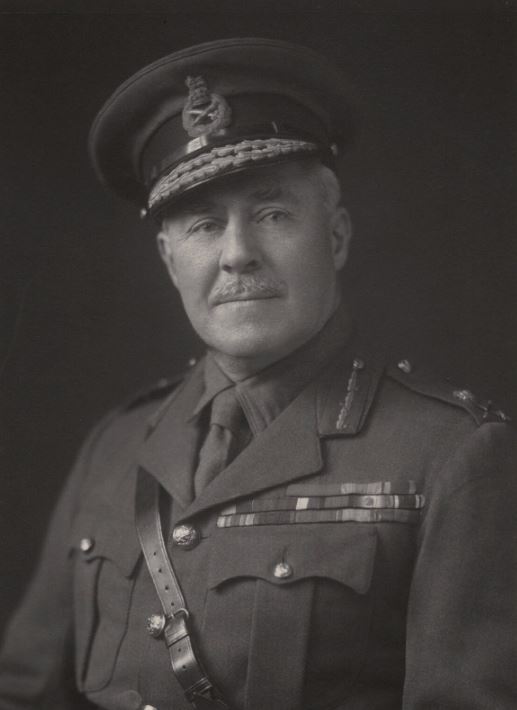
Arthur Reginald Hoskins
(Arthur) Reginald Hoskins was the son of Thomas Hoskins of Belgrave Road, London SW. He was commissioned in the North Staffordshire Regiment on 13 May 1891. Hoskins soon escaped the dull round of regimental soldiering, when - in 1896 - he was posted to the Egyptian Army. During this period attachment to the Egyptian Army was virtually a guarantee of active service. Hoskins fought in the Dongola Expedition (1896) and the Nile Expeditions of 1897, 1898 and 1899. He was mentioned in despatched in all these campaigns and received the brevet of major. He also took part in the South Africa War (1899–1902) as an ADC and intelligence officer. He was again mentioned in despatches and awarded the DSO.
He made his first acquaintance with East Africa in 1902, when he took part in the Somaliland expedition as a staff officer on the Lines of Communication, winning another mention in despatches. His staff training was formalised in 1903 by entry to the Staff College. After passing Staff College in 1905, Hoskins’ career firmly trod the staff path. He was GSO2/DAAG Egypt (1906–10) and GSO2 at the Staff College (1910–13). In August 1913 he returned to East Africa as Inspector of the King’s African Rifles. He was still in post when the European war broke out.
Hoskins was recalled from East Africa in September 1914 and appointed AA&QMG of the newly formed 8th Division on the Western Front. He held this post for only two months before taking up the demanding job of chief of staff to Major-General ‘Tommy’ Capper at 7th Division on 12 November 1914. On 25 March 1915 Hoskins was promoted brigadier-general and given command of 8th Brigade, in Major-General Aylmer Haldane’s 3rd Division. Hoskins had the knack of finding formidable superiors. But he also had the knack of missing the action.
By the time he joined 7th Division its role in the bitter fighting round Ypres was over. 3rd Division was so badly knocked about in the fighting of 1914, especially at Le Cateau, that it was sparingly used in 1915. His spell as BGGS V Corps (6 October 1915–13 February 1916) was a little more fortunate. His transfer to the East African theatre as GOC 1st East African Division, with the rank of major-general, came one day before V Corps’ notorious loss of The Bluff. He was 44. He never returned to the Western Front.
Hoskins spent the rest of the war in East Africa (where he was Commander-in-Chief in 1917) and in Mesopotamia and Palestine (where he was GOC 3rd (Lahore) Division). He was knighted in 1919.
After retiring from the army in 1923 he was Principal of the Philip Stott College, Overstone (1928) and then Principal of the Bonar Law College (1928–38), its successor as a training institution for Conservative Party agents.