
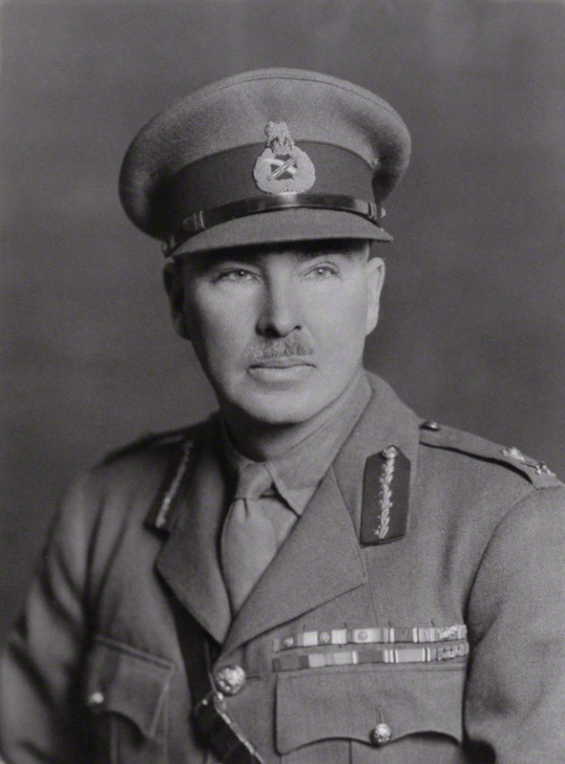
Augustus Francis Andrew Nicol Thorne
(Augustus Francis) Andrew (Nicol) Thorne (‘Bulgy’) came from a wealthy family. This enabled him to make an advantageous marriage to the daughter of Lord Penrhyn. He was only 24, much younger than the vast majority of his contemporaries were able to marry. His privileged background, however, should not be allowed to mask a clever and hard-working professional soldier.
He began the war as Staff Captain 1st (Infantry) Brigade. Thorne was the man who guided Major E B Hankey to his jumping off point before the historic counter-attack of the Worcesters at Gheluvelt in October 1914. In February 1915 Thorne became DAAQMG 1st Division, transferring to the same post in the newly formed Guards Division six months later. In September 1916 he was promoted acting lieutenant-colonel and given command of his old battalion, 3rd Grenadier Guards. He led this on the Somme and in the heavy fighting of 1917 and 1918, winning two bars to his DSO.
Promotion to brigadier-general, as GOC 184th (2nd/1st South Midland) Brigade, 61st (2nd South Midland) Division TF, on 14 October 1918, at the age of 33, was perhaps overdue. When the war ended, less than a month later, his substantive rank was still only that of major.
Andrew Thorne’s career flourished between the wars. By 1939 he was GOC 48th (South Midland) Division. This unit played an important part in the defence of the Dunkirk perimeter the following spring. Thorne’s performance resulted in his promotion to GOC XII Corps, responsible for the defence of Kent. He would have played a key role in repelling any German invasion. From 1941–5 he was GOC Scottish Command. Thorne’s appointment to this post proved useful in the pre-D-Day deception plan, Operation Fortitude. From 1932-35 Thorne had been British Military Attaché in Berlin.
Adolf Hitler, who had been on the other side of the line at Gheluvelt in 1914, took a shine to Thorne, and came to regard him as one of Britain’s best generals. This inclined Hitler to give credence to Allied misinformation about a 1944 invasion of Norway from Scotland. An article on Gheluvelt, written by Thorne, was found in the Führer Bunker after Hitler’s death.[1] Thorne retired in 1946 after a year as Commander-in-Chief Allied Land Forces Norway.
References:
[1] I owe this information to Michael Orr.