
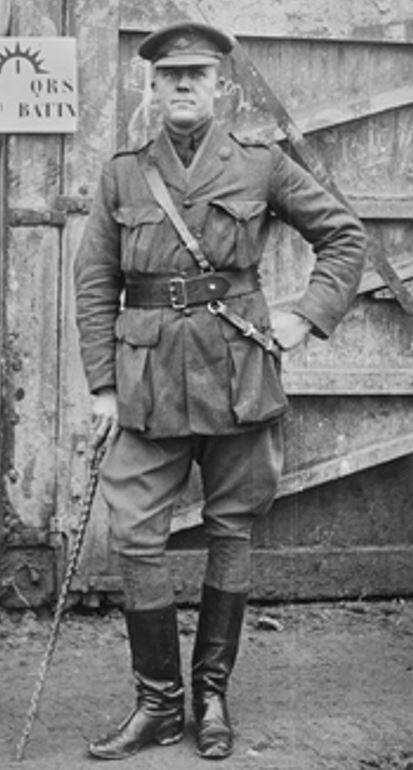
Carl Herman Jess
Carl Herman Jess was one of nine children of George Jess, master painter, a German emigrant to Australia. He began his working life as a school teacher, seemingly having first taught himself. His military interests were apparent from the start. He joined the 5th Battalion Victorian Infantry at the age of 18, transferring to the Australian Permanent Military Force as a sergeant in June 1906. He was commissioned in July 1909. Jess was a dedicated military professional but also a self-taught painter and sculptor (his work can be seen in the collections of both the Shrine in Melbourne and the Australian War Memorial in Canberra, in particular scenes at Gallipoli which he painted from memory).
He wasted no opportunity to further his military education, including enrolling on a military science course at the University of Sydney. His wartime career was closely associated with that of his fellow ‘German’, John Monash.
Carl Jess had been appointed Brigade Major to the 5th Infantry Brigade in 1911, and later that year in Victoria, he became the staff captain responsible for administering the new national scheme of compulsory military training. It was here that Monash noticed Jess's gifts as an organiser and led him to appoint Jess as his staff captain with the 4th Infantry Brigade in 1914.
Jess landed at Gallipoli on 26 April 1915 and was promoted to Brigade Major of the 2nd Brigade. He was wounded at Gallipoli, but remained on duty, and awarded the White Eagle of Serbia for this.
He was given his first command, as CO 7th Battalion AIF, early in 1916, being awarded a DSO for his work at the front line at Pozieres when he was gassed but remained on duty. His appointment as the first Australian to act as an instructor at the Senior Officers’ School, Aldershot, in the spring of 1917 marked the beginning of a wider recognition of his abilities.
On his return to the Western Front he served on the staff of I Anzac Corps and, from January 1918, as GSO1 of Monash’s 3rd Division. Jess’s reputation as coming man was confirmed by his appointment as GOC 10th Brigade, 3rd Australian Division, in October 1918. He was 34 and the youngest Brigadier General in the AIF at that time. By now, the Australian Corps was out of the Line and victory was only days away. There was a sense in which the war ended too soon for Jess.
He was awarded a Companion of St Michael and St George for his leadership during the battle of Amiens. In 1919 Jess commanded the Training Depot at Codford, UK and was director general of repatriation and demobilization for which he was appointed a CBE.
He was clearly an able soldier, as his brilliant passage through the British Staff College after the war shows, but the inter-war Australian army offered few opportunities to a man of his talents.
It took the outbreak of the Second World War to provide him with a satisfactory professional challenge. As Chairman of the Manpower Committee (1938–44), he was a key figure in the mobilisation of Australian society for war. Lieutenant-General Sir Carl Jess retired from the Australian army in April 1946.