
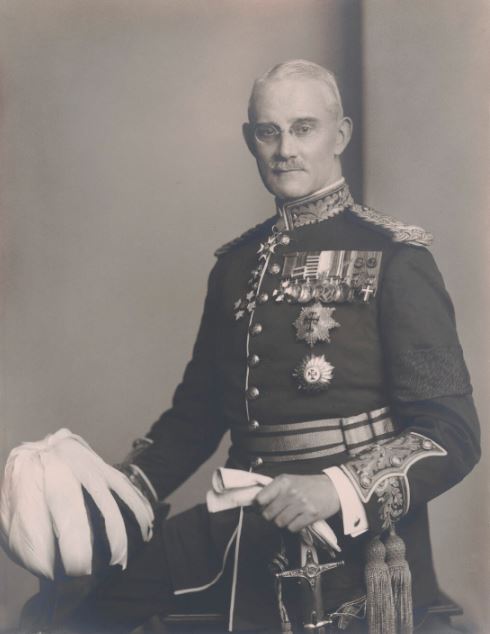
Charles Arthur Ker
Charles Arthur Ker’s career began straightforwardly enough, but his war had an unusual and unpredictable ending. He was commissioned in the Royal Artillery on 15 June 1895. He soon saw active service in Northern Nigeria (1898-9) (where he won the DSO) and South Africa (1899-1901). He was Adjutant RGA Plymouth (1902-5) and Instructor RMC (1906-9). He passed Staff College in 1911. Heavy gunners with psc before their names were not thick on the ground in the pre-war British Army. In the forthcoming war, which would see a huge increase in demand for both heavy gunners and trained staff officers, Ker’s services were likely to be at a premium. Initially, however, the circle was squared with his appointment as DAA&QMG South West Coast Defences (1912-14), a staff position involving heavy guns.
When the war broke out Ker was GSO2 at the Royal Military College of Canada, at Kingston, Ontario. He later served as Brigade Major 21st Divisional Artillery (1914-15), GSO2 (1915), then GSO1 (5 February-24 May 1916) 2nd (Canadian) Division, GSO1 63rd (Royal Naval) Division (25 May-28 July 1916) and GSO1 Lines of Communication Area.
Ker’s background and service record provide no clue to his final appointment, on 7 January 1918, as Head of the British Mission to the Portuguese Expeditionary Force. Liaison work of this kind was usually the province of aristocratic (even Royal) cavalry-types, well versed in the black arts of diplomacy, not of RGA ‘boffins’.
Brigadier-General Ker continued in the army after the war. He was GSO1 at the War Office (1920-23), Colonel Commandant RA (Heavy) Southern Command (1923-26), Colonel Commandant RA Southern Command (1926-27), GOC TA Air Defence Formations (1928-31) and GOC 3rd (Indian) Division and Meerut Divisional Area (1931-34). Major-General Ker retired in 1934.