
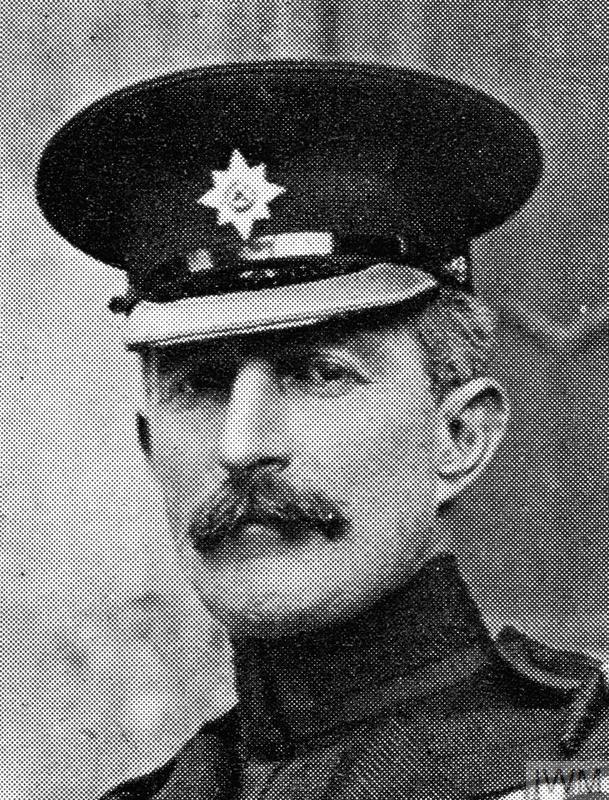
Charles Fitzclarence
Charles Fitzclarence was the eldest son of the Hon. George FitzClarence RN, of Bishopscourt, Co. Kildare. His paternal grandfather was the 1st Earl of Munster, the eldest son of King William IV (late Duke of Clarence) by his mistress, Mrs Dorothea (or Dorothy) Jordan, an Irish actress. Fitzclarence completed an impressive aristocratic pedigree by marrying Violet Churchill, youngest daughter of Lord Alfred Spencer Churchill and granddaughter of the 5th Duke of Marlborough in 1900. He was no aristocratic dilettante, however. From the start of his military career he showed every sign of ambition and seriousness of purpose.
He was commissioned in the Royal Fusiliers from the Militia on 10 November 1886 and was still serving with the regiment when he won the Victoria Cross in the South African War for the relief of an armoured train near Mafeking. Shortly afterwards, however, he transferred to the Irish Guards, on their formation. FitzClarence passed Staff College in 1902. This is indicative of his ambition. He was not a natural staff officer or a natural scholar.
His 1902 Confidential Report describes him as ‘not suited to heavy administrative office work’. ‘He is broad in his views rather than deep,’ the Report continued, ‘and has perceptive faculties rather than reflective. He is not a man of high mental power or educational qualifications, but he has the military instinct and is a leader of men.’ Tall, 6’ 2”, good looking and athletic, he also conformed to contemporary ideas of what a soldier should look like. After passing Staff College, FitzClarence did a tour as Brigade Major, 5th Brigade, at Aldershot (April 1903-March 1906) before commanding 1st Battalion Irish Guards (July 1909-July 1913).
On the eve of the Great War he was a 49-year-old colonel, and had been in command of the 5th London Brigade TF (later 141st Brigade, 47th (2nd London) Division) for a year. His immediate career and life prospects were changed by the removal of Brigadier-General Ivor Maxse as GOC 1st (Guards) Brigade. FitzClarence succeeded him on 26 September 1914. The desperate fighting for Ypres in October gave FitzClarence the opportunity to confirm the verdict of his pre-war reports that he was ‘a thorough soldier, full of resource and decision, quick in grasping the points of any tactical problem in the Field’.
It fell to him, at a vital moment, to order the counter-attack of the 2nd Battalion Worcestershire Regiment at Gheluvelt, sending his Staff Captain, Andrew Thorne, to give the order in person to the battalion’s acting CO, Major E B Hankey. The Worcesters’ attack restored the British line and saved the day. FitzClarence was killed a fortnight later, on 12 November 1914, at Polygon Wood.
He was the third British general to be killed in action or to die of wounds on the Western Front. He has no known grave and is commemorated on the Menin Gate Memorial, Ypres