
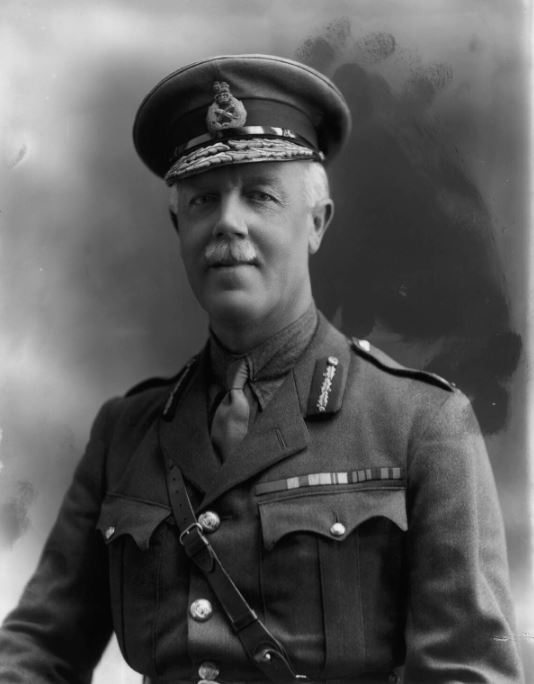
Charles Herbert Philip Carter
Charles Herbert Philip Carter was the son of Captain Willoughby H Carter, of Annagkeen, Co. Galway. At the age of 14 he became a naval cadet, but the navy was evidently not to his liking and he enlisted as a private soldier in the Black Watch in August 1885. He served in the ranks for 3 years 86 days before receiving a commission on 14 November 1888. He transferred to the Royal Scots in 1897 and, finally, to the 2nd Scottish Rifles (Cameronians) as their CO on 5 April 1911.
Much of Carter’s pre-war career was spent in West Africa. He served with the Niger Coast Protectorate (November 1896-December 1899, latterly as CO; he was Commandant of the Southern Nigeria Constabulary (January-October 1900), taking part in the Ashanti Field Force and the Relief of Kumasi, where he was severely wounded; and he was CO Gold Coast Regiment (February 1906-April 1909).
After his two-year tour as CO 2nd Scottish Rifles (April 1911-October 1913), he returned to West Africa as Commandant of the Nigeria Regiment, a post he still held when war broke out in Europe. This unit was charged with the initial attempt to conquer the Cameroons, but was repulsed in August 1914. Despite the expansion of the army Carter found himself on half-pay from November 1914 until June 1915, when he became OC No 10 District (Hounslow). It was from this anodyne posting that he was promoted GOC 184th Brigade, 61st (2nd South Midland) Division TF on 7 May 1916. He was 52.
Carter commanded this formation for less than three months. He was dismissed and sent home after the failure of the attack on Fromelles in July 1916. After a brief period on half-pay, Carter was appointed GOC Welsh Reserve Infantry Brigade (September 1916-January 1917).
He ended his military career as Commander Milford Haven Garrison (January 1917-December 1919) and retired from the army on 13 December 1919.