
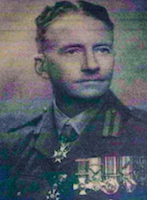
Clifton Inglis Stockwell
Clifton Inglis Stockwell was the eldest son of Colonel C de N O Stockwell, Lincolnshire Regiment. He was gazetted Second Lieutenant in the Royal Welsh Fusiliers on 11 February 1899. His pre-war career was uneventful and included no periods of active service.
When the European War broke out he was a Captain attached to 3rd (Special Reserve) Battalion Royal Welsh Fusiliers. Heavy officer casualties in the early fighting, however, soon required his presence on the Western Front. From September 1914 until March 1915 Stockwell was OC ‘A’ Company, 2nd Royal Welsh Fusiliers. It was during this period that he earned the nickname ‘Buffalo Bill’, bestowed on him by Private Frank Richards and other old sweats because of his aggressive personality and the way in which he threatened slackers with his revolver.
Richards described Stockwell as a ‘first-class bully’, adding that ‘bullies as a rule are bad soldiers, but he was an exception to the rule’. When Stockwell transferred to 1st Battalion Royal Welsh Fusiliers at the end of March 1915, Captain J C Dunn complained that 2nd Battalion had lost ‘one of its strongest personalities’.
In August 1915 Stockwell became Brigade Major, 59th Brigade, commanded by the formidable Cameron Shute. He survived Shute until February 1916 when he became CO 1st Battalion Royal Welsh Fusiliers, a post he held until September 1916 when he was promoted brigadier-general and given command of 164th Brigade, 55th (West Lancashire) Division, where his divisional commander was the equally formidable Hugh Jeudwine. Stockwell was 37. He was only the second man to command 164th Brigade, and the last man to command it during the war.
After the war Stockwell reverted to his regimental rank of major. He attended and passed Staff College in 1919. He served as a staff officer and brigade commander in Ireland from 1920 to 1922. The final part of his career was spent in India as A/Commandant, then Commandant Senior Officers’ School, Belgaum, and lastly as GOC 11th Indian Infantry Brigade.
He retired from the army in March 1932. Stockwell chaired the committee that eventually resulted in the publication of the magnificent account of 2nd Battalion Royal Welsh Fusiliers’ war, J C Dunn’s The War the Infantry Knew, to which he contributed. Stockwell also appears as ‘Kinjack’ in Sassoon’s Memoirs of a Fox Hunting Man.