
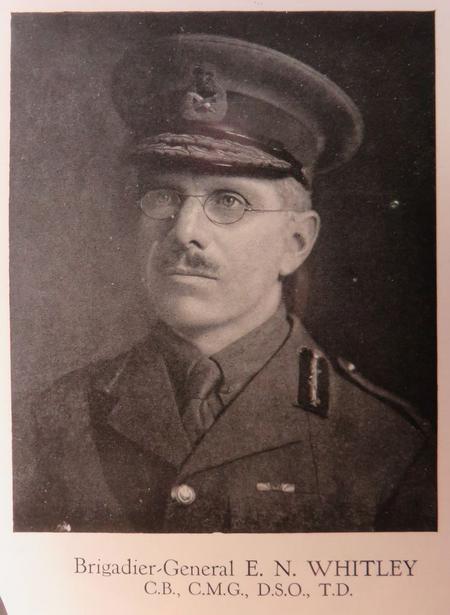
Edward Nathan Whitley
Edward Nathan Whitley belonged to a well-known Halifax family. His father, Nathan Whitley, was sometime Liberal Mayor of Halifax. His elder brother, the Rt Hon J H Whitley, was MP for Halifax and Speaker of the House of Commons. His wife, Julia Kathleen Norris (whom he married in 1902), was the daughter of the Rev William A Norris, Vicar of Floore, in Northamptonshire, descendant of an old Halifax family. After graduating from Trinity College, Cambridge, in 1895, Edward Whitley took articles with a firm of solicitors in Leeds. He was admitted solicitor in 1899 and became a partner in the Halifax firm, Humphrey, Hirst & Whitley. Shortly after graduating, he was also commissioned in the 2nd (West Riding) Yorkshire Volunteer Artillery. Unlike some Volunteers he continued to serve with the Territorial Force after its formation.
When the war broke out he held the rank of major, but was soon promoted to lieutenant-colonel. He went to war as CO 245th (2nd West Riding) Brigade RFA, part of 49th (West Riding) Division, in April 1915.
Whitley reached general officer rank on 31 March 1917 as CRA 47th (2nd London) Division, a post he held for the remainder of the war. Neither the divisional commander, Major-General Sir George Gorringe, nor the division’s last chief of staff (GSO1), Lieutenant-Colonel Bernard Montgomery, were known for their tolerance of fools. Whitley’s survival in command amid such bracing company suggests competence. He was seven times mentioned in despatches and awarded the DSO in 1918.
At the war’s end he was one of only nine Territorials holding general officer rank, one of whom was his fellow Yorkshireman Richard Sugden. This alone made Whitley unusual. What made him even more unusual was that he wore glasses. There were dark rumours that Field-Marshal Haig frowned on short-sighted officers.
Whitley continued in the Territorials after the war, commanding the artillery of 49th Division from 1920 until 1922. He retired in 1929. The rest of his post-war career was dominated by service with the Halifax Building Society, as Director (1919-53), Vice-President (1921-38) and President (1938-45). He was knighted in 1921.