
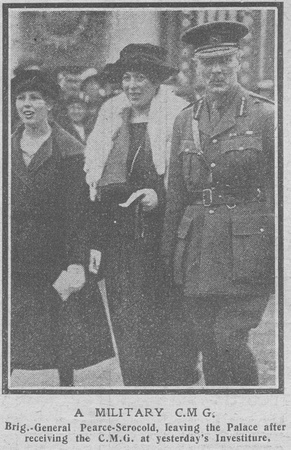
Eric Pearce-Serocold
Eric Pearce-Serocold was the second son of Charles Pearce-Serocold of Taplow, Buckinghamshire. He was commissioned in the King’s Royal Rifle Corps on 9 October 1889. Active service in the South African War (1899-1902) was followed by periods of staff employment (he passed Staff College in 1902): SC Musketry North West District (1903-5); OIC Musketry Duties Welsh and Midland Command (1905) and BM Irish Command (1908). In August 1912 he took command of 2nd Battalion King’s Royal Rifle Corps. He was 42, on the young side for a pre-war battalion commander.
Pearce-Serocold took his battalion to war in August 1914 as part of 2nd Brigade, 1st Division, in the original BEF. He was severely wounded by shell fire on 21 October at the Herenthage Chateau. It seems probable that his health never fully recovered.
On being passed fit for general service Pearce-Serocold was promoted brigadier-general and given command of 68th Brigade, 23rd Division, on 3 June 1915. He remained in command until February 1916, when he succumbed to ill health. The Commander-in-Chief, Sir Douglas Haig, wrote to the War Office on 1 February that ‘Brigadier-General Pearce-Serocold has commanded his Brigade very efficiently, and I consider that he is a most able officer.’ He was recommended for a return to active service as soon as possible. This was not until seventeen months later, as GOC 123rd Brigade, 41st Division. He spent the intervening period as Deputy Commander of the Machine Gun Corps Training Centre at Grantham.
On 18 June 1918 Brigadier-General Pearce-Serocold asked to be relieved of his command, following the heavy fighting earlier in the spring.
‘I beg to report that, owing to the continuous strain on my physical energy, I feel that I am at present unable to do justice to those under my command, and that I ought not to continue in command of my Brigade. It is with great regret and disappointment that I am therefore compelled to request that I may be considered for six months exchange at home, or for an appointment where the work is less strenuous either in France or at home.’
He held no more commands and retired from the army in April 1920. He died of pneumonia, occasioned by an abscess on his lung, in 1926. He was only 56. He had been wounded five times during the war.