
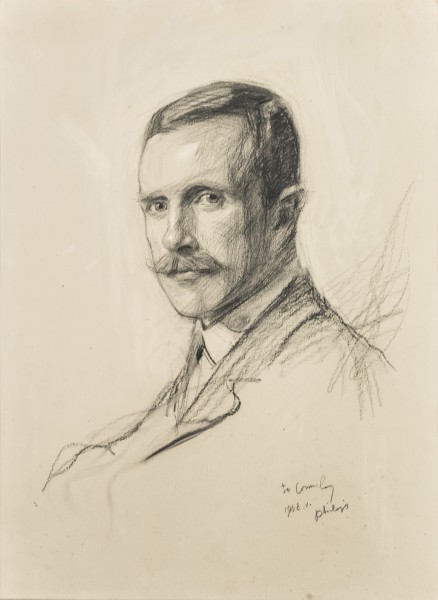
Ernest Craig-Brown
Ernest Craig-Brown was the son of Thomas Craig-Brown, of Selkirk. He was commissioned in one of the backwaters of the British Army, the West India Regiment, on 20 February 1895. He saw active service with this unit in Sierra Leone (1898), during which he was severely wounded, and later the same year transferred to the Cameron Highlanders, with whose 1st battalion he served in the South African War (1900–2). Craig-Brown passed Staff College in 1905. He was Specially Employed at the HQ of the Army (July–September 1908), GSO3 HQ of the Army/War Office (September 1908–July 1912), Specially Employed at the War Office (July–December 1912) and DAAG Alderney and Guernsey (February–Aug 1914).
On 20 September 1914 he was appointed GSO2 of the 17th (Northern) Division, then forming, but within a few days found himself on the Western Front as OC ‘A’ Company, 1st Cameron Highlanders. The battalion suffered heavily in the autumn fighting. Craig-Brown confided to his diary on 16 November that the battalion had ‘no officers worth mentioning [and] no NCOs either’. One of the consequences of this was that he soon found himself CO. He commanded the battalion from January until May 1915. Craig-Brown was candid about the battalion’s poor state of morale and fighting efficiency, which a wet winter in inadequate and disease-ridden trenches did nothing to improve.
His first and last battle as CO was Aubers Ridge (7–10 May), which resulted in more heavy casualties. Major L O Graeme, a 2nd battalion officer who was Craig-Brown’s regimental senior, replaced him as CO on 10 May. Craig-Brown did not take his demotion well and immediately started applying for Staff jobs, complaining that he was now the ‘5th wheel on the coach’. He effected his escape on 25 June, when he was appointed DAQMG 47th (2nd London) Division TF.
He found no more satisfaction in this job, describing it as ‘steady inkspilling broken by occasional jaunts on horse-back or in a motor to see things at a distance’. He remained spilling ink until March 1916 when he again took command of 1st Camerons after the death of Colonel Graeme. Craig-Brown led his battalion throughout the Somme fighting. His letters contain graphic descriptions of the mud and desolation around Mametz and Le Sars. In January 1917 he was promoted to brigade command as GOC 56th Brigade, 19th (Western) Division. He was 46.
Craig-Brown led 56th Brigade at Messines (7 June), after which he received the personal congratulations of General Plumer, GOC Second Army, and at Third Ypres. He was relieved of command on 5 September 1918 after an adverse report on him by his divisional commander, Tom Bridges.
After a brief hiatus, Craig-Brown spent the rest of the war in Salonika, first as Commandant of the Infantry School and finally as Base Commandant, finding time to observe and comment on the flora and fauna and to undertake amateur archaeology. From a personal point of view his had been a frustrating and unsuccessful war.
He retired on 29 July 1925 after a third tour as CO 1st Cameron Highlanders (January 1921–January 1925). In 1926 Brigadier-General Craig-Brown became Controller and Director of the Midlothian Branch of British Red Cross Society.