
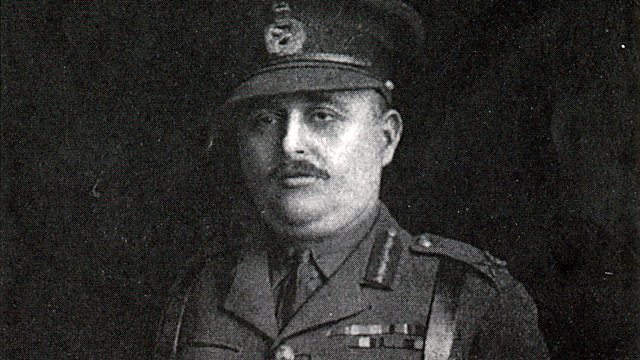
Frank Percy Crozier
Frank Percy Crozier was descended on both sides from families with long records of naval, military and imperial service. His own career, however, did not run along conventional lines, but was rather that of a colonial adventurer and mercenary. His commission in the Manchester Regiment was from the ranks of the Local Military Forces of Natal during the South African War. He later served in Northern Nigeria (1902–5) and Zululand (1905–6). He was forced to resign from the Army in 1908 after failing to honour cheques, a lifelong weakness, and put his military skills up for hire.
The outbreak of war found him in Ireland, training Sir Edward Carson’s Ulster Volunteer Force. He had slept for four months with a pistol under his pillow, surrounded by armed guards, land mines, alarms and contraband ammunition. In August 1914 he was recalled to the colours from the Canadian Reserve of Officers as ‘Captain, Royal Irish Fusiliers’, a regiment in which he never served. He used his influence with Ulster’s Unionist elite to escape from the singularly inappropriate mission of raising a company of Fusiliers in Dublin to become 2 i/c of the 9th Battalion Royal Irish Rifles (‘Shankill Road boys’), part of the 107th Brigade, 36th (Ulster) Division.
Crozier succeeded to command of this somewhat ill disciplined battalion in November 1915 and led it during its costly baptism of fire at Thiepval on 1 July 1916, personally taking part in the attack, contrary to orders. Crozier became notorious in the division for his advocacy of trench raiding. One officer, 2nd Lieutenant J H Stewart Moore, thought that Crozier’s trench raids served no purpose other than to ‘show off’ and dismissed him as a ‘callous and overbearing martinet’.[1] Crozier’s reputation as an aggressive officer did his prospects no harm, however, and he was promoted GOC 119th [Welsh Bantam] Brigade, 40th Division, on 20 November 1916.
‘I am afraid you will be disappointed with your new command,’ Crozier was told.[2] But he was undaunted by this opinion and immediately set about infusing the brigade with his own martial spirit. The key to this, for him, lay in finding the right battalion commanders. One CO was immediately replaced after his battalion lost more than a hundred men in four days to trench feet. Later, and to general astonishment, Crozier sent back a favoured Staff officer, attached to 119th Brigade to gain front line experience, and refused to recommend him as ‘qualified to command a brigade’, because he could not hold the line with confidence or ‘slaughter the enemy’ effectively.
The battalion commanders Crozier eventually acquired were ‘war dogs’ like himself. One had been a sergeant-major in 1914, another a mere private, the third a 2nd lieutenant in the Ceylon Planters Corps. Crozier’s view of war was utterly uncompromising. Like Sherman, he believed that war ‘was Hell’ and certainly he did his best to make it so. By his own admission, some thought him ‘mad’ and a ‘butcher’. He was quite happy to sacrifice a thousand men for some useful purpose, but he hated losing one man for no reason at all. Nothing was more useless in war than ‘a dead body’. Safety in trench warfare lay in seizing the initiative and he expected his battalions to dominate No Man’s Land with aggressive patrolling and raiding. He himself was not averse to reconnoitring ‘beyond the wire’ and the title of one of his most famous books, A Brass Hat in No Man’s Land, is apt.
119th Brigade’s heaviest fighting came in the winter of 1917 and the spring of 1918. After suffering heavy casualties at Bourlon Wood in November 1917, it put up a dogged resistance to the German March offensive, but – together with the rest of 40th Division – was overrun on the Lys in April. The brigade was reduced to cadre strength, refitted and re-organised with new battalions. It played only a minor role in the Great Advance.
After the war Crozier acted as military adviser to the government of Lithuania before taking command, in August 1920, of an Auxiliary Division of the Royal Irish Constabulary, the ‘Black and Tans’. He resigned this command, almost in despair, in February 1921, appalled by the demoralising effects of civil war. Increasingly, during the 1930s, he lent his energies and his pen to the cause of peace, denouncing war as a means of settling international disputes in a series of books that sought to portray war with uncompromising brutality.
References:
[1] PRONI: T.3217, J L Stewart Moore, ‘Random Recollections’, p. 26.
[2] F P Crozier, A Brass Hat in No Man’s Land (London: Jonathan Cape, 1930), p. 131.