
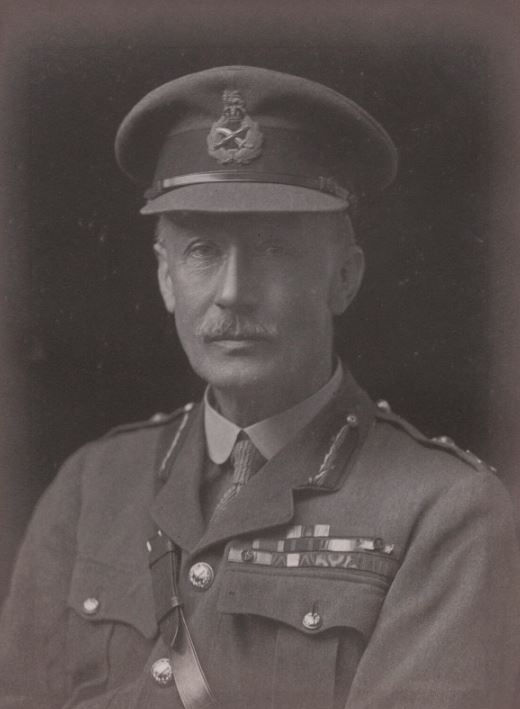
Frederic Manley Glubb
Frederic Manley Glubb was descended from an old Cornish family, but he was born in India where his father, Orlando Manley Glubb, was an officer in the 37th Bengal Native Infantry. As was common, Glubb was sent as a small boy to England, to be brought up by his grandparents at Shermanbury in Sussex, where his grandfather was the Vicar. He was commissioned in the Royal Engineers on 25 January 1877. He saw active service in South Africa (1899-1900), where he won the DSO. His pre-war career prospered and he rose steadily. From 1909 until 1912 he was Chief Engineer, Northern Command, based in York. This appointment brought him into contact with Sir Herbert Plumer, who was GOC Northern Command from November 1911 until January 1915.
Glubb’s wartime career was fated to be closely associated with that of Plumer. In 1912 Glubb transferred to Southern Command, where the GOC was Sir Horace Smith-Dorrien, but in September 1914 he went to war as Chief Engineer of the newly formed III Corps, a post he relinquished on 12 May 1915, when he became Chief Engineer of Second Army, five days after Plumer assumed its command. Glubb was the chief sapper of Second Army for the rest of the war.
The second Army’s location in the notoriously insalubrious Ypres Salient provided numerous engineering challenges and opportunities. His reputation grew with that of Second Army. After the battle of Messines (June 1917), it stood second to none among the BEF’s military engineers. During the winter of 1917-18 Glubb went with Plumer and other Second Army staff to Italy, where he became Engineer-in-Chief. This was a sort of consolation for missing out on promotion to Engineer-in-Chief of the BEF at the beginning of November 1917, a post he was denied on age grounds (he was 59).
Second Army returned to the BEF order of battle on 13 March 1918, a week before the German spring offensive. Glubb contributed his engineering skills to Second Army’s successful defence of the key Ypres position and in the second half of 1918 tackled the enormous engineering problems of the advance in Flanders.
Major-General Sir Frederic Glubb was a man of Spartan simplicities, well known for his dislike of all Latins. He retired from the army in 1919. Glubb had married Frances Letitia, daughter of Bernard Bagot JP of Auchrane, Co. Roscommon, in 1889.
Their son also served in the Great War as a sapper, being wounded three times and winning the MC. He later became Lieutenant-General Sir John Glubb (‘Glubb Pasha’) (1897-1986), commander and chief of staff of the Arab Legion, and author of Into Battle: A Soldier’s Diary of the Great War (1978).