
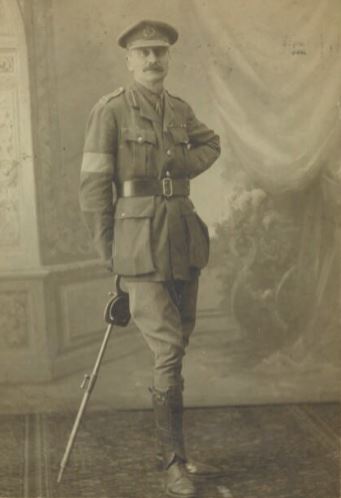
Frederick Montgomerie Carleton
Frederick Montgomerie Carleton was the son of General Henry Carleton CB, Royal Artillery. He was commissioned in the King’s Own (Royal Lancaster) Regiment on 3 October 1888. He soon acquired an impressive CV: adjutant of his battalion (1891-5); secondment to the Egyptian Army (1896-7); active service at Dongola (1896), in Sierra Leone (1898-9) and in South Africa (1899-1902); a DSO; ADC; psc (1902). These were the signs of a ‘coming man’. But, on 22 February 1908, he resigned his commission at the age of 41 and retired to the Reserve of Officers with the rank of major.
He was recalled on the outbreak of war and, from December 1915 until June 1916, was CO 1/4th King’s Own. On 18 June he was promoted GOC 98th Brigade, 33rd Division, and took part in the Somme fighting.
His period in command was, however, short lived. On 28 August the GOC 33rd Division, Major-General Herman Landon, requested Carleton’s removal in a letter to the GOC XV Corps, Lieutenant-General Henry Horne. Landon argued that
‘Present conditions are difficult and require characteristics in a Brigade commander which are not possessed by Gen. Carleton, i.e. quick, practical methods of command, and a cheerful outlook which will communicate itself to the troops’.
Landon’s request was occasioned by the slow progress made by 98th Brigade in closing a gap in the British forward line in front of High Wood. The digging of new trenches was rendered difficult and dangerous by almost constant enemy shelling. Carleton had not been told that a new attack was intended from the newly-consolidate position. When Landon gave him this information, Carleton immediately gave the order for the work ‘to be proceeded with at all costs’, but this was too late for Landon.
Carleton wrote regularly to his wife. His letters, now in the Imperial War Museum, express the anguish he felt at his being sent home and the shock of his removal undoubtedly had a detrimental effect on his health. Once he recovered, Carleton set out to clear his name. His efforts seem to have had an effect.
In November 1916 he was given command of 180th Brigade, at Salonika. He commanded 180th Brigade until August 1917, when his health broke down again and he was invalided home permanently.
He died of a heart attack in May 1922. Carleton’s supercession on the Somme came at an unhappy period in British prosecution of the war, during which command and control seemed to consist of superiors berating their immediate subordinates for their failure to do the impossible. Landon, himself, suffered the same fate in July 1917.