
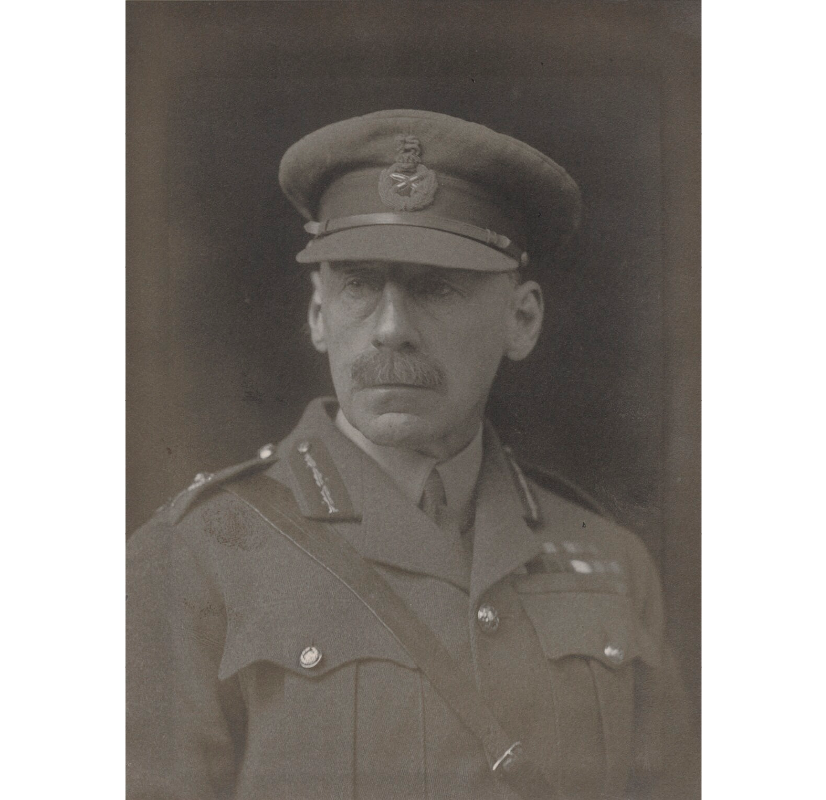
George Frederick Gorringe
George Frederick Gorringe (‘Blood Orange’) was commissioned in the Royal Engineers in 1888. His first experience of active service was in the Dongola expedition (1896), while attached to the Egyptian Army. His apparent immunity to sickness endeared him to Lord Kitchener and his career flourished. During the South African War he was successively ADC to the Chief of Staff and DAAG. Later, he served again with the Egyptian Army (1901–4), as Director of Movements at the War Office (1906–9) and as GOC 18th Infantry Brigade (1909–11).
In 1911, at the age of 43, he became one of the youngest major-generals in the British Army. When the war broke out he was commanding a brigade in India. He remained with the Indian Army for the first two years of the war. In March 1916 he became GOC Tigris Corps, charged with the thankless task of relieving Major-General C V F Townshend’s army besieged by the Turks at Kut-al-Amara. His tactics did not endear him to his subordinates. ‘His cursed optimism, contempt for the Turks, contempt for the principles of war and for the lessons of this war, have again landed us in failure and run up a butcher’s bill. This is culpable homicide,’ complained Brigadier-General Fraser after the attack at Sannaiyat on 5 April 1916.[1] Kut fell to the Turks twenty-four days later. This failure was, apparently, not held against Gorringe.
In October 1916 he succeeded Sir Charles Barter as GOC 47th (2nd London) Division, TF. He commanded it on the Western Front for the rest of the war. Gorringe joined 47th Division in the aftermath of its greatest achievement, the capture of High Wood. Under his leadership the division cannot be counted among the BEF’s elite units. It spent the remainder of the Somme campaign in quiet sectors, distinguished itself at Messines (June 1917) and was held in reserve at Cambrai (November). During 1918 it was heavily engaged during the March Retreat. For a brief period, in August 1918, Fourth Army as an assault unit used the division. It ended the war pursuing the German withdrawal in Artois.
Gorringe’s career did not fulfil its early promise. He was the only divisional commander on 11 November who had been a major-general when the war began. All the corps commanders under whom he served were junior to him in the Army. Some of this is explained by his unpopularity.
A large, arrogant, tactless, officious man, he was often loathed and distrusted. Gorringe was a bachelor. He had only two interests: his profession; and horses.[2] He once ordered the flogging of two Arabs who had dropped some matting and frightened his horse.[3] He was, however, a relentless commander, cool under pressure and calm in a crisis.
His chief staff officer in 1918 was Bernard Montgomery. Montgomery always spoke well of Gorringe and attributed the success of his own ‘Chief of Staff system’ in the Second World War to the lessons taught by Gorringe in 47th Division.[4] Gorringe retired in 1924 as a lieutenant-general after a final tour of duty in Egypt.
References:
[1] PRO CAB45/96/97/98. See also, E Latter, ‘The Indian Army in Mesopotamia 1914–1918: Part II’, Journal of the Society for Army Historical Research, LXXII (291) (Autumn 1994), p. 177.
[2] See Brigadier-General A B Beauman, Then a Soldier (London: P R Macmillan, 1960), p. 24, for the closest thing to a complimentary view of Gorringe. Beauman was Gorringe’s ADC at Lichfield before the war.
[3] Russell Braddon, The Siege (London: Mayflower Books, 1971), p. 38.
[4] Nigel Hamilton, Monty, The Making of a General 1887–1942 (London: Hamish Hamilton, 1981), p. 135.