
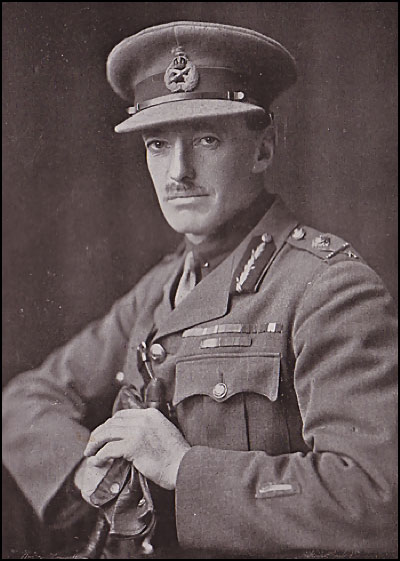
Gerald Farrell Boyd
Gerald (‘Gerry’) Farrell Boyd, ‘the ranker general’, entered the army as a private soldier in the Devonshire Regiment in 1895. He fought in the South African War as a sergeant and was awarded the DCM. He was commissioned in the field as a Second Lieutenant in the East Yorkshire Regiment in May 1900. In 1904 he was promoted Captain in the Leinster Regiment, the rank he held on the outbreak of war. His 1913 Confidential Report described him as
‘Loyal, cool, self-reliant. He possesses in a marked degree the valuable characteristic of a good staff-officer in dealing with many minor matters on his own initiative without giving offence, and at the same time keeping me informed where necessary. He is very quick, thorough and active in mind and body. A good horseman. He has considerable professional knowledge, which he is able to apply very quickly and accurately in the form of orders. I have formed a high opinion of his character and capabilities and would be glad to have him with me on service. I recommend him for accelerated promotion’.
Accelerated promotion is exactly what he got. He began the Great War as Brigade Major in Hunter-Weston’s 11th Brigade. In March 1915 he was promoted GSO2, 1st Division, then under the command of Richard Haking. He also received his majority in the Royal Irish Regiment. In July 1915 he was promoted GSO1, 6th Division (Major-General Charles Ross). He held this post for a year before being promoted BGGS V Corps. He was chief of staff of V Corps for two years before being given his own command, 170th (2/1st North Lancashire) Brigade, 57th (2nd West Lancashire) Division, TF, in July 1918. On 4 September he was promoted GOC 46th (North Midland) Division in succession to Major-General William Thwaites. He was 40.
Twenty-five days later the division broke the Hindenburg Line at Bellenglise, one of the outstanding divisional performances of the war. Boyd embodied the ‘can-do’ spirit of the army of 1918. His Confidential Report at the end of the war spoke of his being ‘a disciplinarian, a tremendous worker, at all times cheerful and optimistic ... and he can, and does, breathe his own indomitable spirit into his men’.
‘Major-General G F Boyd had a most attractive personality,’ recalled the historian of 1/4th Battalion Leicestershire Regiment. ‘He was young. He was handsome… He had a smile for everyone. He had a brain like lightning and an imagination as vivid … When the 46th Division was placed in his hands he seized it as an expert swordsman seizes a priceless blade. This was just the weapon he had been looking for. He would wield it as it had never been wielded before. He would breathe his luck upon it; with it he would leap to victory.’
Major-General Gerry Boyd died young, while Military Secretary at the War Office.