
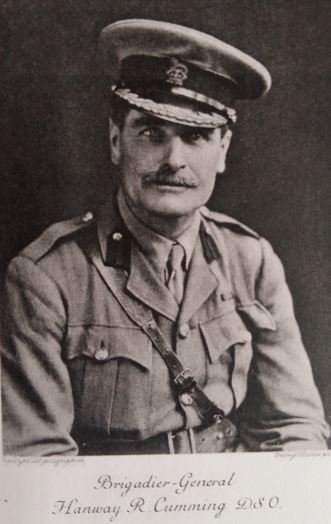
Hanway Robert Cumming
Hanway Robert Cumming was commissioned into the Durham Light Infantry from the Militia in June 1889. He served in the South African War on the staff and was mentioned in despatches. By August 1914 his career seemed firmly set on the staff path. The outbreak of the Great War found him GSO2 in India, a post he held until May 1915. In August 1915 he became GSO1 of 31st Division, transferring to 48th Division in April 1916. On 27 August he was given command of 2nd Durham Light Infantry on the Western Front.
Promotion to brigade command soon followed. His command of 91st Brigade, 7th Division (November 1916–May 1917), was turbulent. His relationship with his divisional commander, Major-General T H Shoubridge, was difficult from the start. Cumming was never a man to mince words. He had no hesitation in disagreeing with orders when he felt them to be foolish. He was even prepared to dispute matters with Hubert Gough, never a man to cross lightly. Shoubridge’s orders increasingly vexed him. He believed that his divisional commander never allowed sufficient time for attacks to be properly prepared and always asked too much of subordinate formations in the futile search for instant results.
The attacks at Bucquoy in February and Croisilles in April 1917 resulted in his writing very critical reports of his divisional commander. At Bullecourt in May Cumming’s continued disagreement with divisional orders resulted in his being sent home. From August 1917 until February 1918 he was Commandant of the Machine Gun Training School at Grantham.
Cumming was a believer in the unified tactical control of heavy machine guns and played a part in the re-organization of machine-guns into battalions under divisional control, a reform which was put into place in the spring of 1918. On 16 March 1918, only five days before the German Spring Offensive, Cumming was returned to brigade commander as GOC 110th Brigade, 21st Division, under the much more sympathetic command of David Campbell, who had a high regard for Cumming’s advice.
Hanway Cumming commanded this brigade for the rest of the war in heavy fighting both in defence and attack. ‘During the last eight months of the war, owing to the scarcity of trained officers, the work of brigadiers was of a most trying nature,’ Campbell later recalled, ‘and it was only men like General Cumming, possessed of health, strength, and indomitable will power, who could possibly have stood the strain.’[1]
Cumming was a man of uncompromising integrity, a prudent, humane commander and a soldier of great energy, determination and resource. During 1918 he showed himself to be an outstanding brigade commander who had fully absorbed the command and tactical lessons of the war.
On 5 March 1921 he was killed in a Sinn Fein ambush at Cloonbannin, near Kerry. The messy legal disputes that accompanied his wife’s claims for compensation left her eventually in financial distress and by 1938 she was a pauper inmate of the Thanet workhouse. Cumming’s incisive and outspoken account of his periods of brigade command, A Brigadier in France 1917-1918, was published posthumously in 1922.
References:
[1] Major-General Sir David Campbell, ‘Introduction’ to Hanway R Cumming, A Brigadier in France 1917-1918 (London: Jonathan Cape, 1922), p. 13.