
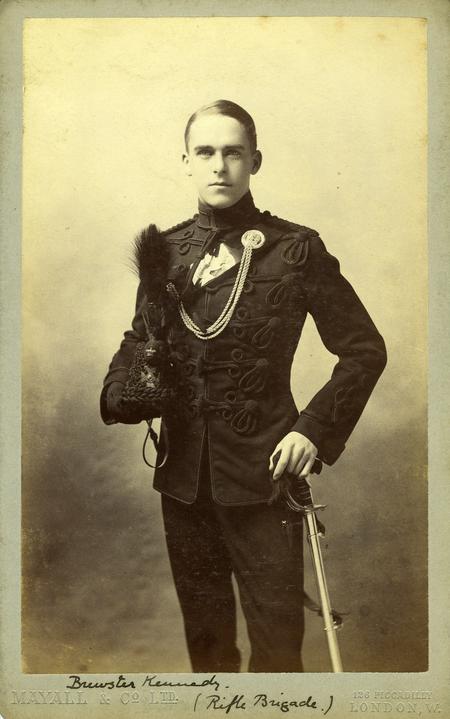
Henry Brewster Percy Lion Kennedy
Henry Brewster Percy Lion (‘Kid’) Kennedy was the son of Vice-Admiral J J Kennedy CB. He was commissioned in the King’s Royal Rifle Corps on 15 October 1898. He soon saw active service in South Africa, where he served not only with his regiment but also on the staffs of Lieutenant-General Sir W Pitcairn Campbell and Major-General F D V Wing. The remainder of Kennedy’s pre-war military service was somewhat anodyne, but on 1 September 1913 he was appointed Adjutant 21st Battalion London Regiment (‘1st Surrey Rifles’) TF. It was a fateful posting.
He was still Adjutant of 21st London when the war broke out. He became the battalion’s CO on 1 March 1915, the day before its parent division, 47th (2nd London), was warned for service in France. Kennedy commanded 21st London until 16 May 1917, winning a DSO in 1916. On 18 May 1917 he was promoted GOC 140th Brigade, 47th Division, and commanded it for the rest of the war. He was 38.
Kennedy was unusual in spending the entire war with the same division and, by the end of the war, was the longest serving officer in it. His promotion did not change him. He retained the instincts of a regimental soldier. He visited his front line daily and maintained an open contempt for the ‘staff’. He refused to wear the red tabs of a brigadier-general, commenting caustically that ‘once a man has put on red tabs it is only a matter of time before he becomes a *******’.
His demeanour was always cheerful, sociable and energetic. Rowland Feilding, who became a battalion commander in 140th Brigade in August 1918, wrote to his wife that he had ‘never met a more companionable man than Kennedy’. Feilding immediately detected the ‘family feeling’ in 140th Brigade that was ‘so necessary for a successful war’.
Before Feilding’s first attack as CO 15th London, Kennedy sent him two bottles of Veuve Cliquot 1906 that he had acquired during the German Spring Offensive. Feilding described the gift as typical of Kennedy’s thoughtfulness and generosity. (Equally typically, Feilding passed the champagne to his company commanders, who passed it on to their sergeants. Kennedy’s influence evidently ran deep in his brigade.)
Unlike many Regular officers, especially those in Territorial formations, Kennedy was prepared to trust his subordinates. Feilding recalled being woken during the middle of the night by a telephone call from Kennedy with instructions for an attack the following morning. ‘Got your map?’ asked Kennedy. ‘Yes, General,’ Feilding replied. ‘See line so and so?’ Yes, General.’ ‘Well, you start from there at 8 a.m.. Your objective is this line …. [giving a further line of map readings].’ Then he rang off. ‘He never fusses, thank God,’ Feilding commented, ‘and he leaves all details to the men whose duty it is to do the job. And that, I venture to think is the proper way to fight battles.’
Brigadier-General Kennedy remained in the army after the war, serving with the British Army of the Rhine until 1924, when he went on half pay. He retired on 1 June 1927. He was Honorary Colonel of 21st London from 1922 until 1932.