
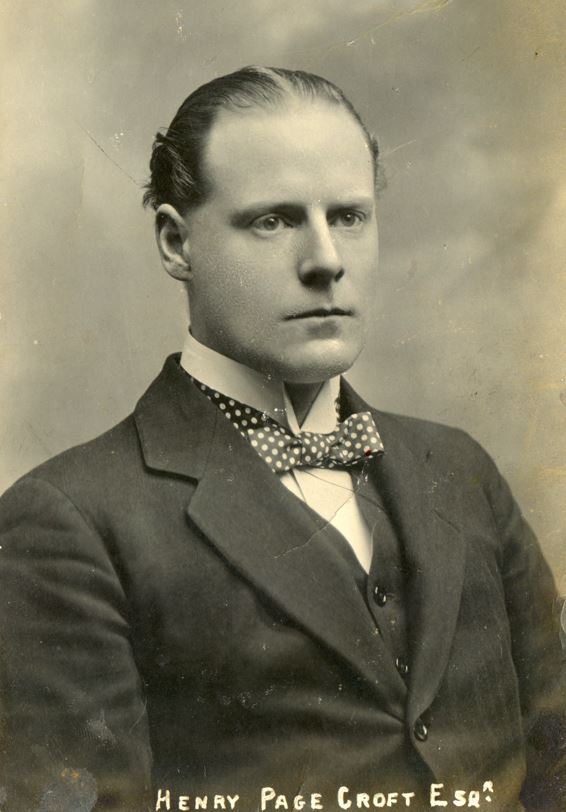
Henry Page Croft
Henry Page Croft’s father, Richard Benyon Croft, was a naval officer who resigned his commission to join the malting business of Henry Page at Ware, in Hertfordshire, following his marriage to Page’s daughter. Henry Page Croft had a comfortable and privileged upbringing. After excelling as an oarsman at Shrewsbury School, he went to Trinity Hall, Cambridge, the rowing college, but left in 1902 without taking his degree. This picture of a rich, feckless sportsman is, however, misleading. Page Croft had two consuming interests. The first was politics. The second was war.
Page Croft was a passionate supporter of the protectionist policies of Joseph Chamberlain. He formed a branch of the Tariff Reform League in Hertfordshire and was Chairman of the national Tariff Reform League’s Organisation Committee from 1913 until 1917. He contested Lincoln as a protectionist in January 1906, splitting the Tory vote and unseating the free trade Unionist MP. Four years later, he was elected to the House of Commons as Unionist MP for Christchurch and in 1912 published a plea for imperial unity, The Path of Empire.
Page Croft’s military inclinations were apparent from his time as an undergraduate, when he joined the 1st Hertfordshire Volunteer Battalion of the Bedfordshire Regiment. He remained in the battalion when it became part of the Territorial Force and went with it to France in November 1914 as its second-in-command.
He commanded the battalion from February 1915 to February 1916. He was a very serious amateur soldier. He was widely read in military history and kept abreast of tactical and other developments in the Regular army. His zeal attracted favourable notice. His name was twice put forward for promotion to brigade command by the GOC 2nd Division, Major-General Henry Horne, who described Page Croft as ‘a born soldier and leader of men … [who had] … done magnificent work throughout the war’. Horne considered that Page Croft’s ‘promotion would be very much in the interests of the Service’, adding that he had ‘never seen a finer Battalion than the 1/Herts Regt.’.[1] Higher authority clearly agreed.
On 7 February 1916 Page Croft was promoted GOC 68th Brigade, 23rd Division, a New Army formation commanded by Major-General Sir James Babington. Page Croft was 34, the youngest brigade commander in the British Army, a Territorial, a businessman and a sitting MP. Babington was a ‘dug out’ and, at 60, the oldest divisional commander in the British Army. It was an unhappy combination. The two men simply did not get on. It became increasingly clear that Babington did not want Page Croft in his division and within six months he got rid of him.
The traditional explanation of Page Croft’s going is that he was persuaded by Sir Henry Wilson that he could assist the national cause more effectively by returning to the House of Commons and agitating for a ruthless prosecution of the war. The release of Page Croft’s personal file to the Public Record Office in 1998, however, makes this explanation untenable.[2] It is now clear that Page Croft was desperate to remain in France and did his utmost to hold on to his command. He never ceased to protest against what he saw as the unfairness of his dismissal.
Page Croft formed the National Party in 1917 to give voice to his brand of xenophobic imperialism. He remained an MP until 1940, when he joined Churchill’s government as Parliamentary Under-Secretary of State for War (1940–5) with a seat in the House of Lords as the 1st Baron Croft.
He published an account of his wartime service in 1917, Twenty-Two Months Under Fire (London: John Murray).
References:
[1] TNA: PRO WO 374/51886.
[2] Ibid.