
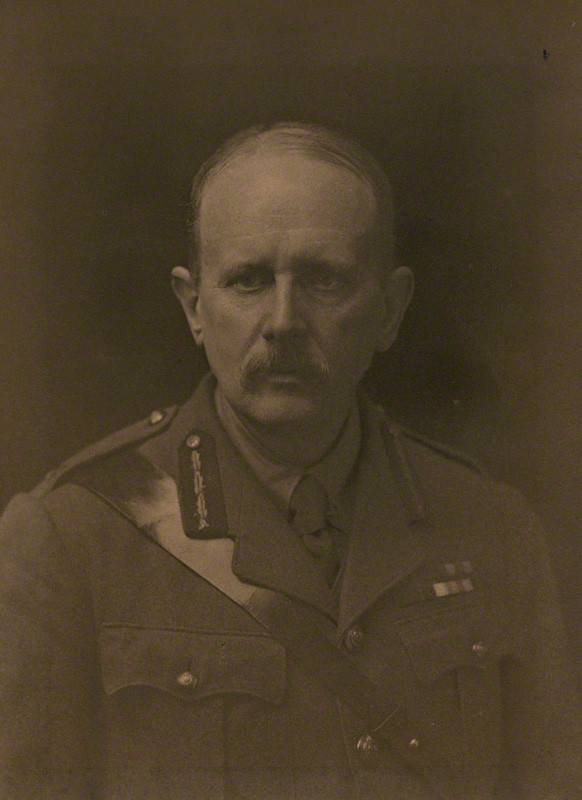
James Edward Edmonds
James Edward Edmonds (‘Archimedes’) was the son of J Edmonds. Although he was born in London, the family was of Cornish stock. Edmonds’s education was essentially scientific, but his father taught him languages at the breakfast table and he became fluent in German, French, Italian and Russian while still a schoolboy. He was clearly not an average child. Edmonds confirmed his intellectual prowess by passing first into ‘The Shop’ in July 1879. Two years later he also passed out top and was awarded the Pollock Medal. He was commissioned on 26 July 1881. In 1895 he came top in the Staff College entrance examination.
It was at Staff College that his peers, who included Allenby and Haig, bestowed the nickname ‘Archimedes’ on him. He coped with the demands of the Staff College so easily that he even found time to write his first book, The History of the Civil War in the United States 1861-1865. Soon after passing Staff College Edmonds was offered a position in the Intelligence Division. During the next decade (1899-1910) he held a series of intelligence appointments. His work during this period gives him a major claim to being the founding father of the British Secret Service, which he helped to establish on proper professional lines, though he was not immune to the outbreaks of ‘spy fever’ that occasionally surfaced in pre-war Britain.
On 1 March 1911 Edmonds became chief of staff (GSO1) 4th Division, commanded by Major-General Thomas Snow. Edmonds went to war with 4th Division in August 1914, but was relieved of his post on 4 September. The Retreat from Mons took a heavy toll. His nerves and constitution succumbed to exhaustion, brought on by lack of sleep and food. He was nearly 53. After a period of rest and light duties, Edmonds spent the remainder of the war as a staff officer at GHQ until appointed Deputy Chief Engineer by Haig in 1918.
Edmonds’s importance, however, lies after the war not during it. On 1 February 1919 he became Director of the Historical Section, Committee of Imperial Defence, with responsibility for producing the British Official History of the war. Edmonds held the post for 29 years. The production of the Official History took 33 years of Edmonds’s life. Edmonds wrote nearly half the 29 volumes, including three-quarters of the volumes dealing with the Western Front. The work involved the ‘sorting, recording and analysing of over 25 million documents’. Drafts were circulated to large numbers of participants, involving Edmonds in a huge correspondence, which is now in the CAB 45 series of the National Archives, to the great benefit of modern historians. Edmonds never had more than a handful of assistants.
He was 87 when the final volume was published in 1949. Without him the project would never have been concluded. Even so, Edmonds has received scant respect for his heroic efforts. The Official History is widely dismissed as ‘official propaganda’, a concerted attempt to cover up the incompetence of the high command, written in language that was emotionally sterile. People who hold these views have clearly never read the books.
Edmonds was an exceptional scholar. He went to immense lengths to establish the facts and to interpret them truthfully. His prose is often vivid and severely judgmental. He wrote and edited a work of enduring historical and literary value and of great integrity.