
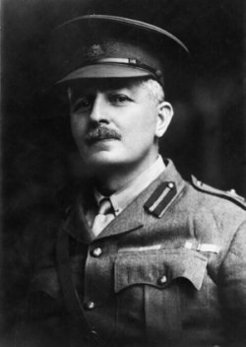
James Gordon Legge
James Gordon Legge was the eldest of eight sons and a daughter of James Henry Legge, a London banker who emigrated to New South Wales with his family in 1878. Legge had to overcome considerable financial deprivation as a young man, but he showed characteristic determination in pursuing an education, graduating BA (1884), MA (1887) and LLB (1890) from the University of Sydney. He began his working life as a teacher at Sydney Boys’ High School (1886-90) and he retained something of the schoolmaster about him for the rest of his life. This was not to endear him to higher military authority and was pregnant with difficulties. He was called to the bar in 1891, practising as a barrister for three years. Legge had served briefly in the New South Wales Militia (1885-6) before securing a commission in the 1st New South Wales Regiment (October 1887). In 1894 he joined the permanent forces of New South Wales and became a career soldier.
Legge’s pre-Great War military career was extensive by Australian standards. He had served a tour of duty in India with the British Army (1894). He had commanded an infantry company in the South African War before becoming adjutant of 1st New South Wales Mounted Rifles (1899-1900). He remained in South Africa after his unit had returned to Australia, serving as intelligence officer to Lieutenant-Colonel Beauvoir de Lisle. After returning to Australia Legge played a key part, together with W T Bridges, in establishing the scheme of universal military service. This brought him into the close company of politicians, providing a source of suspicion about his character and motives. In January 1912 he became Australian representative on the Imperial General Staff in London. In 1914 he returned home as Chief of the [Australian] General Staff, reaching Sydney a month before the outbreak of war in Europe.
Legge spent the early part of the war superintending training, but in May 1915 he was chosen to succeed Bridges as GOC 1st Australian Division and commander of the AIF, following Bridges’ death at the hands of a Turkish sniper on Gallipoli. The appointment was not met with acclamation on the peninsula and resulted in protests from commanders already in place, some of whom were senior to Legge and more experienced in combat. Their protests were to no avail.
This was an unfortunate beginning. Legge was handicapped from the start by the feeling that he owed his position to political influence rather than military ability. Legge did nothing to make himself acceptable by immediately quarrelling with the GOC Anzac Corps, Sir William Birdwood. Birdwood soon removed his uncomfortable subordinate by transferring him to the command of 2nd Australian Division, then training in Egypt. 2nd Division was not committed to the Gallipoli fighting until August, when it was used piecemeal. Legge fell sick in November 1915 and was evacuated to Egypt.
Legge’s first real test as a combat commander was also his last. 2nd Australian Division deployed to the Western Front in March-April 1916. On 28-29 July the division attempted to capture the Pozières Heights, in the first big Australian attack of the war in France. The attack was made with only one day’s notice at the insistence of the GOC Reserve [later Fifth] Army, General Sir Hubert Gough. Preparations were sketchy and artillery support virtually non-existent. The attack was a complete failure and casualties were severe. The position was eventually taken on 4-5 August, at a total cost of 6,848 casualties, a third of the division’s strength. Charles Bean, the Australian official historian, later wrote that the area was ‘more densely sown with Australian sacrifice than any other place on earth’.
At this stage of the war, when things went wrong, as they often did, blame descended to the lowest level at which it could effectively stick. Legge carried the can. When Legge fell ill in January 1917, Birdwood took the opportunity to replace him on ‘health grounds’. Legge lived with the bitterness of his dismissal for the rest of his life.
Legge’s command of 2nd Australian Division has received harsh treatment, not least from Bean, whose strictures have cast a shadow over Legge’s reputation. Bean was not alone in judging Legge severely. Ian Hamilton, who knew Legge from South African days and who had commanded the MEF on Gallipoli, admitted Legge’s intellectual qualities but stigmatised him as quarrelsome and self-seeking. Haig also had doubts about Legge as a combat commander and described his division as ‘ignorant’, a description that could be applied to most formations of the BEF in mid-1916. Legge was undoubtedly tactless and given to flights of fancy. He had an ability to make enemies in the touchy Australian military establishment that bordered on genius. But he was an excellent trainer of troops and an able military administrator. He had the misfortune to command at a period in the war when it was difficult to look good.
After his return to Australia Legge served again as Australian CGS and later as Commandant of the RMC Duntroon (1920-22). His younger son was killed in action on the Western Front.