
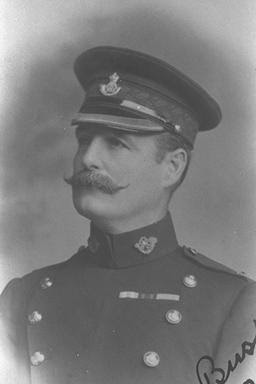
John Ernest Bush
John Ernest Bush was the son of Major Robert Bush, 96th Foot. He was commissioned in the 106th Foot, later 2nd Battalion Durham Light Infantry, from the Militia on 23 October 1880. He came from an accomplished sporting family.[1] Bush’s early career saw him make something of a specialty of being an adjutant: Adjutant 2nd DLI (April 1884–April 1889), including a period in the Sudan (1885–6); Adjutant Great Indian Peninsular Railway Volunteer Corps (November 1895–October 1898), one of the more obscure appointments available to pre-war British officers; and Adjutant 4th (2nd Durham Militia) Battalion DLI (February 1900–September 1903). He also served briefly as Garrison Adjutant Orange River in the South African War (1902).
Being adjutant was often a step on the road to battalion command. Bush duly reached this milestone, as CO 2nd DLI, in August 1906, enjoying a standard four-year tour before finding himself on half-pay. He was rescued from this limbo by the formation of the Territorial Force.
In June 1911 he became the first commander of the York and Durham brigade in the rank of colonel. He retained the post when the European War broke out and was advanced to brigadier-general. He even went to war with his re-named 150th Brigade, part of the 50th (Northumbrian) Division in April 1915. He was 56. 50th Division went into action at Ypres on 24 April, one day after the completion of its concentration, a testimony to the difficulties caused by the German gas attack on 22 April.
After the April crisis 50th Division spent the rest of 1915 training and holding the line. Brigadier-General Bush was invalided home in January 1916. He commanded the East Anglian Reserve Infantry Brigade from September 1916 until 23 November 1917, when he retired from the army.
References:
[1] J.E. Bush played for Clifton Rugby Club in Bristol and for Gloucestershire. He was selected once for Ireland at Rugby but had to withdraw because of army duties. His brother, James Arthur Bush, was Gloucestershire’s wicket-keeper, as well as playing for the MCC. He was W.G. Grace’s best friend and the best man at his wedding. Bush’s other brother, Robert Edwin, played rugby for Clifton and cricket for Gloucestershire. He also became an explorer in Australia.