
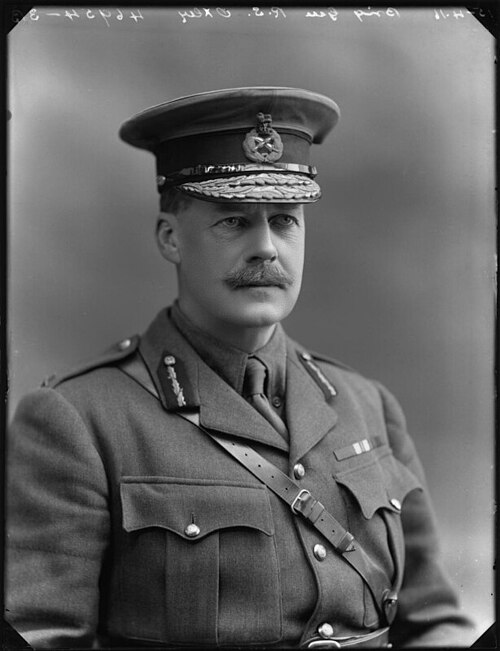
Reginald Stewart Oxley
Reginald Stewart Oxley was the younger son of John Stewart Oxley of Fen Place, Turner’s Hill, Sussex. He was commissioned in the York and Lancaster Regiment on 23 August 1884, but transferred to the King’s Royal Rifle Corps the following November. His only active service was in the Manipur Expedition (1891). But, after passing Staff College in December 1898, where one of his contemporaries was the future Sir William Robertson, Oxley served as Brigade Major, 12th Infantry Brigade, in South Africa (1899-1900), and was mentioned in despatches. He was DAAG North-West District (1901-4), CO 1st Battalion King’s Royal Rifle Corps (1907-11) and GSO1 Staff College (1912-14). He went to war as GSO1 II Corps (August-December 1914). After a period commanding GHQ Troops, he was made GOC 24th Brigade, 8th Division, on 17 March 1915. He was 51.
Oxley’s appointment came in the aftermath of the battle of Neuve Chapelle (10-12 March) in which 8th Division had played a leading part. Like several British attacks of 1915, the ‘break-in’ at Neuve Chapelle went well, but what Field-Marshal Montgomery was later to term the ‘dog fight’ degenerated into confusion, hampered by inadequate resources and woefully inadequate communications. It proved impossible to convert the ‘break-in’ into a ‘break-through’. 24th Brigade suffered heavy casualties (75 officers and more than 1,600 men). Its GOC, Brigadier-General F C Carter, went sick five days later.
Oxley’s baptism of fire was to be even more difficult and unpleasant. The BEF renewed its attacks against the Aubers Ridge on 9 May. The assault was a fiasco. The British artillery bombardment was too feeble even to achieve a break-in. A series of unsupported and unco-ordinated infantry frontal attacks, often made against uncut wire, collapsed in the face of German machine-gun fire. Oxley, himself, ordered two companies of 1st Battalion Sherwood Foresters to re-inforce the costly failure of the initial attack by 2nd Battalion East Lancashire Regiment.
When the GOC IV Corps, Sir Henry Rawlinson, enquired what had happened to the East Lancashires and the Sherwoods Oxley famously replied ‘They are lying out in No Man’s Land, sir, and most of them will never stand again.’ Even so, Oxley sent orders to his two reserve battalions to carry out yet another futile assault later in the day. The order was cancelled on his own authority by the CO 1st Worcesters, Lieutenant-Colonel George Grogan. Oxley later sanctioned the cancellation. This was not an auspicious start to Oxley’s career as a brigade commander. Worse was to follow.
24th Brigade was transferred to 23rd Division on 18 October 1915 and it was as part of this formation that it took part in the battle of the Somme. 23rd Division captured Contalmaison on 7 July 1916. Brigadier-General Oxley was dismissed on 11 July for failing to hold the captured ground after his brigade ran out of ammunition.
Professor Travers has speculated that Oxley’s dismissal owed something to past rivalries at the Staff College with Douglas Haig (who was in the year above Oxley). There is no evidence for this. The key figure in Oxley’s dismissal was not Haig, but the GOC 23rd Division, Major-General Babington. Babington evidently rated neither Oxley nor his brigade. He had reported Oxley as being only ‘fairly satisfactory as a Brigadier’ and ‘certainly not fit for promotion to command a division’.[1]
After the capture of Contalmaison the Commander-in-Chief asked Babington what he would like. Babington replied ‘Give me back my 70th Brigade’. He received it within the week. 24th Brigade went back to 8th Division, minus Oxley.
Brigadier-General Oxley spent the rest of the war in staff positions at home. He retired in 1919.
References:
[1] Haig Diary, 4, 8, 9 and 10 July 1916.