
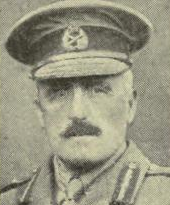
Richard Hutton Davies
Richard Hutton Davies was the son of a London journalist, Theophilus Davies. After leaving school, he was sent to New Zealand to work on his uncle’s sheep station in Canterbury. Later, he settled at Taranaki, in the North Island, where he practised for fifteen years as a surveyor and engineer, pioneering the opening up of the rugged hinterland. His military career did not begin until 1893, at the late age of 31, when he joined the Hawera Mounted Rifle Volunteers. He soon made up for lost time. Within six weeks he became the unit’s commanding officer.
In October 1899 he transferred to the New Zealand Militia. Within a few weeks he was seconded to command a company of the First New Zealand Contingent in the South African War. He put his surveying skills to good use, winning a reputation as an outstanding scout, which brought him to the attention of Sir John French. Davies ended the war in command of the Eighth New Zealand Contingent. This made him the first New Zealand officer to command an independent force on active service overseas. He was also the only colonial officer to be given command of a composite mobile column during the South African War.
Between 1902 and 1909 he played a leading role in the reform of the New Zealand military. In 1909 he was sent to England on attachment to the 2nd (Cavalry) Brigade to prepare him for higher rank. His performance was so impressive that he was offered command of the 6th (Infantry) Brigade, based at Aldershot.
He was still in command when the war broke out and he took his brigade to France with the British Expeditionary Force. He insisted in marching at the head of his brigade during its deployment, a gesture that brought about a state of exhaustion, severely hampering his ability to command. Haig several times commented unfavourably on Davies’ fitness and mental state during the Retreat and after the Aisne he was sent home to raise the new 20th (Light) Division, making him the first New Zealander to command a division in the Great War.
He led 20th Division in only one minor engagement, at Fromelles in September 1915, before failing health compelled him to return to England the following spring.
On 8 April 1916 he became GOC Cannock Chase Reserve Centre. He suffered continuous ill health for the next two years. On 9 May 1918 he committed suicide in a London nursing home specialising in the treatment of army officers with mental disorders.