
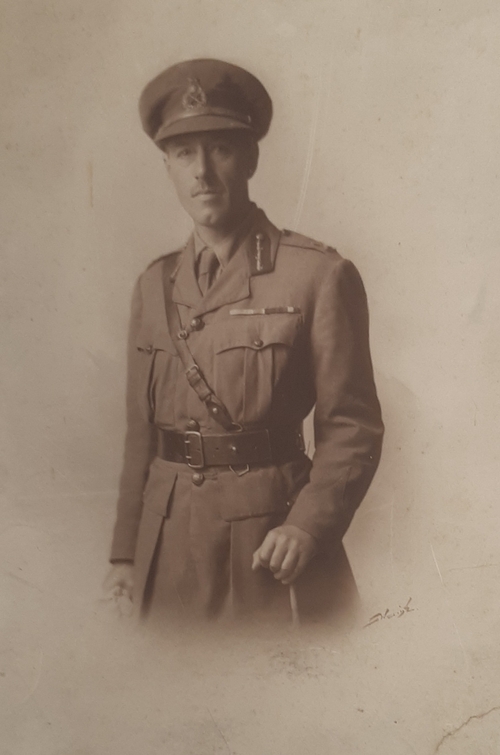
Robert James Bridgford
Robert James Bridgford was born on 10 March 1869, the son of Sir Robert Bridgford KCB. He joined the Manchester Regiment from the Militia in 1890 and for the next eight years spent much time with the mounted infantry when not engaged in field sports. In 1898 he was promoted captain, married Mary Hamilton, daughter of the Venerable F C Hamilton and sent out to the South African War, where he served with the mounted infantry. At the end of the war, in 1902, he was awarded the DSO ‘in recognition of services during operations in South Africa’. After service in India, and promotion to major, he transferred to the King’s Shropshire Light Infantry in 1905.
By the outbreak of the Great War Bridgford was a Lieutenant-Colonel commanding the 2nd Battalion King’s Shropshire Light Infantry in India, and brought them home to become part of 80th Brigade. He was in an ideal situation for speedy advancement and in August 1915 was promoted Brigadier-General and given command of 18th Brigade. After being sent home for a rest during the winter of 1917-18 he returned to France in March 1918 as a Major-General in command of 31st Division, just in time for the Somme and Lys battles of March-April 1918. When the division was sent to help train the Americans, Bridgford was transferred to command the 32nd Division in early May. However, at the end of the month he became one of those who took the blame for German success. In his own account of this he stated: ‘Later in May 1918 got the order of the Boot or Bowler Hat for carrying out orders sent by the Corps Commander during the Bosch push of 1918. He himself with his staff having fled. The Corps Commander commonly went by the name of Foxy Haldane’. Bridgford went home and spent the rest of the war commanding 222nd Reserve Brigade on Salisbury Plain.
He was awarded the CMG (1915) and CB (1918) for his war service, retired in 1922 and became a country gentleman, serving as a Deputy Lieutenant and magistrate in the county of Hereford, when he was not “huntin’, shootin’ and fishing”. He died in 1954.