
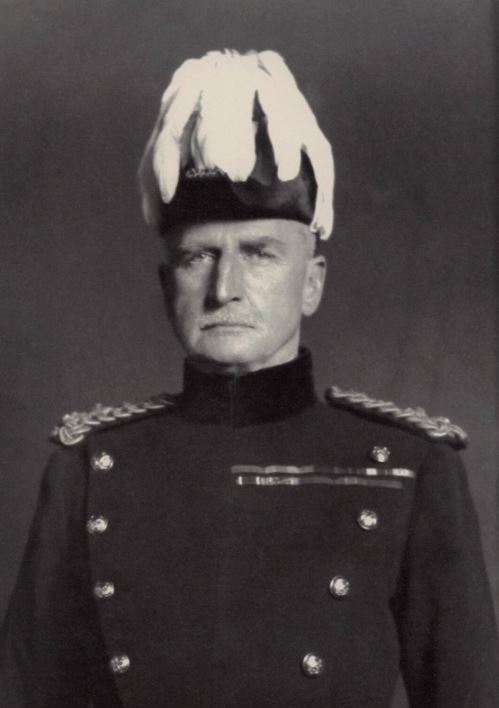
Sir Charles Edward Corkran
Charles Edward Corkran was the son of Colonel Charles Seymour Corkran. He was commissioned in the Grenadier Guards on 15 March 1893. Guards officers have something of a reputation for not being quite serious about their profession. This charge could not be laid at Corkran’s door. His pre-war career profile is that of an ambitious professional: Adjutant 2nd Battalion Grenadier Guards (October 1899–September 1902); ADC to the GOC Forces in South Africa (September 1902–February 1903); DAAG Pretoria District (February 1903–March 1904); DAQMG Transvaal District (March–November 1904); psc (1906); DAA&QMG 2nd London Division (January–September 1911). To this impressive staff CV he could also add active service in the Nile Expedition (1898) and in the South African War (1900–2), in which he was wounded and mentioned in despatches.
When the Great War broke out he was Brigade Major, 1st Brigade, Aldershot, a post he had held since October 1911. He was deployed with 1st Brigade and remained with it until October 1914, when he rejoined his battalion, which had suffered heavy casualties. In February 1915 he returned home briefly as chief of staff (GSO1) 26th Division, a New Army formation then assembling. He was CO 1st Battalion Grenadier Guards from March to July 1915.
He reached general officer rank on 13 July 1915 as GOC 5th Brigade, 2nd Division. He had risen from brigade major to brigade commander in less than a year. He was not quite 43. Corkran commanded 5th Brigade until 9 May 1916, when he transferred to 3rd Guards Brigade after Brigadier-General F J Heyworth was shot dead by a sniper. In February 1916 Corkran was one of two infantry brigade commanders chosen by GHQ to attend the first demonstration of the tank ‘Mother’ (the other was Anthony Reddie, GOC 1st Brigade).
Corkran commanded 3rd Guards Brigade until March 1917. His replacement appears to have been under the ‘six months’ rest’ rule, which had then come into effect. It was recognised that the physical and mental strain on front-line combat commanders imposed a limit on the length of time they could be kept in post. But when Corkran returned to duty, six months later, it was as Head of the British Military Mission to the Royal Serbian Army. He did not return to the Western Front until July 1918, as GOC 173rd Brigade, 58th (2nd/1st London) Division, a second line Territorial formation, perhaps something of a come down for a Guards officer. He was the last man to command the brigade during the war.
Corkran continued in the army after the Armistice. He commanded 183rd Brigade (April–May 1919) and was Commandant of the Senior Officers’ School (September 1919–November 1921) and of the Royal Military College, Sandhurst (October 1923–August 1927).After a brief period on half-pay he ended his career as GOC London District (February 1928–January 1932).
He retired on 1 February 1932 in the rank of major-general and was knighted the same year.