
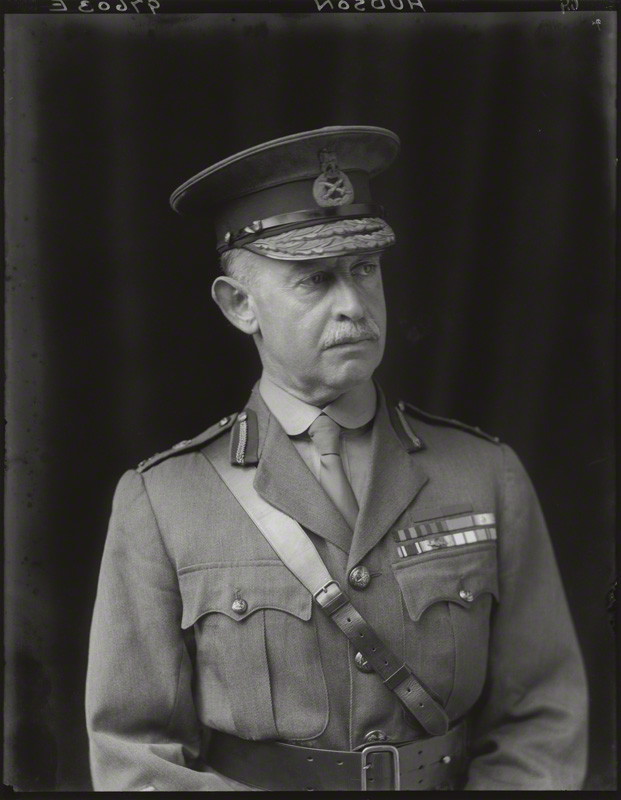
Sir Havelock Hudson (‘Huddie’)
Havelock Hudson (‘Huddie’) was the son of Lieutenant-General Sir John Hudson KCB. He was commissioned in the Northamptonshire Regiment on 22 October 1881, but transferred to the Indian Army in 1885. He also transferred to the cavalry, serving with the famous 19th Bengal Lancers, a regiment whose history he later wrote. Hudson saw active service in the colonial warfare of the North West Frontier and also served in China (1900). His presence on the committee that organised the Coronation Durbar of Edward VII at Delhi in 1903 indicates a flair for staff work.
Douglas Haig was an admirer.
‘By the way Col. Hudson goes home in a week or two - I will give him a line to introduce him to you,’ Haig wrote to his friend Lancelot Kiggell on 5 April 1911. ‘He is a first rate fellow - absolutely trustworthy and keen for the good of the show. He is not p.s.c. but is first rate notwithstanding. He is head of the Training Section under Headlam.’[1]
Hudson was briefly Commandant of the Cavalry School at Sangor (1912) before taking up the position of BGGS Northern Army in October 1912. He held this post when the European War broke out.
Hudson was BGGS (chief of staff) of the Indian Corps from September 1914 until July 1915. On 1 August he was given command of the Regular 8th Division on the Western Front, perhaps a surprising appointment for an Indian Army officer. 8th Division had been sorely tested in the spring fighting of 1918, especially at Neuve Chapelle (10–12 March) and Aubers Ridge (9 May). The division was little used again, apart from the attack at Bois Grenier (25 September), until 1 July 1916, when it did badly and suffered grievously in the attack on Ovillers, losing 5,400 men. It spent the next few weeks precariously holding a deliberately thinned out front in a ‘quiet sector’. This gave the division little time to train or to absorb new drafts.
The formation that was rushed back into the battle (against the Transloy Ridges in October) was not in the best shape. The divisional history frankly summarised the division’s experience in 1916: ‘Fate had given the troops no direct part in the victories of the Somme; but had dealt out to them a full measure of its bitterest and darkest hours.’[2] Philip Howell described Hudson as ‘such a nice little man & very quick & sensible’, but while he was ‘quick enough to see what was going to go wrong’ he had ‘not quite enough personality to be insubordinate & refuse’ pressure from above.[3] At this stage of the war, Hudson was not alone in this failing.
On 10 December 1916 Hudson was appointed Adjutant-General, India, a post he held until 1920. His successor as GOC 8th Division, William Heneker, was unimpressed with the formation he inherited and immediately set about making personnel changes. Paddy Griffith described India as the ‘sin bin of the First World War’.
It is difficult to know whether Hudson had, in fact, been stellenbosched. It may be significant that Hudson did not include his command of 8th Division in his Who’s Who entry. He was, however, a great success in his new post. Later, as GOC Eastern Command, India (1920–4) and as Member of the Council of India (1924–9) he was a key figure in the post-war reform of the Indian Army.
References:
[1] Kiggell Papers (LHCMA). I/8. Haig to Kiggell. 5 April 1911.
[2] Lt.-Colonel J H Boraston and Captain Cyril E O Bax, The Eighth Division 1914-1918 (London: Medici Society, 1926), p. 96.
[3] LHCMA: Howell Papers IV/C/3/188. Howell to his wife, 3 July [1916].