
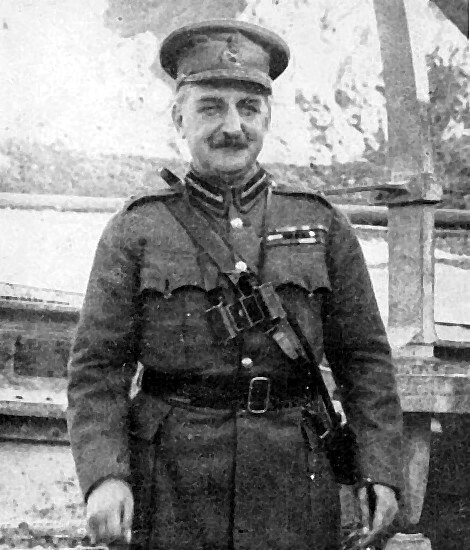
Sir John Grenfell Maxwell
John Grenfell Maxwell (‘Conky’) was commissioned in the 42nd Highlanders [later the Black Watch] on 22 March 1879. When the Great War broke out he was 55, only two years older than Douglas Haig. Like Haig, he had friends in high places, he was a lieutenant-general and a knight, and he could boast a career of great distinction. For Maxwell, however, the war was to prove a source of personal and professional disappointment and, eventually, obloquy. Maxwell was the protégé of his cousin, Field-Marshal Lord Grenfell, with whom he served as ADC in the Egyptian Frontier Force (1885-6), where he won the DSO. He also later became a close friend of Lord Kitchener. Maxwell saw a great deal of active service, including the battles of Tel-el-Kebir (1882) and Omdurman (1898), where he commanded the 2nd Egyptian Brigade.
He commanded the 14th Brigade in South Africa and was later Military Governor of Pretoria (1900-1). He was knighted in 1900. Important staff appointments followed: chief of staff III Corps (1902-4); Inspector-General of the Forces (1904-7). He renewed his connection with Egypt in 1908, when he was appointed GOC British Troops, a post he held until 1912. (He had a considerable reputation as an Egyptologist.)
When the war broke out he was unemployed, but with his friend Kitchener now Secretary of State for War, Maxwell had a right to expect a plum appointment, but none came. He served only briefly on the Western Front, in the first weeks of the war, as Head of the British Mission to the French Army.
In September he returned to Egypt as Commander-in-Chief. During 1915 Egypt became the major staging post, training centre and supply base for three major military campaigns, Gallipoli, Salonika and Palestine. Maxwell found only frustration in these important duties, feeling himself reduced to the role of a quartermaster with no influence on strategy or operations. By the spring of 1916 he had had enough. He asked to be relieved and returned home. It was a fateful decision.
Within weeks he found himself C-in-C Ireland, confronted by the Easter Rising. The British government effectively abandoned control of events to the military. Maxwell was given extensive powers, including that of declaring martial law. This was imposed on 15 of the rebels, who were court martialed and executed, a disastrous error of judgement that turned a failed rebellion into a revolution.
Maxwell ended the war as GOC Northern Command (1916-19). He retired in 1922.