
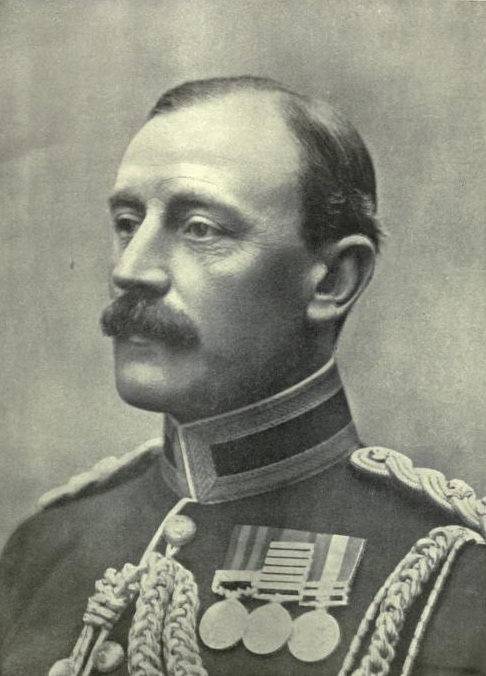
Sir Walter Pipon Braithwaite
Walter Pipon Braithwaite ('Braith') was the youngest son and twelfth child of the Rev William Braithwaite, Vicar of Alne, Yorkshire. He was commissioned into the Somerset Light Infantry in 1886 and quickly saw active service in Burma. His career took on its distinctive shape in 1898, however, when he entered the Staff College. The South African War broke out before he could quite complete his studies and, together with the College's other students, he was sent out as a special serving officer, later becoming Brigade Major and Deputy Assistant Adjutant General.
When the war ended Braithwaite did not return to regimental soldiering. A series of Staff appointments brought him into contact with some of the British Army's leading figures, including Evelyn Wood, Ian Hamilton, Henry Wilson and Douglas Haig. Haig, in particular, held him in high regard.
In 1911 Braithwaite became Commandant of the Staff College, Quetta, which post he still held in August 1914. He came home when the College was closed and was made Director of Staff Duties of the War Office. In March he was appointed Chief of Staff to Sir Ian Hamilton's Mediterranean Expeditionary Force. Much of the obloquy for the Gallipoli campaign's failings fell on Braithwaite.
The Australians widely regarded him as arrogant and incompetent. The future Australian general, John Gellibrand, who was instructed by Braithwaite at the Staff College before the war, was particularly severe.
'Imagination is as foreign to him as independence,' he confided to his diary. 'To sum up, a good regimental officer, fair office man and Brigade Major but a mind like a waiter's and the independence of a tick. Besides, he appears over anxious to please those he thinks influential and this again betrays his waiter's mind.' [1]
This was a judgement that the Australian official historian, Charles Bean, was later to revise.
Hamilton, however, remained a staunch defender, always referring to Braithwaite as 'a rock'. When Hamilton was recalled in October 1915, Braithwaite suffered the same fate. His 'reward' was appointment as GOC 62nd (2nd West Riding) Division, an undistinguished-looking second-line Territorial unit. He undoubtedly owed this command to Haig's lobbying. Undismayed, he turned it into one of the best divisions in the British Army. After a difficult baptism at Bullecourt in May 1917, the division performed well at Cambrai, in checking the German Spring Offensive at Bucquoy (where Braithwaite's personal leadership was conspicuous) and in the Great Advance.
After a brief period as temporary GOC XXII Corps, Braithwaite was promoted to GOC IX Corps on 13 September 1918. Sixteen days later this corps spearheaded Fourth Army's breaking of the Hindenburg Line and continued to lead the advance on the extreme right of the British line. In his short career as a corps commander Braithwaite showed himself open to new ideas and sympathetic to technological solutions to tactical problems. Immediately after the Armistice, Haig commissioned Braithwaite to undertake a thoroughgoing report into staff work during the war.
Braithwaite's only son, Lieutenant V A Braithwaite, 1st Battalion Somerset Light Infantry, was killed in action on the Somme on 2 July 1916, at the age of 20. Braithwaite destroyed all his papers after the war, having no one to leave them to. He organised Haig's funeral in 1928.
[1] E and J Gellibrand Diary, 10 March 1906. Quoted in Jonathan Walker, The Blood Tub. General Gough and the Battle of Bullecourt, 1917 (Staplehurst: Spellmount, 1998), p4.