
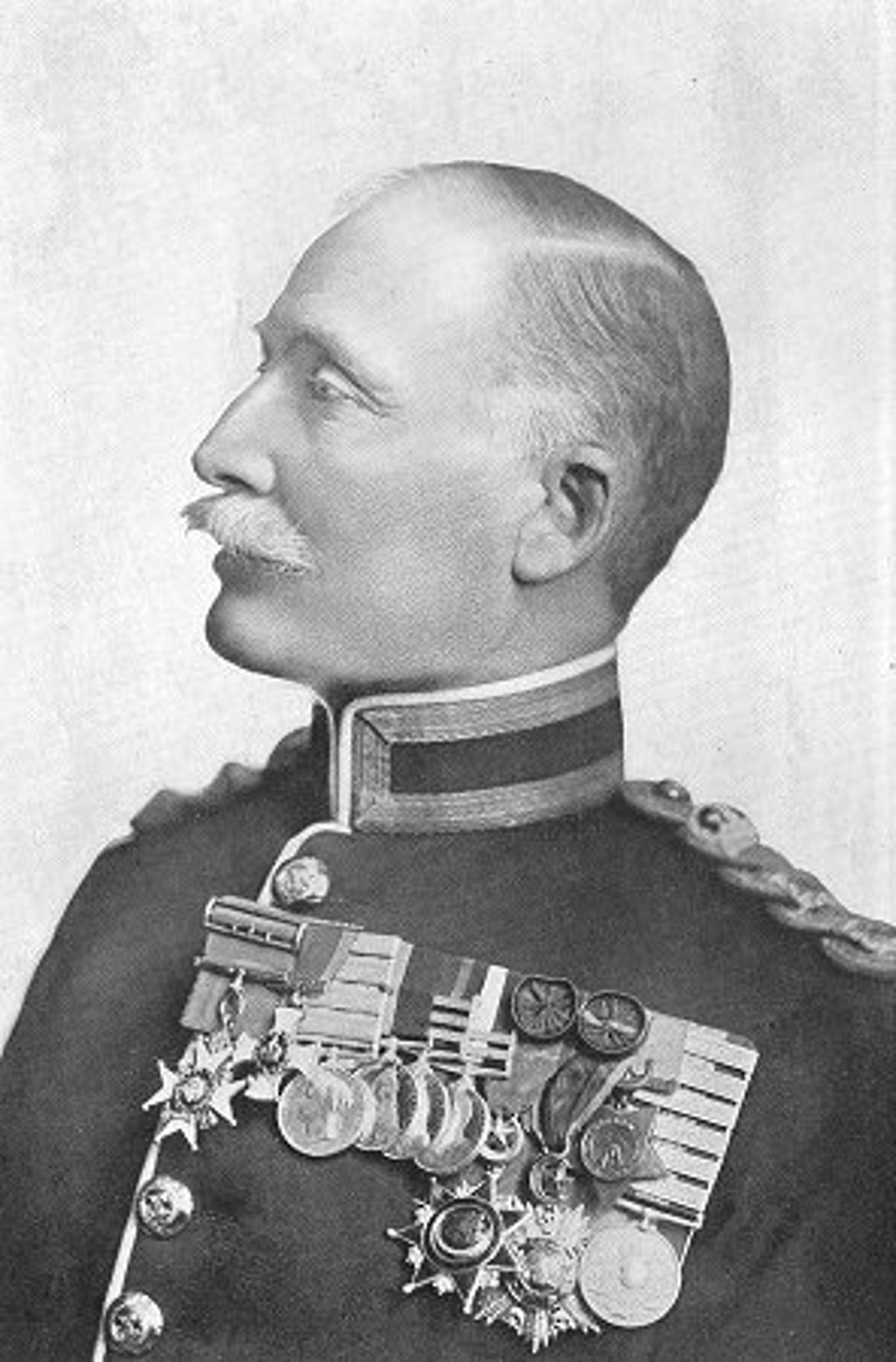
Thomas Edgecumbe Hickman
Thomas Edgecumbe Hickman was one of sixteen children of the great Black Country industrialist, Sir Alfred Hickman Bt (1830–1910), Conservative MP for Wolverhampton West. T E Hickman was commissioned in the 36th Foot (later 2nd Battalion Worcestershire Regiment) from the Militia on 19 February 1881. He was attached to the Egyptian Army from 1884 to 1894, March to November 1896, and 1897 to 1900. So dominant a part did Egypt play in his pre-war military career that it earned him the nickname ‘Hickman Bey’. He was also heavily involved in the South African War and its aftermath, including a period as GOC Middleburg District, Cape Colony (1902–8), when he went on half pay.
He officially retired from the Army on 4 April 1914. By then he had moved into politics. He was elected Unionist MP for Wolverhampton South in 1910. He was especially interested in Irish affairs, becoming President of the British League for the Defence of Ulster and Inspector-General of the Ulster Volunteer Force. Hickman had been second in command to Kitchener at the disastrous battle of Hardub in January 1888. He had assumed command when Kitchener was very nearly fatally wounded. So, it was to Hickman that Kitchener turned in 1914 when, as Secretary of State for War, he decided that he wanted the Ulster Volunteers for his New Army. Kitchener not only got the Ulster Volunteers, but he also got Hickman, who became GOC 109th Brigade, 36th (Ulster) Division on 14 September 1914. He was 55 and a sitting MP.
36th Division deployed to France in October 1915 under a new commander, Major-General Oliver Nugent, who was determined to de-politicise this very political formation. He removed all three brigade commanders within six months. Hickman survived the longest, being replaced in April 1916. 109th Brigade took part in no offensive operations while under his command.