
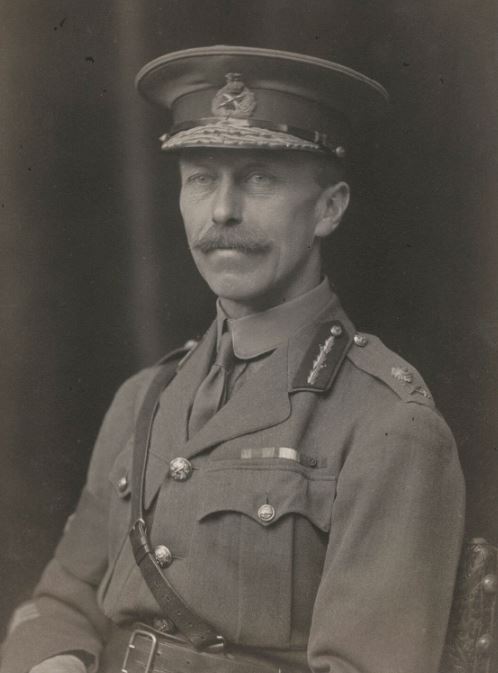
Thomas Stanton Lambert
Thomas Stanton Lambert was the son of the Rev. R U Lambert, Vicar of Christ Church, Bradford-on-Avon. He was commissioned in the East Lancashire Regiment in 1891 and served in India.
When the war broke out he was DAAG at the War Office with the rank of major. He assumed command of the 1st Battalion East Lancashire Regiment in September 1914 after its CO had been killed on the Aisne. Lambert was himself wounded a fortnight later. The wound was severe, causing him to lose the use of his right lung. Following his recovery, in March 1915, he was successively DAAG 37th Division, CO 2nd Battalion East Lancashire Regiment, and acting AAG at GHQ. On 8 March 1916 he was promoted GOC 69th Brigade, 23rd Division.
He commanded this formation during the capture of Contalmaison (July 1916) and the actions at Le Sars (October 1916), Hill 60, Menin Road (September 1917) and Polygon Wood (September-October 1917). He also commanded the brigade in Italy during the winter of 1917-18 until recalled to the Western Front, on 31 May 1918, to command 32nd Division in succession to Major-General R J Bridgford. He was 47.
32nd Division achieved its best attacking results under Lambert’s command, spearheading Fourth Army’s attacks alongside the Australians between August and October 1918. It was Lambert who informed Field-Marshal Haig of mounting German resistance at Amiens, intelligence that persuaded Haig to refuse Foch’s order to continue the offensive and to switch the axis of advance to Byng’s Third Army on the Scarpe.
In 32nd Division’s last action of the war, the Passage of the Sambre-Oise Canal, Lambert chose to cross at many points on a broad front. As a result, he was compelled to keep his artillery well back from the canal. This method was in marked contrast to that adopted by Major-General E P Strickland’s 1st Division, on Lambert’s flank. Strickland chose to cross at two points and then fan out. This allowed him to bring his artillery up close along parts of the canal where no crossings were made. Strickland’s method proved the sounder. 32nd Division captured fewer prisoners (250 against 1st Division’s 1,600) and incurred heavier casualties. One of the casualties was the poet, Wilfred Owen.
Lambert died as the result of wounds inflicted in an IRA ambush at Moydrum on 21 June 1921 while GOC Dublin Brigade.