
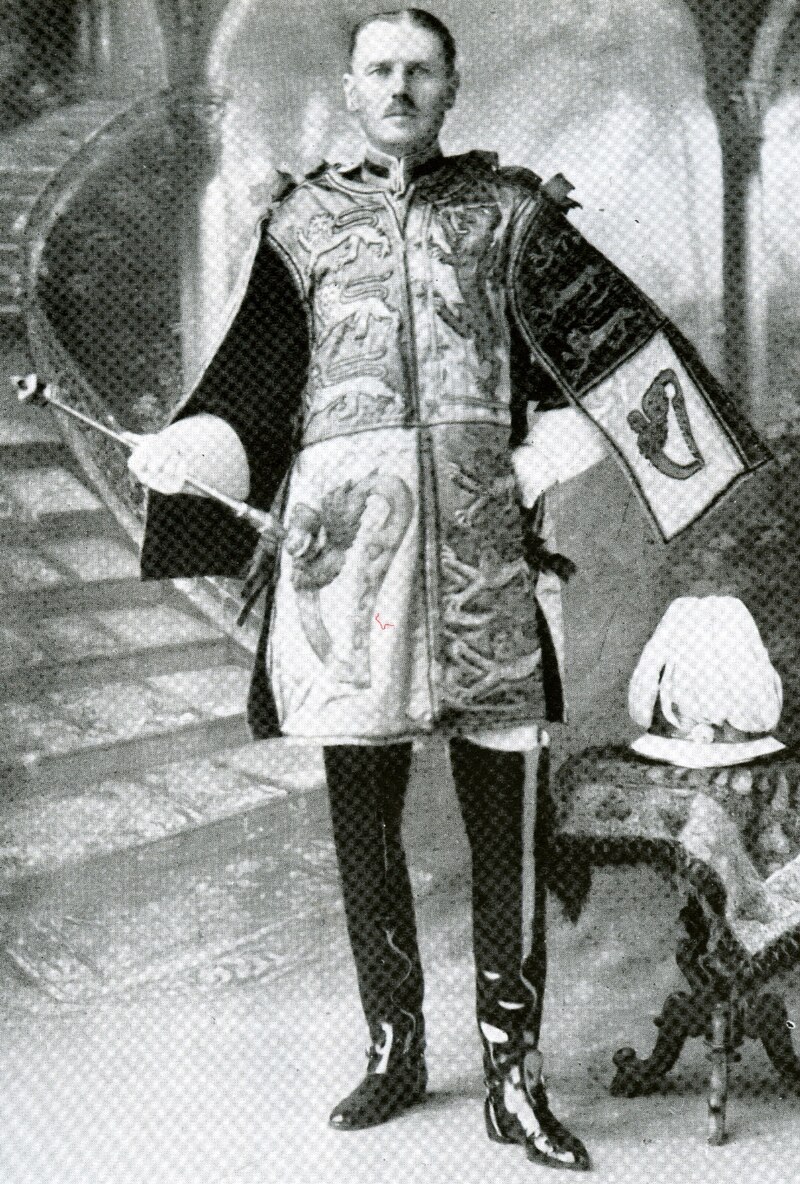
William Eliot Peyton
William Eliot Peyton’s military career was unusual and is difficult to fathom. It began in the ranks of the 7th Dragoon Guards, the regiment formerly commanded (1871-6) by his father, Colonel John Peyton. This surprising beginning was precipitated by Peyton’s failure to pass the Sandhurst entrance examination. Whether service in the ranks of his father’s old regiment was a convenient ‘back door’ to a military career or a punishment it is impossible to tell. Peyton was six feet six inches tall and well built. He was unlikely to have encountered many taunts of ‘daddy’s boy’.
He spent two years in the ranks (1885-7) before receiving his commission on 18 June 1887. Two years later, he married Mabel Gage, daughter of Lieutenant-General E T Gage, third son of the fourth Viscount Gage. He was clearly fully back on track as an officer and gentleman. In 1896 he transferred to the 15th Hussars, which regiment he commanded from 1903 until 1907. Peyton served with the Egyptian Army in the Sudan campaigns of 1896, 1897 and 1898, and was badly wounded at the battle of Salamet, where his horse was killed under him. He went to South Africa in 1900, serving with Thorneycroft’s Mounted Infantry, but his service was cut short by illness that saw him invalided back to England. He passed Staff College in December 1901.
After completing his tour as CO 15th Hussars, he became Assistant Quartermaster-General, India. This was followed, in 1908, by command of the Meerut Brigade. During the Delhi Durbar of 1911 he was Delhi Herald and King of Arms to King George V. He was appointed Military Secretary to the Commander-in-Chief, India, in 1912, the first of three periods as a military secretary in his career.
Peyton returned to England in 1914 on the outbreak of war, taking up the post of chief of staff 1st Mounted Division TF. This was soon followed by command of 2nd Mounted Division TF, which in August 1915 he took (dismounted) to Gallipoli, where it suffered such severe casualties in the fighting at Suvla that reinforcement and extensive re-organisation became necessary.
Peyton took command of the Western Desert Force in Egypt in January 1916 and conducted a successful campaign against the Senussi. But in May 1916, after eighteen months as a combat commander, Peyton was transferred to the Western Front as Sir Douglas Haig’s Military Secretary, a post he held until March 1918. The work of the Military Secretary was re-organised in the summer of 1916. Until that time the MS had operated as part of the C-in-C’s personal staff; after re-organisation the MS had his own branch at GHQ, a reflection of the growth in workload resulting from the army’s massive expansion.
The post of Military Secretary was central to the operation of the BEF’s management of appointments, promotions and removals and its system of honours and awards. But the destruction of the all the papers of the Military Secretary’s office during a German air raid on 8 September 1940 makes it difficult to document the Military Secretary’s activities. In its obituary of Peyton, on 16 November 1931, The Times considered that he had behaved in a ‘straightforward, kindly and sympathetic’ manner and had ‘fulfilled his duties with tact and dignity’. He was knighted in 1917.
During April and May 1918 Peyton ‘commanded’ Fifth Army. This was a nominal appointment. After its defeat on the Somme in March and its re-designation as Fourth Army on 2 April, Fifth Army effectively ceased to exist. Peyton’s command consisted of a reserve army headquarters at Cécy-en-Ponthieu. When Fifth Army was reconstituted on 23 May command was given to Sir William Birdwood. Peyton then took command of X Corps, which had been temporarily in the hands of Sir William Congreve, following the replacement of X Corps’ long-serving commander, Sir Thomas Morland, in April 1918. Peyton held command for only six weeks, during which X Corps remained in back areas.
On 3 July 1918 he took command of 40th Division, which he led through the Hundred Days during its advance through Flanders. Peyton evidently took pride in this appointment, which he lists in his Who’s Who entry, unlike his appointments as MS, GOC Fifth Army and GOC X Corps.
Peyton remained in the army after the war. He was GOC United Province District, India, and 3rd Indian Division (1920-22), MS Secretary of State for War (1922-26) and GOC-in-C Scottish Command (1926-30). General Sir William Peyton retired from the army in 1930.
He died suddenly in the Army and Navy Club, London, on 14 November 1931. He was sixty-five. He left the considerable sum of almost £35,000.