
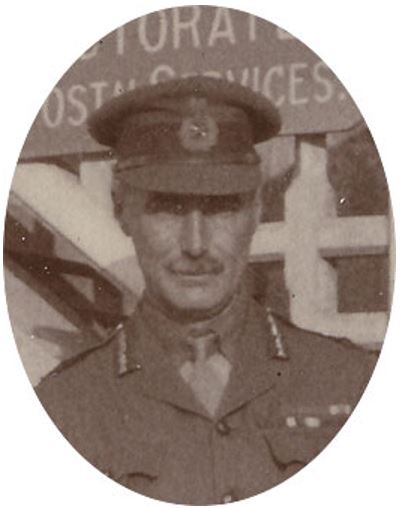
William Price
William Price joined the Post Office as a young man and spent his entire career there. He served in the South African War with the Army Post Office Corps, for which he was made CMG. He later served with the 8th Battalion London Regiment (Post Office Rifles) TF, but on 31 March 1913 he became OC Postal Section Royal Engineers Special Reserve and Director of Army Postal Services.
Price deployed with the BEF to France and remained in charge of the army’s postal arrangements throughout the war. He commanded in the rank of Colonel from 5 August 1914 to 27 May 1918, when the importance of his work was belatedly recognised by his promotion to brigadier-general. And it is scarcely possible to overstate the importance of Price’s work. An efficient postal service was not only essential to the army’s operation but also to its morale. All studies testify to the importance of soldiers being able to maintain their links with home and, especially, to receive news from their loved ones.
The army’s postal arrangements in the event of war were laid down in 1913 as a result of experience derived from pre-war army manoeuvres. All post to soldiers in the field had to be addressed to their units and sent c/o the General Post Office in London. The mail was placed in unit bags on the basis of information supplied by GHQ BEF and despatched along the lines of communication to the railhead post offices and then to branch field post offices located at every supply refilling point in a divisional area.[1] These branch field post offices were the collecting points for return mail. The army took great care to ensure that post for wounded or dead soldiers was not returned to sender until families had been officially informed of the soldier’s fate.
The movement of mail was colossal. During 1916 the weekly number of bags for the BEF received at the GPO rose from 65,079 in the first week of January to 86,163 in the first week of July. By November the weekly average was 100,000. During the four weeks of December the figures were 139,788, 157,948, 150,945 and 123,342.
By October 1916 BEF field post offices were collecting 10M letters and 100,000 parcels a week. In the quarter ending September 1916 498,388 postal orders were issued and 437,686 paid: a year later the figures were 665,327 and 982,674. Very little post was lost and most of that due to enemy action. In the circumstances, the official recognition of Price’s wartime contribution, a CB in 1915 and a CBE in 1918, seems a little churlish.
He returned to the Post Office after the war and was Secretary of the Post Office in Scotland from 1920 to 1924.
References:
[1] The precise arrangements changed over time. See Brigadier-General Sir James E. Edmonds, Military Operations France and Belgium 1916. Volume 1 (London: Macmillan, 1932), pp. 125-9.