
Roland Aubrey Leighton died of wounds on this day in 1915
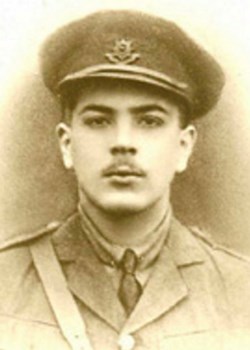
Roland Aubrey Leighton was born on 27 March 1895 in St.John's Wood, London. He was the oldest surviving child of literary parents, Robert Leighton ('man of letters') and Marie (née Connor), a novelist. As a result of the guilt following the death of her first child, Marie spoilt Roland and neglected his younger siblings-sister Clare and brother Evelyn.
Roland went to prepschool in St.John's Wood (London House) followed by a scholarship to Uppingham in 1909.
Other entrants in September were Edward Brittain and Brian Horrocks (who survived the war, rose to General, and was actively involved in the Second World War).
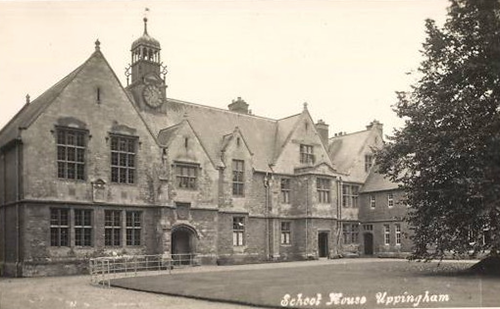
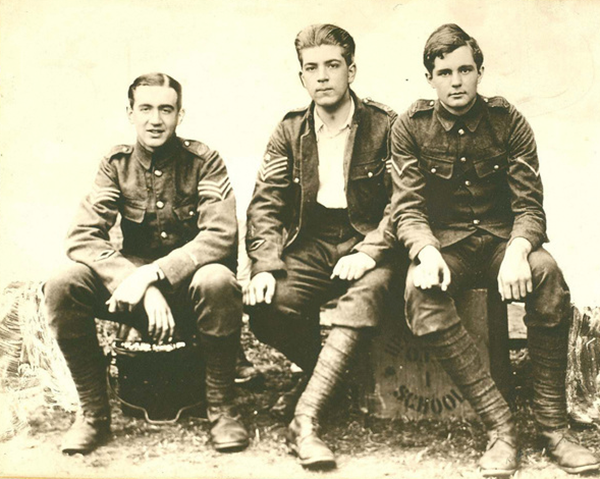
Roland had a distinguished career at Uppingham, winning numerous prizes, and becoming House Captain. He was seen by some to be aloof, and was known by his nicknames of 'Monsignor' or 'The Lord.' He formed close friendships with Edward Brittain and Victor Richardson; Roland's mother called the triumvirate 'The Three Musketeers'.
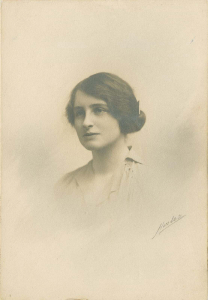
In July 1913, Roland met Edward Brittain's sister Vera, when she attended Speech day. He was invited to the Brittains' house, Melrose, Buxton, in April 1914, where he and Vera became friends. They were soon corresponding regularly, and Vera agreed to attend Speech Day in 1914 despite being in the throes of preparing for her Oxford entrance examinations. Roland collected so many prizes on speech Day that an old boy later recalled him taking them back to his dormitory in a wheelbarrow.
In 1914 Roland gained a scholarship and exhibition to Merton College, Oxford. Edward was to go up to New College Oxford and Victor to Cambridge
Shortly after Speech Day, the Three Musketeers were at OTC Camp, but were hurriedly sent home owing to the outbreak of the war with Germany.
Roland was also keen to enlist, but was having problems owing to poor eyesight. Edward Brittain succeeded in obtaining a commission in the Nottinghamshire and Derbyshire Regiment. Eventually, Roland was commissioned into the Norfolk Regiment, having persuaded a family doctor to issue a medical certificate, which made no mention of his shortsightedness.
In October 1914 Vera went up to Somerville College, Oxford. While she came to terms with her new surroundings and lifestyle, Roland continued to write to her regularly, describing his training. One of the NCOs who served with Roland was the writer R.H Mottram, who was to write the Spanish Farm trilogy.
Roland and Vera agreed to meet up during the Christmas holidays, and spent two days together (albeit chaperoned by her Aunt) in London. On New Years' Eve, Vera realised that she was in love with Roland.
In those heavily chaperoned days, it was difficult for young people to be alone together, but a clandestine meeting was arranged to take place on Vera's return journey to Somerville. They met at Leicester station and eventually Roland accompanied Vera to Oxford.
It was to prove a difficult term for Vera, trying to concentrate on her studies while thinking about Roland. She became ill with flu, and returned home early, only to have a letter forwarded from Oxford informing her that Roland had transferred to the 1/7 Worcestershire Regiment, and was expecting to go to France soon. It was arranged that Roland should come and stay the night. The next day, 19 March 1915 Roland left, and later sent Vera an amethyst brooch as a memento of the day.
Roland crossed to France on the night of 31 March, sailing from Folkestone to Boulogne, and then to rest camp. They then travelled by train and by foot to billets south of Bethune. Roland wrote his first letter to Vera on 3 April, and told her that they could hear the guns in the distance.
Roland's letters to Vera very quickly showed that there was nothing glorious about sitting in a trench. Vera begged Roland not to spare her any details in his letters, although they would have been censored, just as Roland had to censor his mens' letters. His early letters question whether he will be afraid when he finally came under shellfire.
The Worcester's held a part of the front line in Ploegsteert Wood (Plugstreet to the soldiers) for most of April. Roland's letters are also full of the incongruities of war; in one letter he is amazed at some primroses growing near his dugout. In the same letter, he reports that the Worcesters had had their first man killed. He also told Vera about finding the body of a British Soldier who must have lain where he was for some time. It was to form the basis for his poem, Villanelle
Vera decided to become a Voluntary Aid Detachment Nurse, initially during the summer vacation.
On 27 June, after completing Pass moderations exams, Vera began her new life as a VAD nurse at the Devonshire Hospital, Buxton. Although totally unused to the hard physical work, Vera was an enthusiastic addition to the nursing team. Most of the patients were not seriously ill, and her youthful looks and enthusiasm made her popular with the patients.
On 19 August, Vera received a postcard from Mrs Leighton informing her that Roland was due home on leave that day. Vera was able to obtain weekend leave from the hospital, and arranged to meet him at St Pancras Station the next day. Vera also agreed to visit the 1st London General hospital for an interview.
The sight of Roland made Vera alarmed when she first saw him. He looked older, thinner and shabby. Despite their intimate correspondence over the last months, they were shy and ill at ease with each other. They had to readjust to each other's physical presence. Following Vera's interview, and a shopping trip, they set off on the train to Buxton. During the journey, Roland proposed to Vera.
On 13 December, he wrote to Vera informing her that his leave was 24-31 December. She managed to obtain Christmas leave and spent the next few days excitedly preparing for his homecoming. Mr and Mrs Brittain had left Buxton and were temporarily living at the Grand Hotel, Brighton, and the Leightons were renting a cottage at Keymer in Sussex.
Vera came off night duty on Christmas morning, and travelled to Brighton to await Roland's return. When she had heard nothing, she decided that his crossing had been delayed or that communication had been difficult.
On Boxing Day, she was called to the hotel telephone:
"Believing that I was at last to hear the voice for which I had waited for twenty-four hours, I dashed joyously into the corridor. But the message was not from Roland, it was from Clare; it was not to say that he had arrived home that morning, but to tell me that he had died of wounds at a Casualty Clearing Station on 23 December".
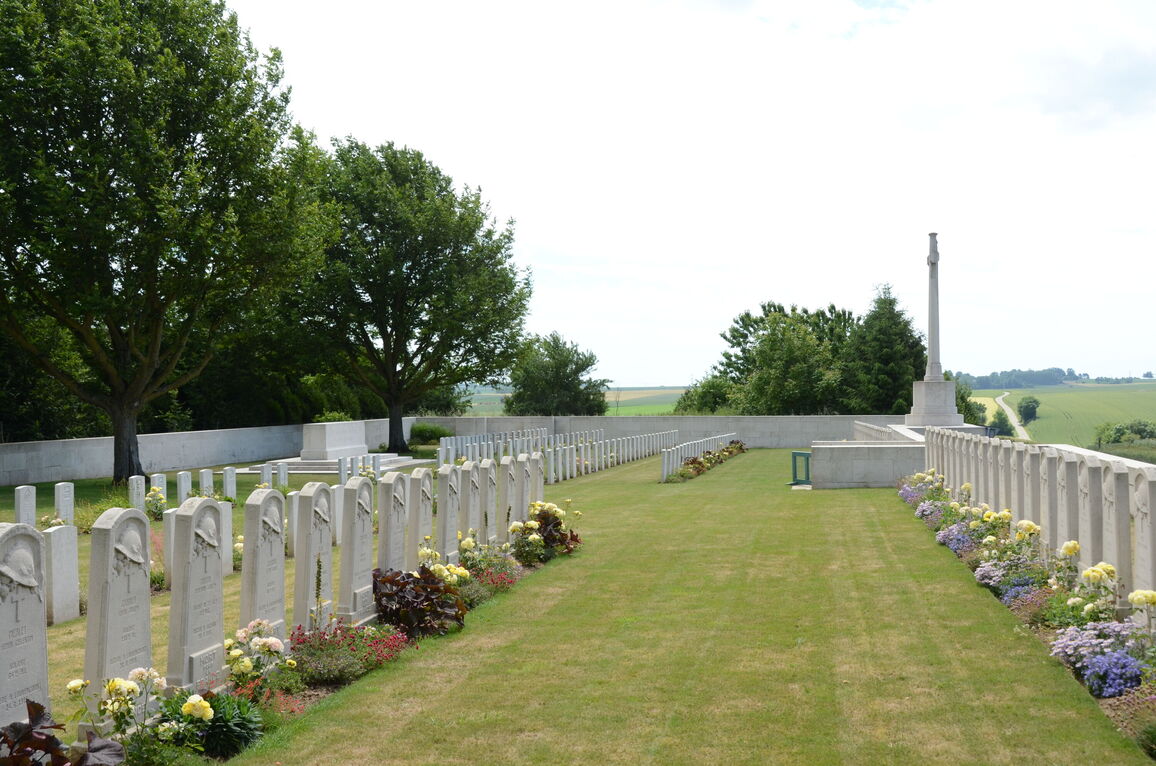
At midnight 22-23 December Roland's platoon was to repair the wire in front of the trench; before letting his men begin the work Roland went forward himself to examine the spot. Just as he reached the wire the Germans opened fire and he was shot in the stomach, the bullet coming out the back. He was taken to hospital at Louvencourt where he died the following evening. He is buried in Louvencourt Military Cemetery near Doullens.
His Colonel wrote of him:
“He had a wonderful brain, very quick to grasp anything, and it was that which first appealed to me in him. He was a splendid soldier and very popular with all I liked him so well that I made him my Acting Adjutant".
Roland's age is incorrectly given on his headstone and in the details being 19, he was in fact nearly 21. His mother suffered a breakdown following his death, and Vera was devastated, although she gradually recovered, and continued nursing throughout the war, serving in Malta and France. She was to visit his grave at least twice, in 1921, and again in 1933.
Lieut. Roland Aubrey Leighton, 1st/7th Bn. Worcestershire Regiment