
The Inaugural Meeting of The WFA: The 1980 Presidential Address delivered by the Honorary President John Terraine
Mr. Chairman, Mrs. Giles and fellow members of the Western Front Association: My first duty, and it is a very pleasant one, is to thank the Chairman for the address he has just given us and his updating of where we stand, who we are, and how we came to be here. I think you would all agree with me that it is perfectly clear that we would not be sitting in this room this afternoon for this purpose if it were not for the immense enthusiasm, energy and drive that John Giles has put into this whole thing, as he says, over a period of not less than ten years. So I think really it wouldn't be a bad idea to say thank you to John Giles again.
Also, I would add that it is magnificent news that we have 282 members, and despite your 75 agenda sheets John, I would be very surprised if there are less than a hundred here this afternoon on my rough count of heads.
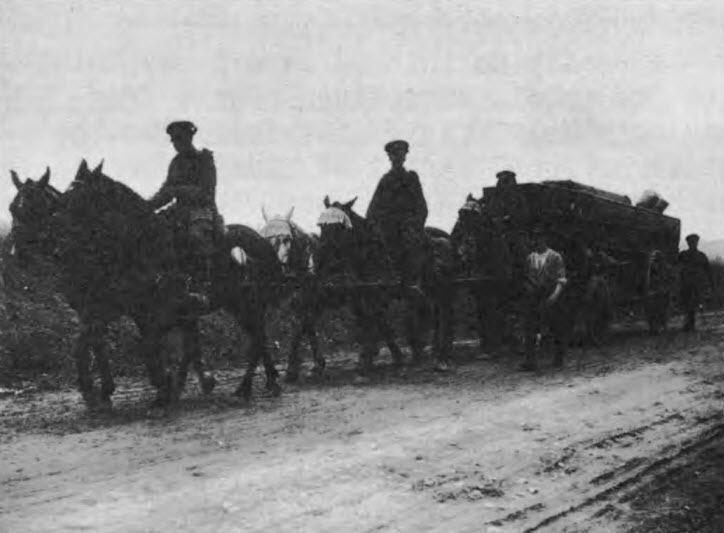
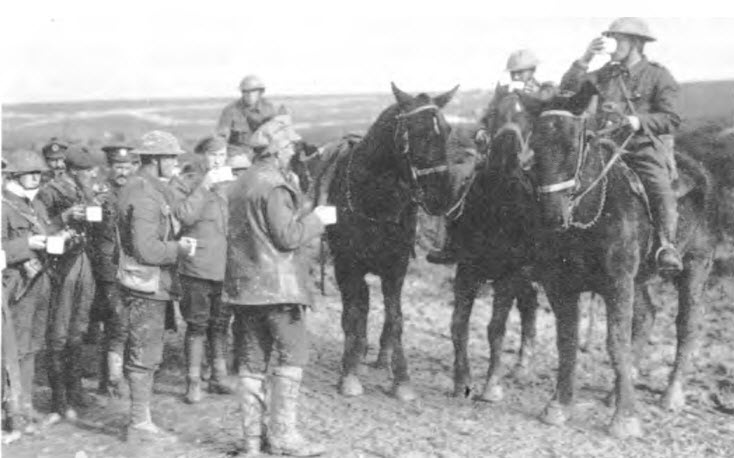
It is no mere figure of speech to say to you now that I feel very honoured and privileged to be here with you today. I am honoured to appear here in the capacity of President of the Western Front Association. I am much honoured to serve under our Patron, Sir John Glubb, whom I have the good fortune to know and who, in addition to being a man of great erudition and great charm, has also written one of the best books about the war on the Western Front that I have ever come across. Sir John Glubb's 'Into Battle' is full of those insights, those unexpected shafts of information about curious things which bring us a better understanding of the day-to-day texture of that war. In particular I think it is his recollection of the last great horse-drawn war that sticks in my mind, though not in the sense of dashing cavalry charges or spirited gallops into action by the Royal Horse Artillery and the sort of thing you get lots of pictures of. What he is interested in is the working horses, those great powerful, patient creatures of the Royal Engineer field companies (which was his own Corps) and the pontoon trains, and also, one might add, the Army Service Corps general service wagons and the Royal Garrison Artillery. As Sir John said "It warms one's heart to see the big horses working", and it warms mine to read his description of them doing it.
We intend to report to him that this inaugural meeting of the Association has been a remarkable success with a remarkable turnout, and give him our greetings in his 84th year.
Well, I said that I was honoured and privileged, and possibly some of you may have wondered why I used two words where one seem to do. But I felt I needed two words, because apart from the honour which I have mentioned, I also always feel acutely privileged by any connection with the Western Front of 1914-1918. Those of you who have read any of my own books on that war will know that I take a somewhat different view of the Western Front from that of many other writers. Certainly I do not share the sense of utter revulsion that possessed a very large number of people indeed during the 1930s, and contributed so handsomely to our impotence in 1939 and 1940 and our weakness for many years thereafter, and which I regret to say does continue in certain quarters to this day.
As I have said in my last book 'The Smoke and the Fire' I am absolutely sure that if Churchill was right, as I believe he was, in calling 1940 the finest hour of the British people, the great defensive and offensive victories of 1918 on the Western Front were the finest hours of the British Army.
But, as Lord Haig said in his final Despatch "If the whole operations of the present war are regarded in correct perspective, the victories of the summer and autumn will be seen as directly dependent upon the two years of stubborn fighting that preceded them". In other words, the experience of the British civilian army on the Western Front has to be seen as a totality. It is wrong to separate the victorious conclusion from the mighty effort that made it possible, and that is why I cannot view the British contribution on the Western Front, from Mons in 1914 to the return to Mons in 1918, with any other emotion than very great pride.
In a nutshell, what we have to remember and, I would urge, make other people remember, is that this was the only occasion in the whole of its history when the British Army engaged and defeated the main body of the main enemy in a continental war. Since that main enemy was Germany in her pride, and the main body in question was the magnificent German Army, I consider this a finest hour indeed, and no-one should ever forget it.
And that, may I suggest, is where we should come in - to remind people of the great endeavour of the Western Front, certainly in a spirit of very deep reverence, certainly also with deep compassion for the great protracted agony that occurred there, but always with admiration for the continuous endeavour of all arms and all ranks, and always with pride at what was achieved.
I really do think - dare I say this? - that we should discourage people from making purely tragic pilgrimages to the Western Front, except of course when they do so for personal reasons, to put flowers on a grave, or some similar private purpose.
May I submit to you that July 1st is not the most appropriate day on which to visit the Somme? July 14th strikes me as a better time, for that was the day on which the British Army showed that it was back in business, that it was going to carry on despite everything that had happened on July 1st, and in doing so it gave the battle the texture which caused General Ludendorff to say at the end of it "The German Army had been fought to a standstill and was utterly worn out". In fact the truth is that the German Army never recovered from the Somme, and that is not a fact you can easily take in if you go there on July 1st.
March and April can be pretty bleak on those windy uplands, as I know from personal experience, but if you go to the Somme in March and April, you can commemorate the British Army's defensive victories of 1918 which marked the end of the German ascendancy, no less, and make no mistake about it, they were victories. The Germans made some spectacular advances in March, less so in April. They had some very showy tactical gains to display, but they made no strategic gains whatever during those two months, and in fact March and April 1918 were a German disaster.
You might suggest to anyone who is round there in April that Villers Bretonneux could be a place to go to. It is of course very much a Tank Corps and an Australian shrine; not for nothing is the Australian National Memorial sited at Villers Bretonneux. But don't let's forget the 8th and 58th British divisions who were very much "among those present", and that the recapture of Villers Bretonneux on April 25th, the third anniversary of Anzac Day, gave a very strong hint of the kick that was left in the British Army in 1918.
The best day of all of course, by far the best for visiting the Somme, is August 8th, the "Black Day" of the German Army, the beginning of the end, the first of the Hundred Days of victory, mostly British victory, which brought the end of the war. And might I suggest we should encourage visits just a little further north in September, to Bellenglise, just north of St. Quentin, where the 46th (North Midland) Division, a Territorial Force formation, broke through the Hindenburg Line on September 29th - one of the very finest feats in the Army's whole history.
And September is not a bad time to look at Ypres and think of General Plumer's 1917 victories of the Menin Road Ridge and Polygon Wood. But the best date of all for Ypres must be October 4th, the day of the Battle of Broodseinde, which the Germans also called a "Black Day". I cannot help thinking of Ypres as really General Plumer's place. I think it is a great pity that Lord French took that title; Plumer I think was much more entitled to it. He was said to have known every stone in the Ypres Salient, and those who know anything about that careful, competent, professional, but always compassionate soldier, will know that ghastly though so much of it became, the Salient under him cannot have been all bad.
There is one other thing I would like to say about the Western Front, an attribute of it which I think this Association must respect if it wants to be taken seriously, and it is this; let us always remember that the Western Front was not a piece of British property. The length of the Western Front varied from time to time. When the Germans retreated to the Hindenburg Line in 1917 they shortened it perceptibly; when they advanced in 1918 they lengthened it again. When the Allies advanced it shortened once more to the extent that whole Allied armies disappeared from the Order of Battle, simply because there was no room for them on the contracting front. But if we say that it was about 450 miles long most of the time I think we shan’t be far wrong„ Of those 450 miles the British Army at no time held more than 125. I think we should always remember that what this means is that whereas there was no part of the Western Front on which the Germans did not fight, virtually from first to last, and no part of the Western Front where the French did not fight at some time or other, there were very large parts which never saw a British soldier. We, as an Association, should not - I think must not - neglect those parts.
Don't, I beg you, when you go over there, don’t neglect Verdun because it was not a British battle. Don’t forget the Argonne. Don’t just see the British cemeteries along the Aisne - there are others. That forlorn, overgrown, weedy, apparently forgotten Italian cemetery at Soupir on the Aisne always gives me a pang when I look at it. They were all men, they were all soldiers who fought in those places in their different uniforms, Enemies and Allies; Allies who spent a long time wondering if the British were ever going to arrive, and in some cases couldn’t believe it when they did.
But above all, wherever you go on the Western Front, never forget the men on the other side because it was they - that splendid German Army of 1914-1918 - that made the Western Front what it was; their skill, their resolution, their courage, their almost unbelievable endurance. And when we look at our British cemeteries, when we stand at Tyne Cot, or on the ridge at Thiepval, or anywhere, and wonder as we must, how all those men come to be lying there, don’t let us fall into the old, ignorant, arrogant trap of blaming ourselves, our generals, our unreadiness, our lack of imagination and all the other familiar alibis. Let us give credit where credit is due. The German Army fought superbly; that is what killed so many Russians on the Eastern Front, and so many Frenchmen, so many Belgians, so many Americans, and so many British soldiers on the Western Front - that and nothing else. And then we may remember again that our citizen army actually defeated that magnificent instrument of war, and our tears will surely be tears of pride.
References:
Glubb (Sir John) 'Into Battle - a soldier’s diary of the Great War'
Terraine (John) 'The Smoke and the Fire - Myths and Anti-Myths of War 1861—1945'
For more about John Terraine, see here.
Becoming a member of The Western Front Association (WFA) offers a wealth of resources and opportunities for those passionate about the history of the First World War. Here's just three of the benefits we offer:

This magazine provides updates on WW1 related news, WFA activities and events.

Access online tours of significant WWI sites, providing immense learning experience.

Listen to over 300 episodes of the "Mentioned in Dispatches" podcast.


