
Mustafa Kemal Pasha - The Scourge Of The Gallipoli Front
At the end of the 19th Century in the Ottoman Empire, Turkish boys were only given one name. On 21 March 1881 a son was born to Zubeyde the wife of a customs officer-cum-lumber merchant Ali Riza in the town of Selanik, Salonika (now Thessalonikani). He was given the name of Mustafa (often incorrectly written Mustapha). Whilst at military High School in 1893, he was given the nickname Kemal = Perfection (some translations quote it as The Perfectionist) by his mathematics teacher. Later in his life he was given the title of a military commander = Pasha.
Thus came on the scene of history Mustafa Kemal Pasha (hereafter MK), the most famous of Turkey's soldiers. It was he who was destined to do the most to wreck the ambitions of the British Government to clear the Dardanelles Straits so the Royal Navy would have unimpeded access to the Sea of Marmara, the Bosphorus, the Black Sea and Britain's ally in the Great War, Russia. And to make the Suez Canal safe from Turkish intervention.
Early days and the Balkan Front
MK's schoolboy nickname, Perfection, followed him during his studies at the Military College, at Monastir (now Bitola) and the Harbiye War Academy in Istanbul. But MK was already harbouring seditious thoughts about the decadent rulers of the Ottoman Empire.
In 1905, MK graduated from the Turkish War Academy with the rank of lieutenant. His first posting was to Damascus in Ottoman Syria as a captain in a cavalry regiment, where his seditious thought took roots in the formation of a secret society called Vatan (Fatherland). In 1907 MK was posted back to his home-town, and became an openly active member of the Committee for of Union and Progress/Union and Progress Party. From this base in 1908, a small group of army officers formed a cabal - the so-called Young Turks - led by the militarist Enver Pasha. The Young Turks imposed a constitutional regime on the ruler of the Ottoman Empire, Sultan Abdul Hamid II, (The Damned).
MK soon gained renown within the army as an excellent professional soldier, and he served with distinction in the Italo-Turkish War of 1911-12 in Ottoman Tripolitania (now Libya) and the First and Second Balkan Wars of 1912-13.
Unfortunately, the most military minded of the Young Turks, War Minister Enver Pasha, became concerned by MK's outspokenness and growing popularity, and dispatched him as Military Attaché in Sofia, Bulgaria; a post he held at the outbreak of the Great War in 1914.
In November 1914, at the same time Turkey had joined the Central Powers, KM was posted to the IIIrd Army Corps at Rodosto (now Tekirdag) on the Sea of Marmara. He was appointed as commander of the Turkish 19th Division that was part of the Turkish 5th Army of six divisions that was formed to defend the Gallipoli Peninsular. The command of the Turkish Fifth Army was given to a German General Otto Liman von Sanders, with whom MK quickly developed a good professional relationship.
In November 1914, the number of Turkish troops on the Gallipoli Peninsular was small and they were poorly equipped. Most of the guns in the coastal forts were old and some lacked ammunition. The situation changed when the Royal Navy, at the insistence of Winston Churchill, The First Lord of the Admiralty, tentatively shelled the outer forts at the entrance to the Dardanelles Straits in November 1914. Forewarned that a landing by the British Mediterranean Expeditionary might well follow, a rapid build up of troops, ammunition and portable artillery guns took place; these guns included 22 new Krupps howitzers which were prove to be decisive.
The follow-up shelling of the Dardanelles Straits defences in February and March 1915 by a joint Anglo-French task force of heavy warships, along with temporary landings by Royal Marines, only added to the urgency of the Turkish build up. The numbers of Turkish troops increased thereafter by 600% to 84,000 men by late April 1915. Amongst these were Colonel MK and his 19th Division who were stationed close to the Agean coast of the Peninsular along the rocky coast near the Gaba Tepe promontory.
The landings at Beach Z and after
At 0500 hours on 21 March 1915, a 8,000 strong, invasion force, mainly comprised of Australian and New Zealander Army Corps (ANZAC) troops, led by British General Sir William Birdwood, came off-centredly ashore at Z Beach close to the Gaba Tepe promontory. The invasion force was in for an unpleasant shock. En route to the landing, they had disparagingly decried the Turkish Army as 'only Asiatics' and condescending called them 'Johnny Turks'. Now they were to learn of the military skill, ruthlessness and determination of MK and his troops that he so successfully inspired.
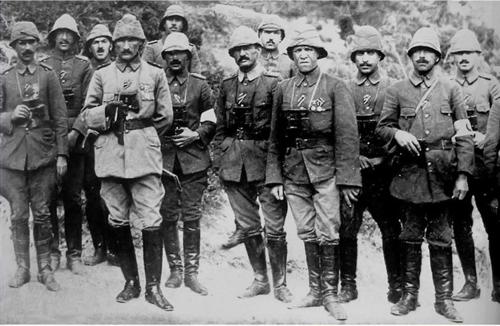
Learning of the invasion force, MK had grouped his forces. Without authorisation, by the afternoon of 25 April 1915, he had moved the entire 19th Division onto a dominant hill - Chunuk Bair on the Sari Bair Ridge - overlooking Beach Z. MK addressed his troops and told them to expect nothing else than to die for the Fatherland. So they should do their duty and drive the infidels back into the sea.
The rather disorganised ANZAC landing had taken place in, and around, a small cove - later to be known as Anzac Cove - against an outcrop of cliffs. It wasn't until the afternoon of 21 March that the ANZAC had sorted itself out and began to advance into the hills off Z Beach. There they were violently attacked by the Turkish 19th Division in suicidal waves. By nightfall, after desperate fighting, and huge casualties on both sides, the ANZAC had been forced back onto the small beachhead around Anzac Cove that was at a maximum only a kilometre deep and two kilometres wide. Denied the option of a re-evacuation that night by the British commander of the Mediterranean Expeditionary Force, General Sir Ian Hamilton, the ANZAC was corralled in the cove that was to be named after them. Large reinforcements were rushed to the Front by the exultant Turkish command with MK becoming the hero of the hour, even as his division's casualties mounted to unprecedented levels.
For the next three months, both sides lost a huge number of men in a never-ending campaign of attack and counter-attack, but neither side could overcome the other.
By the beginning of May 1915, MK had lost 14,000 men. But Enver Pasha and the junta in Istanbul wanted even more pressure applied to the beleaguered and suffering ANZAC locked in their disease wracked and squalid trenches and dug outs.
The next Turkish offensive on the ANZAC took place on the night of 18th May 1915. MK, who now had the equivalent of four Turkish Divisions under his command, and the almost unqualified support of General Liman von Sanders, launched a frontal attack against the now reinforced (by the Royal Naval Division) ANZAC enclave of 12,000 men.
Although the Turks had superiority in artillery, the attack failed. It was another huge casualty loss for the ruthless MK, with 10,000 Turks lost to less than 1,000 ANZAC.
Such were the losses in this battle that, exceptionally, MK agreed to a cease-fire for the collection of casualties and the removal of the dead from the shattered battlefield.
The initiative then moved to the beleaguered Anzac Cover's. Birdwood had received more reinforcements (an Indian Army brigade) by sea to raise his strength to 22,000 men.
After the slaughter of 18 May, MK discontinued his suicidal full frontal charges, but made further reinforcements of former weak sectors of the Anzac Cove enclave checkmating Birdwood's plans for a breakout. This meant that Birdwood had to wait until August 1915, and the general British advance north in the Suvla Bay Operation, before he could act. Once again this put the zone of action into the bailiwick of MK.
The Allied plan of the offensive was to put ashore a force of 20,000 at Suvla Bay that would link up with an outbreak by Birdwood's men from Anzac Cove towards the Sari Bari Ridge. There the combined Allied force of 60,000 would drive across the Peninsular to the Dardanelles Straits, dividing it in two and isolating the Turkish forces in the southern part between the two Allied concentrations of troops in the North and South.
Foreseeing the eventuality of a new general Allied offensive, Liman von Sanders and MK had distributed their troops across the Peninsular, leaving only a small force of 1,200 covering Suvla Bay.
On the night of 6 August 1915, the Allied troops led by General Frederick William Stopford landed at Suvla virtually unopposed, except for heavy sniping. Simultaneously, Birdwood's troops at Anzac Cove broke out towards Sair Bari Ridge. Since MK's troops at Suvla Bay could only put up light resistance, the invaders were able to advance into the hills behind Suvla Bay by the evening of the next day with less than 2,000 casualties. Birdwood's force was repulsed by a typical Turkish suicidal charge personally led by MK at Chunuk Bair on Sari Bari Ridge. However, a secondary Allied force managed to hold the nearby commanding height at Lone Pine.
The failure of the Turkish commander at Bulair, further north, to expedite reinforcements cost him his job and Liman von Sanders appointed MK to command both of the sectors adjacent to Sari Bari.
On 10 August 1915, MK despatched his now reinforced troops to recapture Sari Bari and the surrounding heights. Within a few days, the Allied advance had been stopped and new pressure put on the now almost united Suvla Bay/Anzac Cove enclave.
The Birdwood and Suvla Bay initiative had failed with 12,000 Allied casualties and 20,000 Turkish.
The final battle of MK on the Gallipoli Peninsular was another Allies attempt at a breakthrough to the Anzac Cove via the Scimitar and W Hills on the Sari Bari Ridge. Launched by General Hamilton's 29th British Division on 21 August 1915, with yet another side-show by Birdwood's men on Hill 60 to the southwest, once again the British were unable to hold a captured objective - Scimitar Hill - or reach the final objective of W Hills. Casualties in the action were again high on both sides; 29th Division and Birdwood's force together losing 5,000 more men. With more than 40,000 casualties from wounds and disease in the month of August alone, Hamilton was running out of human resources. MK, of course, still had on call ample reserves, should he have needed them.
Fighting in the battle zones of the Peninsular rumbled on the classic trench warfare style of the Great War.
The Allies withdraw
With demands for the fighting on the Salonika Front getting greater priority than the seemingly fruitless campaign in Gallipoli, moves began in London to extricate the Allies from Gallipoli.
On 11 October Hamilton was informed the an evacuation would take place, and upon his deferring to take action, he was replaced by General Charles Carmichael Monro who recommended the evacuation of the Suvla Bay and Anzac Cove beach heads.
On 7 December 1915, the British Government, with the support of the Secretary of State for War, Field Marshal Herbert Horatio Kitchener, decided on a total withdrawal from the Peninsular of Gallipoli. In a skilfully executed series of evacuations that began on 10 December 1915, all Allied troops had been safely evacuated by 9 January 1916, without the loss of a single man. All were taken off from the beaches on which they had landed 9 months earlier.
Whilst it was assumed that MK and his 100,000 troops had no inkling that the Allies were evacuating over a period of a couple of weeks, it may well be that both Liman von Sanders and MK has a good idea what was going on. They only wanted to hasten the Allies departure without more bloodshed. Even then the final casualty list was terrible.
- Turkey: Number of men who participated = 450,000. Casualties = 218,000 (48%). Killed = 87,000 (19%).
- Allies: Number of men who participated = 480,000. Casualties = 182,000 (40%). Killed = 44,000 (9%).
Despite these losses, and there is no doubt MK was, at least in the early days, heedless of casualties, and absolutely ruthless in his demands, MK was hailed by Turks as the National Hero of Gallipoli, and remains so to this day. He was promoted to General in appreciation of his heroic efforts.
After Gallipoli
His career after Gallipoli was rather less illustrious, but by no means unappreciated since the odds against Turkey were increasing all the time. His first posting was in 1916 to Anatolia, on the Caucasus Front, as a Corps Commander.
With the collapse of the Russian Army in the Caucasus, MK was transferred to Palestine where he challenged the dictatorial roles of Generals von Falkenhayn and Liman von Sanders over the Turkish Army stationed there.
Undefeated in the field of battle, and after a period of enforced sick-leave in December 1917, MK was recalled to active duty in September 1918. He finished the war at Alleppo, in Ottoman Syria, as commander of the Turkish Seventh Army and, later, the commander of all the Turkish Armies in the north.
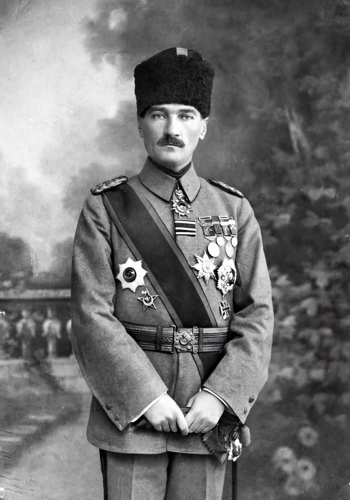
After the war, MK returned to Anatolia as Inspector General of the Turkish Army, which positioned him very well to champion his cause for Turkish independence. In 1921 he was elected as the President of the alternative (to the Sultan) ruling body, the Great National Assembly at Ankara.
In 1922, MK was confirmed as Commander-in-Chief of the Turkish Army with the rank of Marshal. Soon after he defeated the Greeks before they could invest Ankara.
The proclamation sponsored by KM in 1923 of a republic led, in 1924, to the abolishment of the Ottoman Caliphate and KM's appointment as the president of the Republic of Turkey. (A post he held until his death in 1938 of cirrhosis of the liver). This appointment ultimately led to his adoption in 1934 of the title Ataturk (Father of the Turks) to add to his other impressive title, Gazi (Warrior Hero) granted by the National Assembly in 1921,
Postscriptum
Although the life of MK was dominated by strongly held controversial political and sociological views, and a ruthless view of the conduct of war, his reputation as one of the most accomplished military commanders of the Great War is universally accepted.
His role in the creation of modern Turkey is, and is likely to remain, unchallenged.
Becoming a member of The Western Front Association (WFA) offers a wealth of resources and opportunities for those passionate about the history of the First World War. Here's just three of the benefits we offer:

With around 50 branches, there may be one near you. The branch meetings are open to all.

Utilise this tool to overlay historical trench maps with modern maps, enhancing battlefield research and exploration.

Receive four issues annually of this prestigious journal, featuring deeply researched articles, book reviews and historical analysis.


