
Ross Bastiaan's Bronze Memorial Plaques on the Western Front
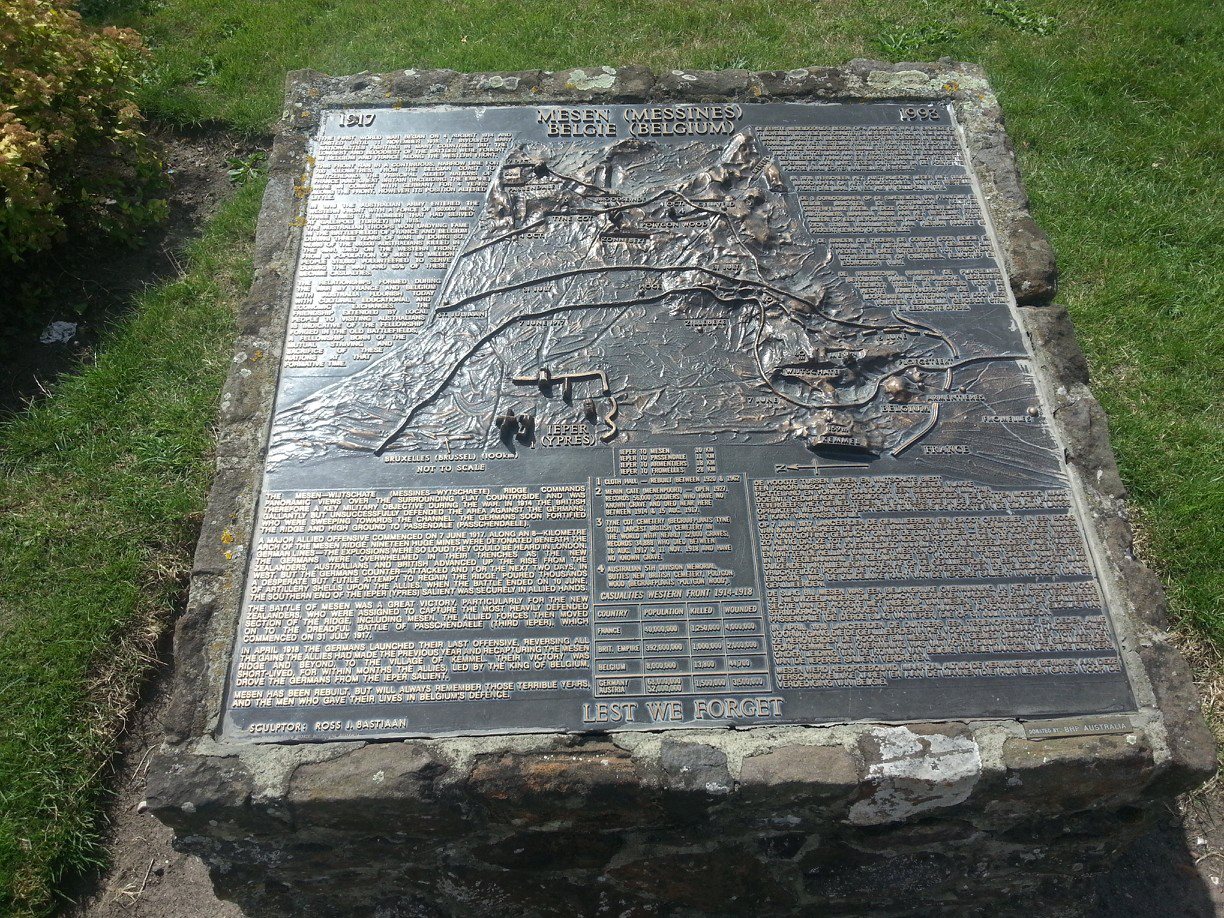
Few visitors to the Western Front in recent years will not have seen the very distinctive bronze bas relief memorial plaques commemorating actions of the Australians during the Great War. These memorial plaques are all the work of Dr Ross J. Bastiaan who is a specialist periodontist and who, for the last twenty years, has been in full-time practice in Melbourne. Since 1989, beyond the world of dentistry, he has been involved in the making of these bronze memorial plaques commemorating Australia's involvement on the two World Wars and are located on every major battlefield in which the Australians fought. Dr Bastiaan has used his dental skills, materials and equipment to sculpt the memorial plaques.
From the outset, the work performed by Dr Bastiaan has been on a purely voluntary basis with funding coming from the large multi-national companies and Australian organizations and individuals who support the concept of national pride through recognition of past achievements. The aim of the plaques is, primarily, to focus Australians' attention on the sacrifices made by their predecessors in that part of the world and, secondly, to inform a local population of Australia's role in their history.
Clearly, the bronze plaques (which are multi-lingual) have involved a great deal of personal effort and time by Dr Bastian and it is to his credit that one man's efforts have ensured that a nation's achievements are not forgotten. Indeed, his bronze plaques will ensure that a lasting recognition of Australia's past efforts and will strengthen the Australians' feelings of pride in being an Australian - particularly when travelling abroad.
Examples of Dr Bastiaan's work on the Western Front are listed below:
France
- Villers-Bretonneux - Mairie - to left of the main entrance steps.
- Villers-Bretonneux - Australian War Memorial - to the left of the memorial adjacent to the hedge and the out-building.
- Pozieres - Windmill site - behind the memorial tablet and before the mound.
- Pozieres - Gibraltar site - Australian 1st Divisional Memorial - to left of the main entrance on Australian soil.
- Mont St Quentin - Australian 2nd Division Memorial - to west side and behind the 'Digger' memorial.
- Peronne - Historial de la Grand Guerre -to right of the drawbridge into the Historial.
- Bullecourt - Australian Memorial - to the left of entrance on road side.
- Fromelles - VC Corner Cemetery - 400 metres east of cemetery between two German pillboxes and midfield.
- Hamel - Mairie.
- Mouquet Farm, Pozieres- Australian 1st Division Memorial.
Belgium
- Ypres - Menin Gate - adjacent to the Australian Roll of Honour on the Ramparts.
- Passchendaele - in centre of town opposite the church.
Messines - in town-centre square.
In addition to those listed above (which commemorate the actions of Australian units), there is also a plaque at Vermandovillers, France commemorating the actions on 23rd August 1918 of Lt L. McCarthy of the Australian 16th Battalion for taking 50 prisoners and capturing some 700 metres of trench for which he was awarded the Victoria Cross. This plaque is on the wall of the Mairie at Vermandovillers.
It is understood that, in addition to the above plaques, there are at least 20 plaques commemorating the Australians' actions at Gallipoli and that the total of Dr Bastiaan's plaques has now reached 100. In London, duplicates of his plaques are located in the Palace of Westminster (Gallipoli plaque) and in the Imperial War Museum (River Kwai plaque).
The next time you are visiting the battlefields, do look out for Dr Bastiaan's bronze memorial plaques. They are truly masterly works of one man's dedication to his nation's achievements.
Becoming a member of The Western Front Association (WFA) offers a wealth of resources and opportunities for those passionate about the history of the First World War. Here's just three of the benefits we offer:

Identify key words or phrases within back issues of our magazines, including Stand To!, Bulletin, Gun Fire, Fire Step and lots of others.

The WFA's YouTube channel features hundreds of videos of lectures given by experts on particular aspects of WW1.

Read post-WW1 era magazines, such as 'Twenty Years After', 'WW1 A Pictured History' and 'I Was There!' plus others.
Other Articles


