
The Army Service Corps on the Western Front
With their usual wry deprecating humour the soldiers of the British Army labelled the Army Service Corps – later the Royal Army Service Corps – Ally Sloper's Cavalry. Ally Sloper was a British weekly comic strip about a rent-dodging con man and drunkard that first appeared in the late 1880's and ran with huge popular success until the early 1920's.[1] The cavalry jibe probably referred to the huge numbers of the comparatively unglamorous draught horses and mules that the ASC deployed on the Western Front.
Background
The origins of an integrated Army Service Corps with officers and men serving in the same corps go back to a new charter dated 11th December 1888 when a consolidation took place of various elements involved with the transport and supply of military material and munitions on and off the battlefield. However, as far back as March 7th 1794 an uniformed military transportation unit was created known as the Corps of Waggoners or, incorrectly, as the Royal Waggoners. (The Regimental March, from 1875 until 1945, was 'Wait for the Waggon').
On 27th November 1918 (i.e. after the Armistice on 11th November 1918) the Corps received the Royal prefix by the grant of a Royal Warrant in recognition of its sterling service in military logistics during the Great War, and on the Western Front in particular.
Organisation
In 1914, at the outbreak of the Great War, the ASC was under two Directorates: Transport and Movements; Supplies and Quartering. In September 1914 these two directorates were reorganised and a Director of Supplies and Transport (Brigadier S. S. Long) was appointed. The ASC was already a complex amalgam of units with different responsibilities, and as the war progressed these units became much larger in size and of increasing diversity in function.
The basic organisation in 1914 was of ASC Companies that individually specialised in duties including horse drawn transport, mechanised transport (including buses and ambulances), stores/warehousing, quarters for men and horses, remounts (replacement horses), railways, catering etc. As the war progressed additional responsibilities were undertaken including the management of civilian Labour Corps formed from various nationalities.
Examples of ASC Companies
Horse drawn transport:
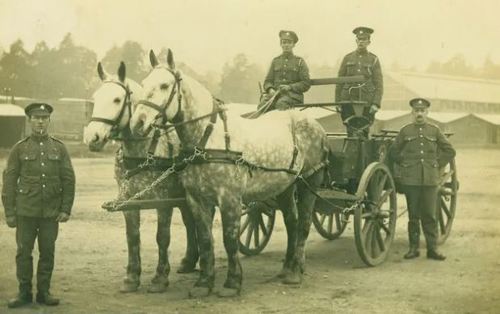
Like all of the belligerent armies on the Western Front, the British Expeditionary Force (BEF) in France and Belgium depended extensively on the horse for the transport of men and materials, along with large numbers of mules (female horse/male donkey) as purely draught and pack animals. Mules - when they could be persuaded to co-operate - were by far the more resilient and hardy of the two species.
In particular, the draught horses and mules were employed to move the Field Artillery pieces around the battlefield. And, in concert with the ubiquitous, two-horse, four wheeled, 15-cwt. (0.75-ton), Mark X, General Service (GS) wagons, transported much of the essential material and munitions of war; particularly in the early years.
Each Army Division had a HQ Coy and four Horse Transport Coys ASC – The Divisional Train. Other ASC personnel were deployed at Corps and GHQ levels.
Remounts:
Such was the demand of the BEF for new and replacement mounts, draught horses and mules – the attrition figures on the Western Front were enormous (see below) – that an entire organisation (the ASC Remounts Service) was created. It sourced these animals from the UK and far flung locations such as North and South America, India and South Africa, as well the more traditional British Army horse markets such as Ireland.
A total of around 800,000 horses and mules served the British and Empire troops on the Western Front of which over half died either died from wounds or diseases acquired on active service.
Mechanical Transport:
The British placed more reliance on mechanised transport (MT) on the Western Front than did the other belligerent's armies, but it never even came close to replacing the horse and the mule by machines. However, routinely, from 1915 onwards, large artillery pieces were moved by purpose-built ASC caterpillar tracked, or wheeled, tractors as these heavy guns were beyond the hauling capacity of even teams of six or eight draught horses or mules. Such heavy equipment was kept at ASC Siege Parks from which also operated the Ammunitions Columns that kept the gun batteries supplied.
As the pool of motor and traction vehicles increased on the Western Front the complexity of the ASC involvement expanded and reorganisation and rationalisation grew apace. The mechanised vehicle quickly gained an important role in all forms of transport. It rose from a total of just over 500 assorted mechanical vehicles in the ASC world-wide at the outbreak of the Great War in 1914, to around 105,000 at the Armistice in November 1918 and ranged from motor cycles to huge tractors.
A significant means of mechanised human transport on the Western Front was the British public transport omnibus. These were donated by, or requisitioned from London omnibus companies and other municipal bus services across Great Britain; some civic donors being generous to a fault in that, as a consequence, the general public faced a shortage of public transport throughout the Great War. By late 1914, the sight of a converted London bus in use as a military transport was a common occurrence in France and Flanders. In total around 650 of these former civilian buses (operated by nearly 2,000 men) were deployed on the Western Front as general troop transports, ambulances and other military transportation purposes; twelve were even converted into mobile pigeon lofts! Uniquely, the Auxiliary Omnibus Park, which was the ASC operational unit, received a Mentioned in Despatches award.
Another significant advance was the introduction of ASC water and MT fuel tankers. The former were essential to provide adequate, safe, water supplies to the men in the trenches and the latter to meet the ever increasing demand for fuel for the dispersed fleets of Mechanical Transport.
Tanks:
From all but the earliest days of the British tank development project ( i.e. May 1916 onwards) the ASC was responsible for recruiting volunteer drivers and mechanics and training them. On the 23rd February 1917 all these drivers and support staff were formally transferred to the Heavy Branch, Machine Guns Corps (later, July 1917, the Tank Corps). But ASC workshop staff continued to have responsibilities for driver and basic repairs training, and for the other MT transport of the Tank Battalions.
Railways and waterways:
To move the huge quantities of materials that were required to fight the War, the ASC relied extensively on the existing national railways and waterways in the UK, France and Belgium. In addition the Royal Engineers built an extensive network of small gauge railways to connect the railheads in France and Belgium with the Front Line and so greatly facilitated the working of the ASC supply chain and the movement of heavy artillery and tanks. Some of the rolling stock, and even rail track, was requisitioned from the existing British mainland rail network and as a result there was a chronic shortage of rail transport in parts of the Mainland; particularly so during the latter part of the War.
Labour Corps:
From the moment of the arrival of the BEF in France in August 1914, problems arose over the landing of stores and equipment at the Channel Ports: the number of indigenous port workers was totally inadequate for the task. This was a foretaste of the serious labour shortages that would increasingly plague the British military authorities throughout the duration of the Great War. Accordingly, the ASC created cadres of British and other nationalities as Labour Companies to perform these mundane but essential tasks. Twenty-nine of these ASC Labour Companies were transferred in August 1917 to the newly formed Army Labour Corps.
Similarly, ASC labour companies had been formed for the railways and, from 1917 onwards, Chinese coolies, and other foreign volunteers, were recruited from their homelands in large numbers into a specially created independent Labour Corps. This force of foreign volunteers eventually numbered nearly 200,000, out of a combined civilian labour force on the Western Front of 400,000. Even so, throughout the War the British Other Ranks, (including the troops of the ASC), were routinely expected to perform almost daily labouring duties in addition to their service as soldiers on active service. After the War there were claims that these additional labouring duties were a serious drain on the health and morale of the fighting soldier on the Western Front. Accordingly, without the labour services provided by these civilians and foreign volunteers, the workload of the British troops on the Western Front could have well become unsustainable.
Depots, stores, warehousing, and distribution systems:
By late 1914, the warfare on the Western Front had developed into a static trench-based Front Line, 475 miles (760km) in length. This tended, to some extent, to concentrate and stabilise the supply chain. But the complexities of supply multiplied as the army's Quarter Masters endeavoured to keep the troops and their transport animals fed, and to maintain an ever-increasing flow of the enormous amounts of materials of all kinds that were required to prosecute the war. All of which had to be delivered to the front Line troops in appropriate quantities and in good time to ensure that essential military operational criteria were met. At its maximum strength in 1918 the BEF had over 3,000,000 men and 500,000 animals to be so sustained.
To feed this supply line the ASC established large Central Base Depots on the Mainland from which the materials for war were ferried across the English Channel to the General Base Depots – Calais and Boulogne for Northern Sector troops and Dieppe, Le Havre and Rouen for the Southern. From here the ship-loads were sent on by rail to Regulating Stations to be broken down into manageable quantities and forwarded via railheads to the Refilling Points.
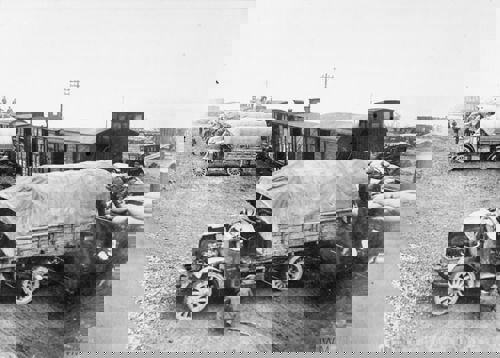
Horse or Mechanised Transport of the Divisional Train then carried the supplies to dumps created for the Division and its Brigades. The final distribution-point was the Field Supply Depots where the Quarter Masters of the respective operational units could collect their rations and supplies for direct distribution to the Front Line. In the Front Line proper, the manhandling and distribution of all this material, including munitions, was usually carried out by the Front Line soldiers themselves.
Assisting the Army Medical Services:
The ASC paid a significant role in the deployment of the Royal Army Medical Corps Field Ambulances (FA's) on the Western Front. Each of the 150 FA's that saw service on the Western Front had a complement of around 40 ASC NCO's and men. They took care of the horses and wagons and, where increasingly present, the motorized ambulances and transport. Also, they drove the ambulances that were required for the movement of the wounded on and behind the battlefield, and carried out the often frequent relocations of the usually tented FA units.
The ASC also provided support to the British Red Cross Ambulances on the Western Front.[2]
Salvage:
In an ever escalating war of technology and material, the ASC, under the BEF Controller of Salvage, played a vital role in the salvaging of vehicles of all kinds, often under enemy fire, plus the recovery of the detritus of war and its recycling back to the war industries in the Homeland.
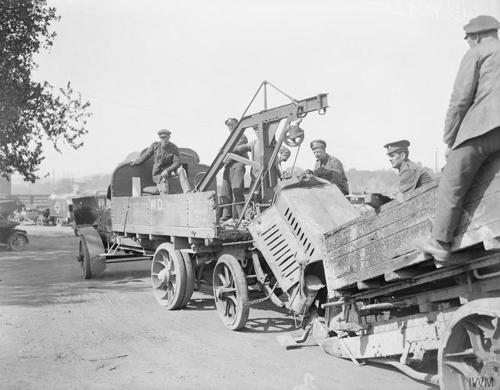
The salvage of expended ammunition cases alone provided huge amounts of highly valuable and scarce metals for the munitions industry and that of all kinds refillable containers was a vital reusable resource.
Conclusions
The ASC was one of the Cinderella units of the Western Front and it received little in the way of commendation, or entries, in the official reports of the Great War. Although the 200,000+ officers and men of the ASC who served on the Western Front could not normally be considered to be combat soldiers, many were exposed daily to the capricious dangers of the battlefield as they moved around it performing their varied duties of supplying and transporting the fighting man. Certainly the German Artillery deliberately concentrated on the ASC supply routes, depots and resting places of the ASC's animals of burden.
On occasion, when the military situation demanded, (e.g. The German Spring Offensive, March 1918) the ASC troops were ordered to take up their rifles and were drafted into the Front-line defences. Also, whole groups of ASC men were drafted into Front-line battalions and other active service units as replacements for casualties whilst their place was taken by troops who were not considered fit for Front-line duty i.e. 'B' and 'C' medical grades. Additionally, colonial and Empire troops were drafted into ASC Transport and Supply Companies to release additional 'A' medical graded ASC men. Something like a total 100,000 fit ASC troops were so released and retrained for posting to fighting units on the Western Front, including over 100 officers to the Royal Flying Corps.
The varied dangers faced by the ASC troops are attested to by their overall casualty rates that totalled 16,000 (4.9%), with 2,600 (0.8%) killed in action, or died of wounds. Another 5,900 died of disease (1.8%). It is unusual to see a 1914-18 British War Memorial of any size without finding the name of a member of the ASC listed upon it.
[1] 'Alley Sloper' was contemporary slang for a rent dodger i.e. someone who sloped off down the alley to avoid the rent man
[2] One of the two VC's awarded to ASC men in the Great War was awarded in 1918 to an ambulance driver (Pte. R.G. Masters) attached to 141st F.A. in the Bethune Sector, France.
Further information on the ASC
To watch Rob Thompson give a presentation about the ASC, go here
Becoming a member of The Western Front Association (WFA) offers a wealth of resources and opportunities for those passionate about the history of the First World War. Here's just three of the benefits we offer:

With around 50 branches, there may be one near you. The branch meetings are open to all.

Utilise this tool to overlay historical trench maps with modern maps, enhancing battlefield research and exploration.

Receive four issues annually of this prestigious journal, featuring deeply researched articles, book reviews and historical analysis.


