
The British Military Policeman on the Western Front
There has been a Provost Marshal (Military Policeman) in the British Army since the reign of King Henry III in the mid-13th Century. He was first known as the Sergeant of the Peace.
The original British Military Police force was created out of a demand from Sir Arthur Wellesley (later the Duke of Wellington) for a special military cadre to control the wanton plunder and drunkenness of his soldiers in the Iberian Peninsular in the early years of the 19th Century. Matters came to a head in 1812, when at the Battle of Ciudad Rodrigo his army rampaged out of control for three days and three nights.
In 1813, the British military establishment agreed to the now Viscount Wellington's request and created the Cavalry Staff Corps with a Provost Marshal as its commander supported by 24 Assistant Provost Marshals.
In the interim between this time and the outbreak of the Great War, the British Mounted Police Force (MPF) and the Military Foot Police, (MFP) were created to meet the changing needs of the service. These were two self-contained cadres but each was an integral part of the Cavalry Staff Corps under the command of the Provost Marshal. Both these cadres were recruited from serving soldiers with at least four years of service and a good conduct badge. There were no MP Private ranks: all were Lance Corporal or above to give them authority over the soldiery.
The British military police force in August 1914
The strength of the Cavalry Staff Corps at the outbreak of the Great War was:
- Total strength = 511.
- Regulars: Officers = 3
- Other ranks = 508.
Another 253 Other ranks were quickly recalled to The Colours for The Duration raising the overall total strength of the Cavalry Staff Corps to 764.
With Field Marshal Kitchener's announcement of the creation of a Volunteer (New) Army in August 1914, it was quickly realised by the British commanders of the British Expeditionary Force (BEF) that a compensatory increase in the force of military policemen would be required. And, as the war on the Western Front slid into a state of virtually static trench-warfare, the need for the policing of movement of men and material in the congested environment of the Western Front battlefield became increasingly imperative.
Moreover, it also became apparent that the involvement of the British Army in other theatres of war meant a large number of military police would be required in these locations too.
Accordingly, the formerly high standard of recruitment and probation were eased somewhat, and military police recruits were sought from time-served soldiers, and serving and former civil police. Also, large numbers of the infantry and cavalry were redeployed to military police duties.
The deployment of the Military Police on the Western Front
Initially, each army Division was assigned the following military police:
- Assistant Provost Marshal. (A commissioned officer, usually with the rank of Captain).
- 25 NCOs of the Military Mounted Police.
Military Police units responsible for the Lines of Communications had similar numbers of staff, but were often under-strength to undertake the whole list of tasks they were asked to perform.
Later, on in the war, as the numbers of troops in the field rose dramatically, the strength of the Divisional and Line of Communications forces rose correspondingly with the active service units themselves providing additional men (see below).
At the Corps level, headquarters had a detachment of Military Foot Police the numbers of which depended on the tasks to be performed.
In all 25,000 MP's served in the Great War, the majority on the Western Front.
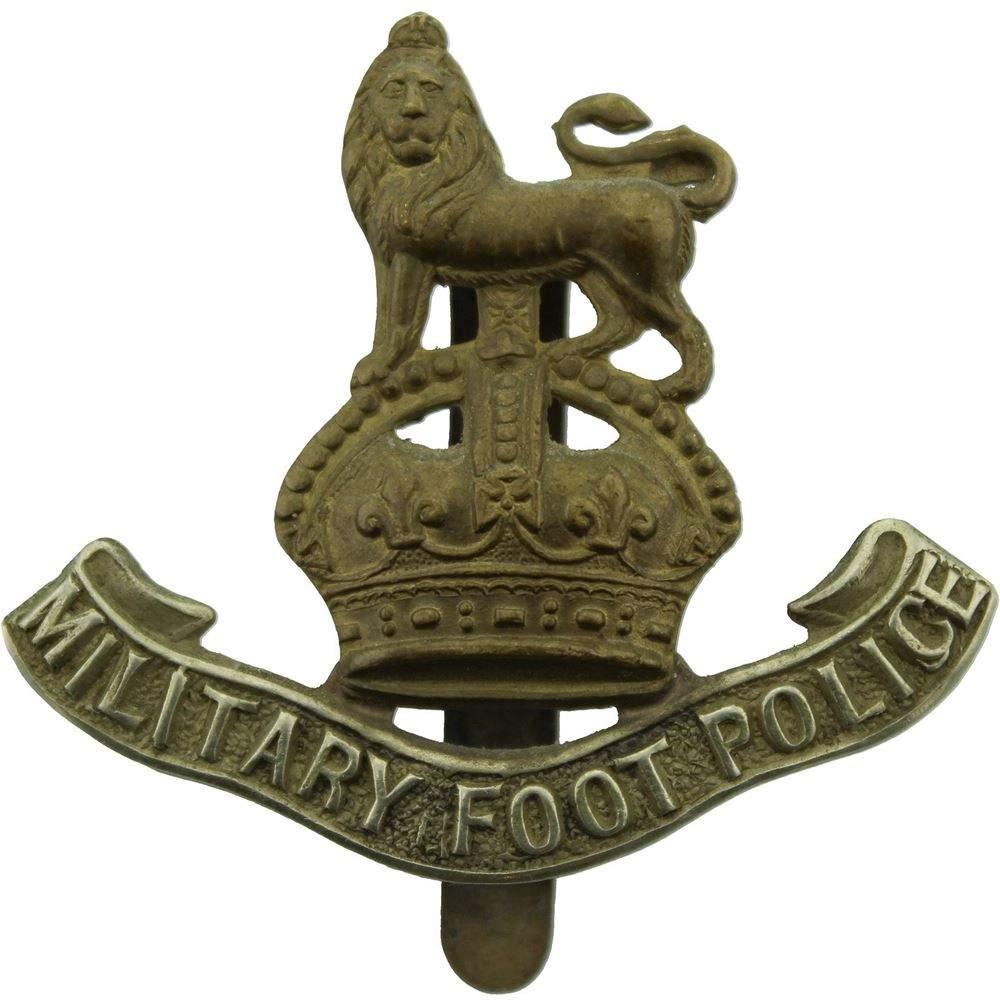
The role of the Military Police (MPs) on the Western Front
In the field, the Provost Marshal and the APMs determined what the priority tasks were and deployed their men accordingly. However, there was a general understanding of what these tasks were:
Stragglers' Posts:
Essentially it was the task of the MPs to establish fixed points from which they organised the flow of men who had become detached from their units and to reunite them. The MPs also had to ensure that regimental runners and couriers were in the correct operational area and to direct them as necessary.
Traffic Control:
The limited roads that fed most battle zones required strict traffic control if chaos was to be avoided and safe passage of men and material established. The so-called 'Tender points' such as cross-roads and bridges were frequently targeted by enemy shelling and, later, bombing from aircraft, so the task of the MPs that manned them was often difficult and dangerous.
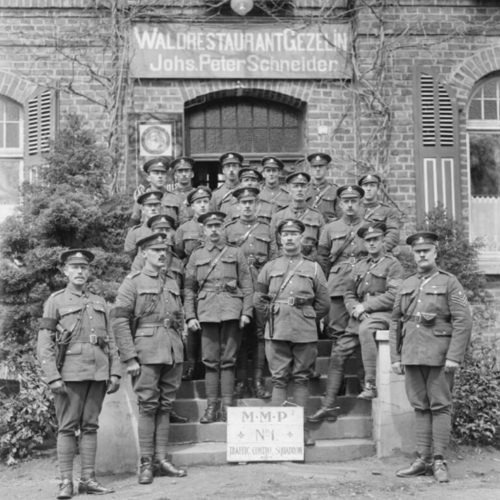
Control of Strategically Important Areas:
Locations such as ports, railways and rear troops concentration areas had to be patrolled and protected from unauthorised persons.
Crime control:
Soldiers have always been prone to commit crimes of all sorts given their ready access to arms and the likelihood of the breakdown of Civil Law and Order in the battle zone. From 1915 onwards, considerable numbers of convicts were inducted in the Army creating potential foci of troublemakers. Frequently, in the absence of the established forces of Law and Order, the MPs had to protect the civilian population and control their movements.
Control of the Walking Wounded:
Every battle zone produced a stream of lightly injured soldiers known as the Walking Wounded. After appropriate treatment, these soldiers had to be collected by the MPs from the various Aid Posts and Dressing Stations and escorted back to their parent units. As the numbers of Walking Wounded frequently exceeded the capacity of the MPs to handle them efficaciously, field battalions and other units in the area created their own 'trench' or 'battle' police under the overall supervision of the divisional APM. These auxiliary 'police' also took some responsibility for traffic duties when the need arose.
Prisoners of War:
the military police ensured their collection and transfer to areas in the rear where POW cages and camps were established and maintained by the MPs.
The MPs Uniform
The MP in the Great War wore the standard khaki battle dress. The peaked cap was topped with a crimson-red cloth cover (hence the nicknames 'Red-Cap' or 'Cherry Knob') and a black cloth brassard bearing the letters 'MP' in red was worn on the right arm. Later, at the Front, a steel helmet was introduced with the letters 'MP' painted on the front.
The Corps demanded an exceptionally high standard of turnout from its MPs.
A holstered pistol was the normal personal weapon, although other small arms would be carried when required.
Special duties
Beyond the routine anti-crime duties mentioned above, the APM and his staff faced particular problems with desertion and wilful disobedience, including violence against officers and NCOs. All armies have the problem of what to do with reluctant soldiers, but, given the very high casualty rates on the Western Front, avoidance of duty quickly became a serious problem and was rigorously dealt with to prevent its spread to epidemic proportions.
Although self-inflicted wounds did occur in the British Army, they were far less prevalent than anecdote would suggest and usually easy to identify.
Suicide, although not common, did occur and in many regiments it was covered up as an accident or recorded as killed in action, which in a way it was.
By and large the problem of ill discipline was kept in reasonable bounds on the Western Front with a few minor exceptions - mostly labelled as 'loyal ill discipline' and mainly centred on Empire and Colonial troops. However, there was no mutiny in the British trenches, and wide-scale mutiny was avoided in the British Army in the Great War. (In a single incident at the Etaples Base in Northern France in September 1917, the shooting dead of a long-serving British soldier by a MP for trying to leave camp against orders, was said to be the cause of a serious outbreak of loyal ill discipline there).
The methods employed in maintaining discipline in the ranks were the traditional ones of encouraging regimental loyalty and punishment within the regiment, or at special Field Punishment Centres supervised by the Provost Marshal.
Imprisonment for the more obdurate and serious offenders was carried out in the British Military Prisons manned by the Military Provost Staff Corps. Extra provision was made during the Great War by establishing two Military Prison Ships and five Military Prison establishments in the rear areas of the Western Front.
The military prison regime was deliberately severe with the aim of making the conditions in the prisons at least as harsh as that faced by soldiers serving at the front, with equal amounts of hard labour such as digging entrenchments etc.
As early as 1915, some military prisoners were taken prematurely out of custody and returned to military units for active service at the Front.
Statistics on military offences and punishment
The figures detailing the discipline problem (only 3,080 British servicemen [0.05% of those who served] were sentenced to death for desertion or other serious military and civil crimes) are indicative of the success of the Provost Marshal, the Military Police and the auxiliary unit police in dealing with the problem. And stories of packs of riotous British deserters roaming the French and Belgian countryside are just that - stories.
Inevitably, the question of the execution of British Great War soldiers for dereliction of duty has received a great deal of attention. Particularly so in recent years under the campaign title of 'Shot at Dawn'. Here, the contingencies of fighting the War and maintaining discipline and good order in terms of the mores and values of the time have been largely overlooked in favour of a more emotive questioning of the individual verdicts.
There is no doubt that some of the executed servicemen who were to British military discipline were quite possibly innocent of the capital charge, or medically incapacitated (e.g. shell-shocked). But the majority of the 346 (including 266 deserters and 37 murderers) were absolute rogues. T hey were quite determined not to do their duty unlike the vast majority who did so, and of whom 700,000 (12%) were killed, 1,700,000 wounded (30%) and 600,000 (11%) discharged as disabled.
Moreover, in terms of its relevance to the duties of the Provost Marshal and his staff, any censure of the military police is quite inappropriate. The Corps did not execute anyone: this task was delegated to the parent unit of the condemned, or the members of a serving military unit so delegated. The Provost Staff was responsible for the arrest and the detention of the accused, and aiding the Prosecution, but their duty stopped there. The decisions as to the confirmation and carrying out of the death sentence were the sole responsibility of the most senior level of the British High Command. And, indeed, Australia emphatically forbade execution of its own 129 condemned servicemen (including 119 deserters), although they were serving under British command.
Casualties, ratios and awards
World-wide, 375 MPs lost their lives in the Great War, the majority on the Western Front, and representing 2.5% of the maximum establishment of 15,000.
This 1918 establishment of 15,000 MPs gave a ratio of around one MP to around 300 servicemen and women. Before 1914 it was closer to 1:3,000.
Corps members were awarded 477 military decorations with 13 DSOs.
Postscriptum
There is no doubt that the military police in the Great War were viewed by the soldiery with a range of emotions from guarded respect to loathing. The old soldiers of the Regular Army were particularly apathetic to the new cadre of MPs. They felt that some of new-comers fell far below the selected excellence of the pre-war MPs as the need for numbers took precedence over the normal high selection standards.
As is the nature of all armies, positions of such personal power were a magnet to the psychopath, the sadist and the bully. Despite the extreme danger faced by many MPs - particularly those in the Lines of Communications units - the Corps also offered hide-away positions for the craven, who in turn were often perversely hard on the seasoned veteran fresh from the Front or the Convalescence Hospital.
However, overall, the Great War MPs performed a sterling service by maintaining discipline, orderly conduct and a well run transport system inside and outside of the battle zone that was to the mutual benefit of all concerned. The MPs also generally succeeded in winnowing out the criminal and the non-compliant elements, thus lightening and justifying to some extent the burden shared by the large majority obedient and compliant soldiery.
Becoming a member of The Western Front Association (WFA) offers a wealth of resources and opportunities for those passionate about the history of the First World War. Here's just three of the benefits we offer:

Identify key words or phrases within back issues of our magazines, including Stand To!, Bulletin, Gun Fire, Fire Step and lots of others.

The WFA's YouTube channel features hundreds of videos of lectures given by experts on particular aspects of WW1.

Read post-WW1 era magazines, such as 'Twenty Years After', 'WW1 A Pictured History' and 'I Was There!' plus others.


