
Loading, Aiming And Firing the SMLE Rifle
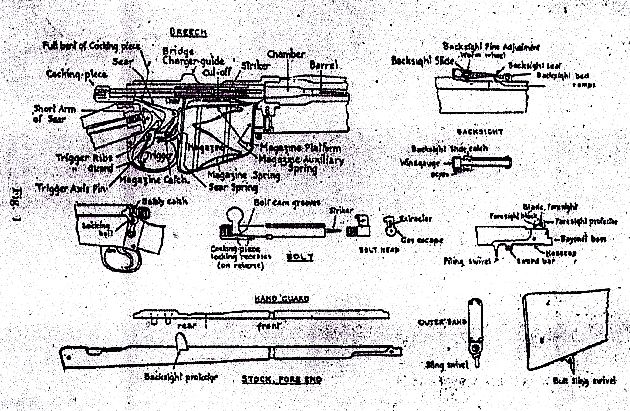
The poor quality of the first drawing with this article is obvious, but it is from a wartime small arms training manual and captures the style of the time. It also names parts of the rifle, which I will refer to later on.
The Mark III Short magazine Lee-Enfield is a bolt-action magazine rifle which holds 10 rounds and, if necessary, another in the chamber or 'up the spout. Rounds were issued in chargers - steel clips holding five rounds. The chargers came in cotton bandoleers, which had five pockets, each pocket containing two chargers.
Loading
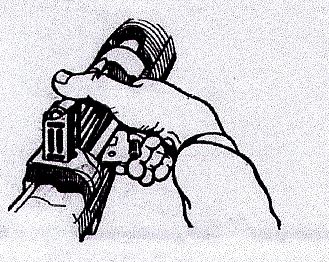
Loading is simple. Push forward the safety catch, which is on the left side of the body. Raise and pull back the bolt lever. Push down and to the right on the thumb-piece of the cut-off and the magazine will be exposed. (The cut-off is a small plate, which swivels over the top of the magazine. When closed, it prevents rounds already in the magazine being loaded and allows the rifle to be used as s single-shot weapon. When rapid fire is needed the cut-off is opened and the magazine spring lifts a round to be fed into the chamber each time the bolt is pushed forward.) Over the breech is the bridge charger guide. Fit a charger into this and push rounds down into the magazine with the thumb as shown in drawing 2. This drawing also shows the fingers hooked under the open cut-off. Flick out the empty charger - the bolt will not close otherwise - and load another charger.
The magazine is now fully loaded with 10 rounds. If the cut-off is left open, the act of closing the bolt and turning down the lever will push a round into the chamber and cock the action. With the safety catch in its forward position, the rifle will fire when the trigger is squeezed.
Aiming
Before firing the rifle, it has to be correctly aimed by lining up the backsight and the foresight with the target. Looking along the top of the rifle, the backsight appears as a ~U' and the foresight as a thin blade. The correct aim has the foresight in the centre of the 'U' and level with the top of the shoulders of the backsight. This picture, when placed on a target as in Drawing 3, will be accurate.
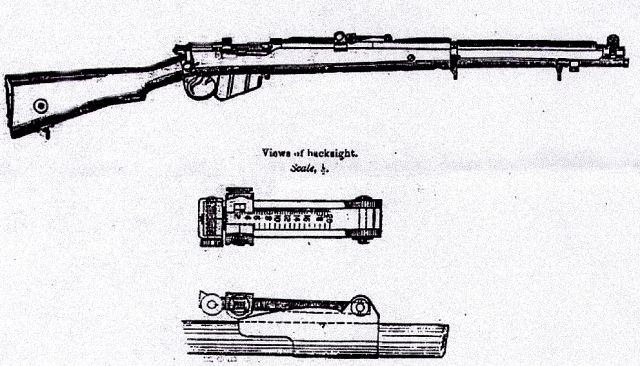
However, targets in Battle appear at different ranges and it is necessary to set the sights at the appropriate distance to ensure a hit. The SMLE backsight is fixed to a leaf with a slide. This leaf is graduated from 200 to 2,000 yards at 25-yard intervals and, when the slide is moved to the required range, the backsight is raised to give the elevation needed. A windguage is also fitted to give lateral adjustment in windy conditions. Drawing 4 shows the backsight and leaf.
Firing
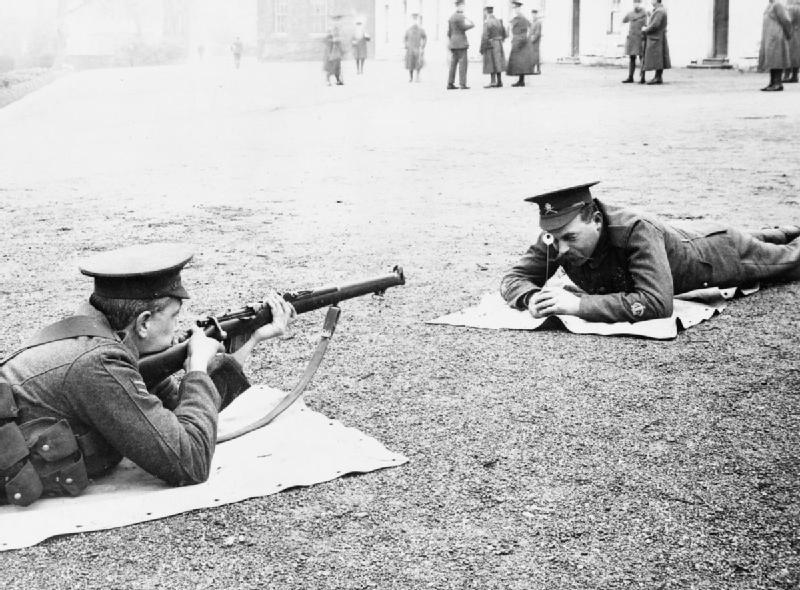
The rifle is loaded, safety catch forward, correct aim taken; everything is ready for the shot. The trigger is squeezed gently with the right index finger. There will be some backward movement of the trigger and then a check will be felt. You have taken 'first pressure'. Keep squeezing and the rifle will fire - that's the second pressure. The idea of a two-stage trigger is for safety purposes.
The .303' cartridge develops a pressure of about 18~5 tons per square inch. This pressure is felt as recoil or kick and gives the firer a sharp knock in the shoulder. Recruits would invariably anticipate the kick with some trepidation, but with a firm hold and practice its effect is negligible. Experienced riflemen barely notice recoil. After firing, opening the bolt will eject the spent cartridge case and closing it will push another round from the magazine into the chamber. The standard for rapid fire was to discharge 15 rounds accurately in one minute. Old soldiers could frequently exceed this number.
Some of you may have SMLE rifles, which do not have a cut-off or a windguage. These are the SMLE Mark III, introduced in January 1916, and these parts were omitted to speed up production of rifles.
Becoming a member of The Western Front Association (WFA) offers a wealth of resources and opportunities for those passionate about the history of the First World War. Here's just three of the benefits we offer:

The WFA regularly makes available webinars which can be viewed 'live' from home. These feature expert speakers talking about a particular aspect of the Great War.

Featured on The WFA's YouTube channel are modern day re-interpretations of the inter-war magazine 'I Was There!' which recount the memories of soldiers who 'were there'.

Explore over 8 million digitized pension records, Medal Index Cards and Ministry of Pension Documents, preserved by the WFA.
Other Articles


