
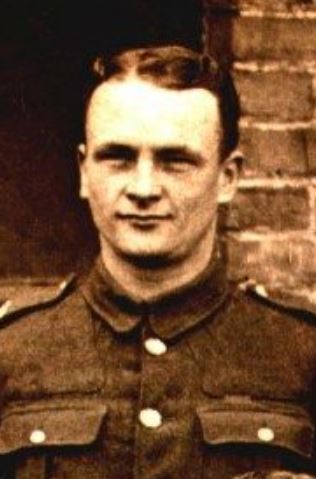
Sergeant Douglas Hunter DCM
Douglas Hunter was born on the 2 June 1895 in the Manningham area of Bradford.
On the 21 September1914 he answered Lord Kitchener's call to arms by joining at his Local recruiting office in Bradford, the 16th Battalion West Yorkshire Regiment later to become known as the "1st Bradford Pals". The Regiment became part of the 93rd brigade, which was in the 31st Division.
The Regiments making up the Brigade consisted of the 15th (Leeds Pals), the16th and 18th (Bradford Pals) West Yorkshire Regiment, and the 18th Battalion of the Durham Light Infantry (Durham pals).
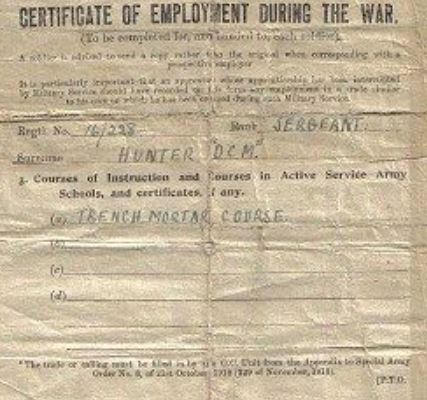
His service number was 16/228, the prefix of 16 showing he was part of the 16th West Yorkshire Regiment. After initial training at Skipton and Ripon (North Yorkshire) the Regiment was sent to Egypt on the 6 December 1915 to take part in the Defence of Suez.
They first arrived at Alexandria, but later sailed to Port Said and finally to Kantara, which was on the east bank of the Suez Canal. They were encamped in an area known as "Point 70".
The Regiment stayed in Egypt from 21 December 1915 until the 1 March 1916, finally arriving in Marseilles France on the 6 March 1916. From Marseilles they entrained for the journey to Pont Remy, finally marching to Mereleaasart.
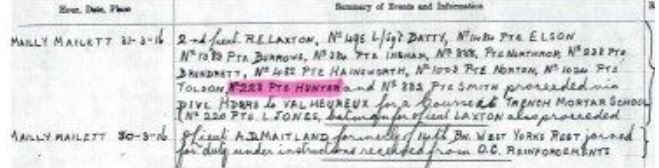
From the War Diary extract the name of Pte Burrows can also be seen. They were to become lifetime friends serving for the duration of the war. Following the war they worked together for over forty years in a large mill in Batley West Yorkshire where Hermann Burrows became the owner and Douglas a manager.
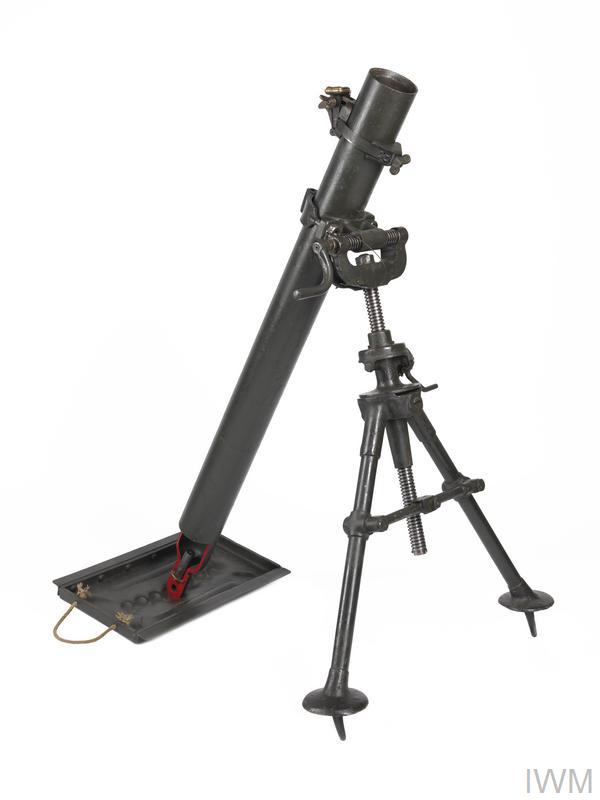
After training on the Stokes Mortar, they formed the 93rd Light Trench Mortar Battery which consisted of men from all four Regiments within 93rd Brigade.
The 93rd Light Trench Mortar Battery
Stokes Mortars were used in companies of rifle battalions and Light Trench Mortar units.
Each Trench Mortar unit would have gun teams, which would normally consist of three men. They were an indirect fire support weapon (i.e. they fired up and over trenches, landing down into enemy trenches). They could fire High Explosive (HE) rounds either air bursting or ground detonation and also smoke rounds. Smoke was used to both hide our positions from enemy observation and fire and to cover our movements and attacks.
Each gun team could be moved, and could if well trained, carry out a fast rate of fire it was possible to have four shells in the air at any one time. They could also lay false screens so that the enemy would believe an attack was coming. These would draw away German troops from the real attacks.
On the 13 April 1916 at 2 pm, they were finally put on active service. On the 14 April 1916 they occupied billets at Hebuterne for the reconanacing of trenches and the enemies front line positions.
The build up to the Battle of The Somme had begun, and on the 20 April 1916 the first of the 93rd Light Trench Mortar Batteries registered on the enemy trenches.
The following dates are extracts from the 93rd Light Trench Mortar Battery War Diaries (WO/ 95/2362).
Work on trenches and dugouts had to be carried out at night. This was to conceal the movement of earth, which had been removed and placed in the rear of existing parados. On the 23 April 1916 one gun emplacement was established six or seven yards in front of Wolfe Trench and a communication trench was dug from the trench to the emplacement.
Reconnaissance of trenches and enemy positions was carried out regularly, mainly at night enabling batteries to find a specific target. Some of these actions are mentioned as follows: -
16 May 1916 19 rounds fired on enemy trench mortar and machine gun emplacements, each mortar would find a specific target, register on it and then retire before any retaliatory action could take place.
The Stokes Mortar used by the Battery was extremely efficient but once fired, the Mortar projectile could be observed by the enemy giving away the whereabouts of their own position. This could however be used to our advantage, as was shown on the 22 may 1916.
A pre-arranged time of 3pm with Artillery field guns and howitzers saw 16 Stokes shells fired on enemy trenches from which canister bombs had been fired the previous day.
Immediately the enemy replied with shrapnel, H.E and two canisters, to which our Artillery shelled the enemy positions heavily for some time with good effect.
The Somme
Much training had been carried out for the great offensive, which was to take place on the Somme, and on the 1 July 1916 all was in rediness with the 93rd Light Trench Mortar Battery. Being part of the 31st Division the idea was for the 93rd Brigade to attack and take Serre on the right, and on the left the 94th. All were in position in Colin camps for the bombardment. Two Stokes guns had been positioned in Grey Sap known as B Sap with Lieut Evers in command. Two more Stokes guns were placed in Bleneau Sap. This was known as A Sap with Lieut Bobby in command. These Saps were more exposed to the enemy fire as they were in front of the main trench system but linked to it. The rest of the eight trench mortars were spread along the firing line with Captain Titford in charge.
As our bombardment commenced the enemy artillery retaliated very heavily with deadly effect. 2nd Lieut Bobby was killed, Captain Titford was wounded, four others were killed or died of wounds and eighteen were wounded. The action had been extremely costly to the battery and they were very fortunate to have any survivors. During the bombardment seventeen hundred rounds had been expended. Apart from the loss of men nine out of the initial twelve mortars were out of action. Fortunately all the mortars were salvaged and seven were made ready for action. Lieut Evers was put in charge of the Brigade mortars.
Following this action the Brigade was moved to Vielle Chapelle and carried out training on the 24th of July, eventually reliving the 94th Light trench Mortar Battery on the 28th of July.
Photographed below - Douglas Hunter top third from right, Hermann Burrows top right.
Officer in middle with dog is Lt F C Prickett OBE drawn from the 18th Batt Durham Light Infantry.
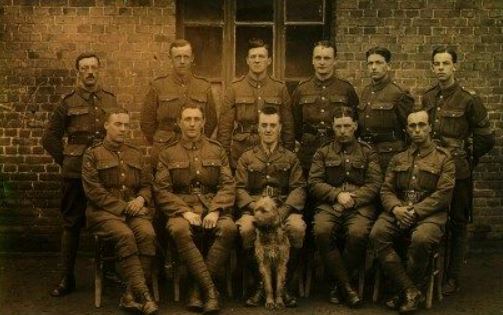
Lieut F C Prickett was to take command of the 93 Light Trench Mortar Battery on the 28th of July, after Lieut Evers had been wounded by a raiding party. One Sergeant had also been wounded in the same attack.
This intelligence report on the 23 August 1916 illustrates the war was not just been fought on the land and sea
Intelligence Report
At 7pm one of our aeroplanes was hit by enemy shellfire. The aeroplane was seen to drop for some distance during which a portion of the machine burst into flames. Two dark objects were seen to drop and the plane descended in a spiral manor until lost to view behind trees somewhere in the direction of Festubert village. The aeroplane was burning fiercely the whole time. The two dark objects were obviously the air crew.
The following extracts were taken from the 93rd Brigade War Diaries and reports of actions from the 93rd L.T.M.B Commanding Officer in Charge.
As shown in the war diary of the 28 July 1916 when the enemy wounded Lieut Evers on a trench raid his command was taken over by Lieut F.C. Prickett. This officer was to be in charge of the battery for the rest of the war.
On the 17 October 1916 the 93rd Light Trench Mortar Battery moved to Thivres. From there they moved to Warront Wood St Ledger. On the 30th October they moved to Rossignol Farm.
Lieut Prickett makes the first report on the 11 November 1916, and Douglas Hunter is mentioned as being in charge of number 2 Gun Team. The team consisting of 16/228 Lance Corporal Hunter D, 803 Pte Marshall and 21/149 Pte Cable. There were two other Gun Teams in this section and all were placed in positions in Rualt trench. The officer in command of these gun teams was Lieut H Smyth Pigott.
Oppy
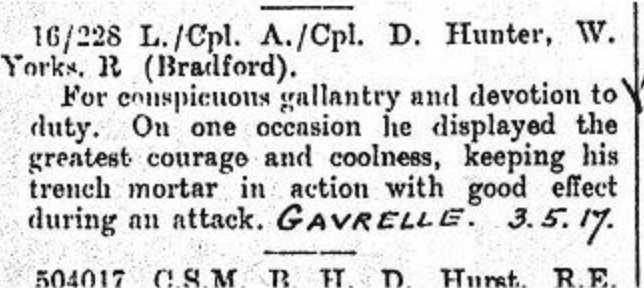
It was on the 3 May 1917 that Douglas was to win his DCM (Distinguished Conduct Medal) in the battle of Oppy Wood at Gavrelle.
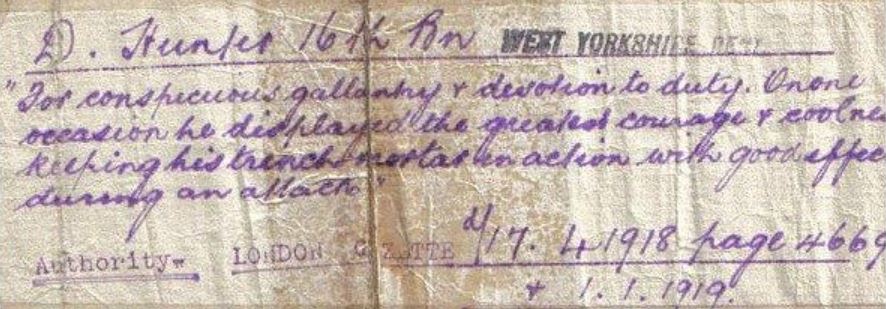
Douglas Hunter was first entered into the London Gazette on the 1 January 1918 and later on the 17 April 1918. These entries did not show the date or the place the action had taken place, this was found for me by David L Seeney - research advisor for Sunset Militaria to whom I am most grateful.
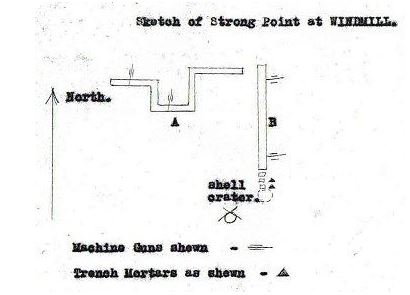
The action at Gavrelle on the 3 May 1917 in which Douglas Hunter won his DCM was probably won at the Windmill area of the battle, as shown in a copy of a report by Lieut H Smyth Pigott.
The report by Lieut H Smyth Pigott is dated the 3 May 1917:
Report by O.C. Trench Mortars At Windmill Position.
At 10.30 pm Lieut Smyth Pigott and Trench Mortar teams left the battle headquarters at B.30 Central and made their way to the Windmill position arriving at 10.30 am. A carrying party arrived with 16 rounds of Stokes shells. Work had already commenced on building emplacements and digging a trench, this work was finished by 3.30 am.
The 'creeping barrage' opened at 3.45 am and was followed by the first wave of the 18th West Yorkshire Regiment at 4.05 am and the second wave at 4.08 am moving through the positions of the battery. At 4.15 am the first two Prisoners with two Escorts came back through the position.
A couple of enemy machine guns continued firing throughout the advance, one to the right and one to the left. On seeing this the Stokes Mortars fired all their rounds in the direction of the gunfire but this failed to stop most of the fire, this was because the Trench Mortar fire could only be registered on the enemy by the sound from their guns.
At 4.25 am two wounded, two S.B and three O.Rs from No 5 Platoon of the 18th West Yorkshire Regiment returned jumping into our position. They stated that their platoon was withdrawing, but knew nothing else. They were told to return to the attack and place themselves under an Officer or N.C.O. They left with one S.B.
At 4.30 am another wounded man jumped into their position, this was not surprising, on observing the enemy they could be seen advancing slowly from shell hole to shell hole about 50 yards away and they were bayoneting the wounded as they did so.
It was decided to take the mortars across to the trench held by our Machine Gunners, but as they were half buried and the enemy were only 50 yards away, there was no time to take them. They ran across to where the machine Gunners were but two men had to remain behind to fully bury the Trench Mortars to stop them falling into enemy hands.
On reaching the post the officer in charge Lieut Dingley was found to be mortally wounded, this left Lieut Pigott in charge of the defence.
At 5.30 am L/Cpl Marshal of the 93rd L.T.M.B and L/Cpl Raynor of the 93rd Machine Gun Coy were sent back with a verbal message for reinforcements.
At 5.35 the two guns in 'A' trench were out of action. 'B' trench was being heavily bombed so two men raced across the bullet swept open and brought back a gun but there was no ammunition left in 'B' Trench.
The remaining crews from the Trench Mortars carried out rifle fire on the enemy in conjunction with the remaining Machine guns. Our men could be seen withdrawing in the dip below followed by the enemy, our fire finally halted the enemy but at this point we had lost over one hundred men.
At 7.15 am an enemy aeroplane flew over and registered on their position to which they were shelled with 5.9 inch. At 7.25 the last Machine Gun became out of action so it was decided to withdraw, they fought their way back, returning fire on the enemy and managed to get away with slight casualties.
This report was signed by Hugh Smyth Pigott 2nd Lieut 18th West York's Regt attached 93rd L.T.M.B. The report was given to the C.O of the 93rd L.T.M.B Capt F.C. Prickett and although Lieut Smyth Pigott had commended members of the Machine Gun Coy for this action I feel sure that the senior CO would have done the same for his own L.T.M.B crews.
It is possible that Douglas Hunter could have won his DCM on the left of the attack but as shown earlier LCpl Marshal had served in No 2 gun team with Douglas Hunter and they were under the command of Lieut Smyth Pigott.
One such attack occurred on the 31 August 1917, the enemy had put down a very heavy barrage on the British front lines; this was in the area of Mericourt. Two groups of enemy were seen to be attacking positions on the line. Immediately we retaliated with Lewis guns. Later a wounded man reported he had seen the enemy entering the line on the left.
The commanding officer of the 93rd Light Trench battery was ordered to open fire and did so with deadly effect causing heavy losses to the enemy. Patrols were sent out once they had managed to stop the trench mortar fire. It was later found that the enemy had not managed to enter the front line and had only managed to reach the wire where they had been met by devastating trench mortar fire. Thus the trench raid had been repulsed.
Douglas Hunter was to take part in many battles and skirmishes. However, I remember him telling me about one incident in 1917. A British recognisance patrol out at night had come across a party of the enemy building a new trench system. It was decided to leave them until they had finished their work before taking any action.
After several weeks of working on the system the enemy started to move in their weapons. Because of this it was decided to act. Douglas Hunter and his crew, plus one other crew were moved in under cover of night to register their weapons on the trenches.
The trenches were completely destroyed with their weapons. This always seemed to amuse my Grandfather as the enemy had spent such an amount of time building the system. This kind of operation revealed how accurate and deadly the Stokes Mortar could be and in the later stages of the war would become a key weapon against the enemy.
On registering on particular targets a spotter could often see the damage which had been inflicted on the enemy as described in this War Diary entry: -
Three Stokes Guns from positions from 250 yards in rear of front line raged and bombarded the enemy's front line and wire. A dugout was hit sending pieces of wood some 20 feet in the air. After smoke had cleared, broken beams were plainly visible. The wire was also damaged to great extent.
On the 28 February 1918 the 16th Battalion West Yorkshire Regiment was disbanded and Douglas Hunter DCM became part of the amalgamated 15/17th Battalion West Yorkshire Regiment, as shown in the London Gazette entry of 21 August 1919.
Medaille Militaire
Douglas Hunter DCM was also awarded the Medaille Militaire by the French. This was entered in the London Gazette on the 21 August 1919 as 16/228 Corpl (acting Sergeant) Douglas Hunter 15/17th West Yorkshire Regiment attached 93rd Light Trench Mortar Battery (Bradford).
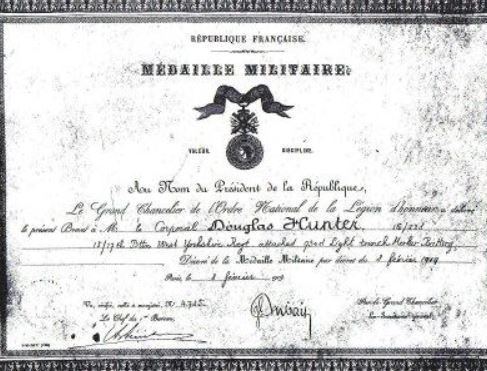
The entry makes no mention of the time or place when this medal was won but I do know from conversations with my mother (daughter of Douglas) the winning involved an attack on a farm. Two major battles fit this criteria. One being on the 10th to the 13 April 1918. This was the battle of Hazenbrouck and the battle of Ankle Farm, which took place on the 29 June 1918. The later I think would be the more feasible of the two.
The 93rd Brigade diaries have a report from Captain F C Prickett on the 29 June 1918 describing the actions of the 93rd Light Trench Mortar Battery on the night of June 26th and 27th 1918.
Special positions were selected by the officer in Command of the Battery on the night of the 22 June 1918, these were a line of trenches and selected for these reasons: -
- Enfilade fire on to the target could be obtained at close range
- After the attack had been delivered all Mortars could immediately lift on to their SOS lines without moving from their positions.
- Emplacements were clear of all assembly positions of the attacking troops.
Nine mortars were then dug in and 800 rounds of instantaneous ammunition were carried forward to the Gun Pits by the evening of the 24th and 25th.
All Mortars were set up by a Compass bearing and by direct observation. Two enemy Machine Guns had been located and each had a special Mortar detailed to deal with them. There was no previous registering of any description before the attack so that the known Machine Guns had no reason to move from the positions they had been taking up nightly before ZERO hour on "Z" day.
2/Lieut G.W. Hinchliffe was detailed to be Officer in charge of the Mortars but this Officer was unfortunately killed by an enemy sniper only three hours before ZERO hour. A priority message was sent by the senior NCO, who was Corporal Johnson explaining that 2/Lieut Hinchliffe had been killed.
Following this message the reserve Officer Lieut G. Turner and the Battery Sergt-Major proceeded immediately to take over command. Lieut Turner reported everything in position, a message being received by 1130 pm to this effect.
All Mortars opened up a hurricane fire with the opening of the Artillery barrage as pre-arranged. Each Mortar had its allotted task. The No 1,s in charge of the Mortars had in writing the length of time their mortars were to be in action as each Mortar varied according to the Artillery creeping barrage. During the firing the following was reported:
"1 broken striker, this was immediately replaced from the spare part bag.
6 misfires."
On completion of the hurricane bombardment each Mortar lifted on to its arranged SOS line150 yards east of the Becque.
The approximate number of rounds fired was 444; this left about 35 rounds for SOS with each Mortar. The nine mortars were left on their SOS lines until the evening of 27th and 28th, when five were moved to take up fresh positions for further operations.
The enemy's barrage was put down about 30 yards in rear of our positions without doing any material damage.
After this battle it was reported that the enemy had 135 men buried. Other dead enemy were said to be considerable in number just east of the Becque stream but they could not be buried. This made the enemy's known casualties at 257.
Epilogue
Sergeant Douglas Hunter DCM 16/228 left the British Army on the 27 March 1919. He was then serving with the15/17th West Yorkshire Regiment. The 16th having been disbanded in February 1918. He was demobilized and transferred to Army Reserve Z.
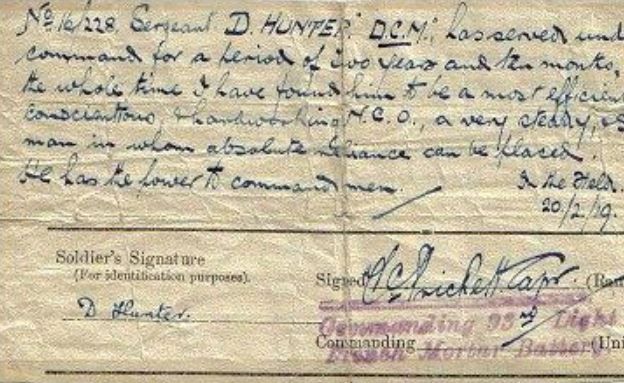
Douglas felt he had been lucky to survive the full duration of the war. His brother Donald had not been so fortunate, having been killed on the 21 September 1916 near Guedecourt whilst serving with the 10th Battalion Yorkshire Regiment. This date was of some significance as Douglas Hunter DCM had had joined the British Army on the 21 September 1914, exactly two years earlier.
In 1939 Britain was once again at war with Germany. Douglas Hunter had married and moved to Batley West Yorkshire where he worked for his best friend Hermann Burrows of J R Burrows. Douglas and Hermann had served together throughout the Great War.
Douglas Hunter married Lydia (formally a Cowgill) who came from Gigleswick, North Yorkshire.
By the outbreak of war they had two children. His eldest child, Donald Noel was named after his brother who was killed at the Somme in 1916. He also had a daughter Margaret Elizabeth who is still alive today.
Douglas Hunter DCM enlisted on the 16 June 1940 into The 40th West Riding Battalion. Home Guard. He was promoted to Lieutenant on the 1 February 1941 and discharged on the 31 December 1944 on Disbandment of the Home Guard.
His Rank on Discharge was Lieutenant and his National Registration Number was KNGC 195/1.
He qualified for the Defence Medal, which he was awarded to him on the 21 July 1948.
Douglas Hunter's medal roll consisted of:-
- Distinguished Conduct Medal (DCM).
- Victory Medal.
- British Medal.
- 1915 Star
- Medaille Militaire (French)
- Defence Medal
Douglas had survived two World Wars and gone on to live a good life knowing he had been a lucky man. He often told me stories of his exploits during the War but being young I did not fully appreciate the historical value of them.
I had always felt proud of my Grandfather, after all I hade been born in his house in Batley (West Yorkshire) and had been given his first name as my middle. I was not to follow in his footsteps in the Army but I did serve in the Royal Navy in the early 1970s.
Douglas Hunter DCM was to die on 18 June 1978 of natural causes.
I was left his Distinguished Conduct Medal in his will, along with the original Citation. After several years I decided it was time to find out more about my Grandfather thus starting over five years of research into him. I was unable to obtain his War records as they were part of the Burnt records of 1940.
I feel sure there are many unanswered questions, especially the full story of how his DCM was won and under what circumstances. Unfortunately the War Diaries of the 93rd Light Trench Mortar Battery did not extend beyond August 1916 and his own Battalion Diaries 16th West Yorkshire Regiment did not really cover his Attachment in any great detail.
Another line of enquiry would have been through his Commanding Officers War Records (Captain F C Prickett OBE), but he was still serving in the British Army in 1922 and these records were not available.
References
Public Record Office, Kew.
Following piece numbers from WO 95
(WO95/4590).
16th West Yorkshire Regiment in Egypt. 22nd December 1915 to 1 March 1916.
(WO95/2362).
16th West Yorkshire Regiment in France. 6 March 1916 to 1 February 1918
(WO95/2362)
93rd Light Trench Mortar Battery in France and Flanders. 20 April 1916 to 30 August 1916
(WO95/2359).
93rd Brigade Diaries in France and Flanders. 1916 to 1918
Article from Stand To! issue number 67, April 2003
Becoming a member of The Western Front Association (WFA) offers a wealth of resources and opportunities for those passionate about the history of the First World War. Here's just three of the benefits we offer:

The WFA regularly makes available webinars which can be viewed 'live' from home. These feature expert speakers talking about a particular aspect of the Great War.

Featured on The WFA's YouTube channel are modern day re-interpretations of the inter-war magazine 'I Was There!' which recount the memories of soldiers who 'were there'.

Explore over 8 million digitized pension records, Medal Index Cards and Ministry of Pension Documents, preserved by the WFA.


