
The .303 Cartridge
Most of us know that the Lee-Enfield rifle's calibre was .303", but few of us realise that this cartridge was first introduced in 1888 and went through a number of changes over the next 22 years to give the .3O3" Ball Cartridge Mark VII which was used in the First World War and since.
The cartridge, or round, consists of four main components:
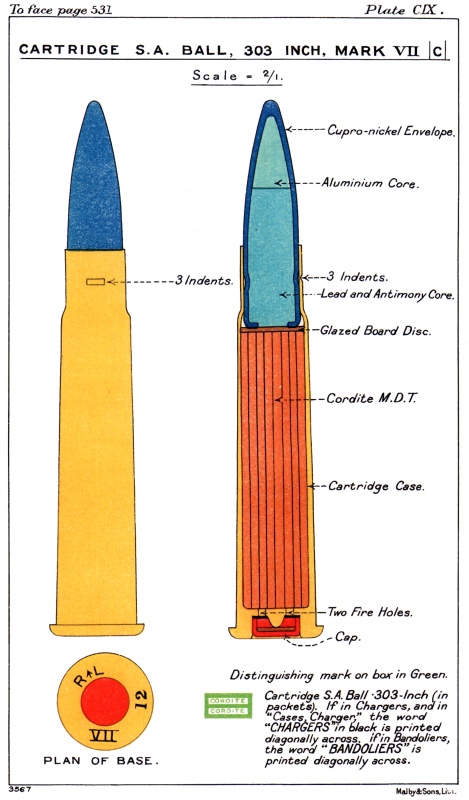
The Case
This contains the other components, is of solid drawn brass. Brass is used because its elasticity allows it to expand when the cartridge is fired and contract once the pressure generated upon firing has decreased.
The .303" case has a rim at its base which serves to seat the cartridge in the rifle's chamber and also provides a purchase for the rifle bolt's extractor claw to withdraw the case from the chamber. Around the base, the military practice is to have an identifying stamp which gives the manufacturer's initials, the mark of cartridge, and the year of manufacture. The headstamp illustrated shows that this Mark vii cartridge was made by the Royal Laboratory (part of Woolwich Arsenal) in 1912. Headstamps, which are many and varied, are a fascinating study in themselves and give useful information about the round.
Cap or Primer
Seated in the centre of the cartridge base is the Cap or Primer. Made of copper, it contains a chemical composition which reacts violently to a sharp blow and creates a hot flame. The blow is provided by the rifle's firing pin and the flame penetrates into the cartridge case through two small fire holes.
Propellant or Charge
The primer's flame reaches the Propellant or charge contained inside the case and causes it to burn rapidly - it does not explode. This rapid burning produces a high volume of gas and, because it is within a confined space, an immediate increase in pressure results. The pressure, seeking a weak point to escape, acts upon the base of the bullet and drives it up the barrel.
The propellant used in the Mark Vii round is Cordite, a fast burning composition of nitroglycerine, guncotton, and mineral jelly. It looks rather like thin spaghetti.
The Bullet
This is crimped into the cartridge case neck by three indents. It has a two piece core consisting of an aluminium front portion, to give length without weight, and a lead rear portion. The core is encased in a copper/nickel jacket. Lead, being a soft metal, would be unable to grip the rifling properly at high velocities, and the jacket gives the extra resistance needed for this purpose. Bullet shapes vary, the early patterns had round noses, but as improved propellants gave higher velocities, so the bullet took on a more streamlined shape with a pointed nose. The pointed nose was not intended to aid penetration into a body as is sometimes thought.
Introduced into service: 1st October 1911 (approved 3rd November. 1910).
Overall Length of whole round: 3'-3.075"
Bullet Weight: 174 grains.
Muzzle Velocity: about 2,400 feet per second.
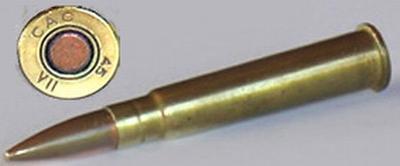
The Mark VII round represented the height of British military cartridge design. There are many variants, including tracer, armour-piercing, and incendiary. It continued in service throughout the Second World War and in its armour-piercing form was used in aircraft armament. It continues to be manufactured and used today.
Becoming a member of The Western Front Association (WFA) offers a wealth of resources and opportunities for those passionate about the history of the First World War. Here's just three of the benefits we offer:

The WFA regularly makes available webinars which can be viewed 'live' from home. These feature expert speakers talking about a particular aspect of the Great War.

Featured on The WFA's YouTube channel are modern day re-interpretations of the inter-war magazine 'I Was There!' which recount the memories of soldiers who 'were there'.

Explore over 8 million digitized pension records, Medal Index Cards and Ministry of Pension Documents, preserved by the WFA.


