
The Hygiene War
Read any serious descriptive account on life on the Western Front in the Great War, and sooner or later, usually sooner, the matter of the squalid conditions under which it was fought is raised. Once the war settled into the trenches, the die was cast. The potential for squalor is self-evident. Several million men - the women war workers were located in the relatively healthier conditions behind the lines - lived a troglodyte existence in what was an burgeoning open cemetery, and a poorly run one at that. All of the combatants human needs had to be met, month after month, in these cramped trenches, bunkers and just plain holes in the ground. Meanwhile, huge amounts of munitions and toxic gas were employed to disrupt and pollute the land so to make it as humanly untenable as possible. In the quieter sectors conditions might be somewhat better, but not much.
In the British Army one of the greatest slurs that could be made against a Battalion was for it to be said that 'It had left a dirty trench'. And one of the gripes often made about certain of the Allies, was that they often handed over poorly maintained and unhygienic trenches.
To be sure, many of the British soldiers - particularly the later conscripts - came from backgrounds where hygiene standards at home were quite rudimentary. Few bathed regularly and their clothing, both outer and under, was worn far longer than would be thought acceptable today. But, historically, the British army always insisted on cleanliness and self-care by its troops, as many a scruffy recruit learned to his cost after being subjected to salutary cold baths and scrub downs.
In the British Army, hair was worn very short and beards were prohibited. (Strangely, this was not the case in the French Army. Hence the nickname for the ordinary French soldier poilu, The Bearded One). But even military discipline faced an up-hill battle in the insalubrious conditions in the trenches. The classic targets for snipers were the routes where water-carriers plied and the approaches to latrines. There are many cases where several soldiers a day were sniped whilst carrying water or using the latrine.
Even if the filthy mud, awful stench, cramped living conditions, and the continual presence of innumerable well fed rats, is given due weight, there is one affliction that above all was cursed and hated by all ranks - being lousy. As the word implies, this means being infested by the human louse. However, this is not a single species. There are, in fact, two quite different human species of lice, one of which has two varieties. And, each of these three lice has its own specific life-style.
Infestations
If we started at the top of the Great War soldier's body, we might have found the head-louse. It has the scientific name Pediculus [Genus] humanus [species] capitas [variety].
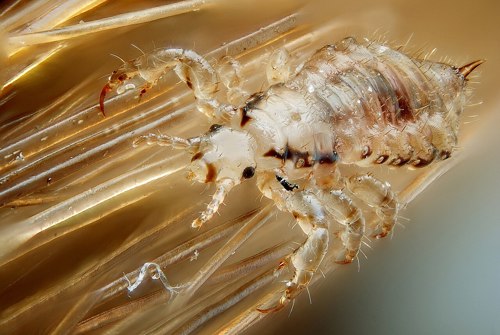
As the name indicates, this louse mainly lives on the head - scalp hair, eyebrows and beard - where it clings to the hair by powerful pincers. To feed, it descends to the skin and sucks blood. It glues its eggs individually to a single hair, where they can be removed by use of the well-known nit-comb. Hence the army's preference for short cropped, or shaved, hair and no beards. No head-hair - no head-lice. No doubt many a martinet sergeant major decided that if a squaddie's eye-brows grew too long, these too had to be cropped short. So relief from the predations of this louse were fairly easily remedied: By the barber and, if necessary the nit-comb.
On the soldier's body we might have discovered the body louse - Pediculus humanis corporis.
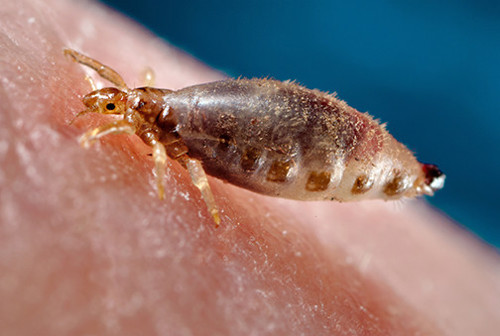
Despite its name, this louse does not live directly on the body - although, of course, it feeds there - but prefers to secrete itself and its eggs away in the clothing of the host. Seams are a favourite location. Once a louse infestation gained a foothold it was extremely difficult to get rid of in the conditions of the trenches, particularly those in an active war zone. Only the complete removal of all the clothing, a careful bathing in hot water with plenty of soap, followed by a complete change of new or sterilised washed clothes, including underwear, socks etc.' would have any hope of fully eradicating the infestation. Partial remedy could be achieved by ironing the seams of all the clothing with a hot flat-iron; not a ready option in the trenches. But the infestation usually flared up again unless the measures were very thorough indeed. Of course, in the Great War there were no insecticides like DDT; although even fifty years ago the human louse had become totally resistant to that insecticide.
The last of the three human lice we might have found is the pubic louse - Phthyrus pubis - which, as the name indicates, lives in the pubic (and anal area) suspending itself from the pubic hair by large crab-like claws.
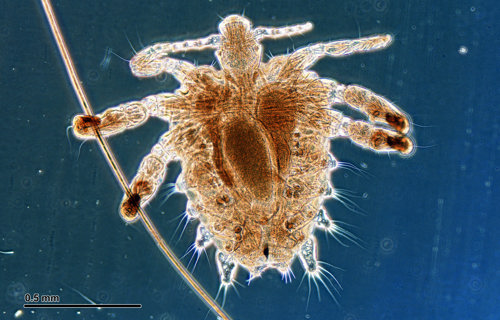
In shape it is rather squat, hence the common name, crab louse. These lice can also be found on other body hair. The crab louse is usually transferred from person to person during sexual contact, but on occasion it can be spread through shared clothes and bedding.
All these lice produce intense itching and lesions which under unsanitary conditions can become seriously secondarily infected. But, as will be seen from the above, the most common kind of louse infestation is that of the body louse. Unfortunately, this is the louse which transmits a series of infections, most important of which is endemic typhus. This disease is caused by a small organism -resembling in some ways both viruses and bacteria - called Rickettsia. The disease produces a high fever and a rash with mortality in the military population of up to 50%. A variety of epidemic typhus became so common on the Western Front, it became known as 'trench fever'. There was no vaccine for endemic typhus in the Great War.
Conclusions
Terrible though the casualties due projectiles, explosions and toxic gas were on the Western Front in the Great War, the toll due to disease was even higher by a ratio of 6:4. Many of the episodes of disease could be directly attributed to the poor environmental and sanitary conditions in the war zone.
The Army Medical Services could and did do better when, 21 years later, the call again came for their war-time services. The hard won experience gained on the battlefields of the Western Front was of invaluable use then, as it still is today.
Becoming a member of The Western Front Association (WFA) offers a wealth of resources and opportunities for those passionate about the history of the First World War. Here's just three of the benefits we offer:

The WFA regularly makes available webinars which can be viewed 'live' from home. These feature expert speakers talking about a particular aspect of the Great War.

Featured on The WFA's YouTube channel are modern day re-interpretations of the inter-war magazine 'I Was There!' which recount the memories of soldiers who 'were there'.

Explore over 8 million digitized pension records, Medal Index Cards and Ministry of Pension Documents, preserved by the WFA.


