
The Indian Army on the Western Front
One and a half million volunteer soldiers from the Indian continent served in the Great War, 850,000 overseas. Of these 72,000 (5%) died - 50,000 (3%) were killed in action - of which 7,000 died on the Western Front.
When the war was declared, the native rulers of India gave their strong moral support to the British Government's war aims and generously contributed money to aid the British in fighting the war. Notably, the Nizam of Hyderabad gave 60 lakhs of rupees = £400,000, and the Maharajah of Mysore 50 lakhs = £333,000; a huge amount in those days. They also supported the sending of Indian troops overseas.
The Indian Army contingent - the Indian Corps - that served on the Western Front, consisted of two Divisions of infantry, namely the 3rd (Lahore) Division, and the 7th (Meerut) Division, along with their support troops of pioneers, artillery, and one Brigade of cavalry, the 4th (Secunderbad) Cavalry Brigade.
Although nominally under the authority of the Indian Government, once these troops arrived in an area under British operational control - eg The Western Front - they came under full British military authority.
Whilst all private soldiers (called sepoys from the Persian word for soldier = sipahis) were from the Indian sub-continent, the majority of the officers were British, as were some of the non-commissioned officers (NCOs).
The Indian troops were recruited in India from the so-called martial races, e.g. Sikhs, Pathans, Dogras, Jats, and Rajputs, not forgetting the Gurkhas from Nepal.
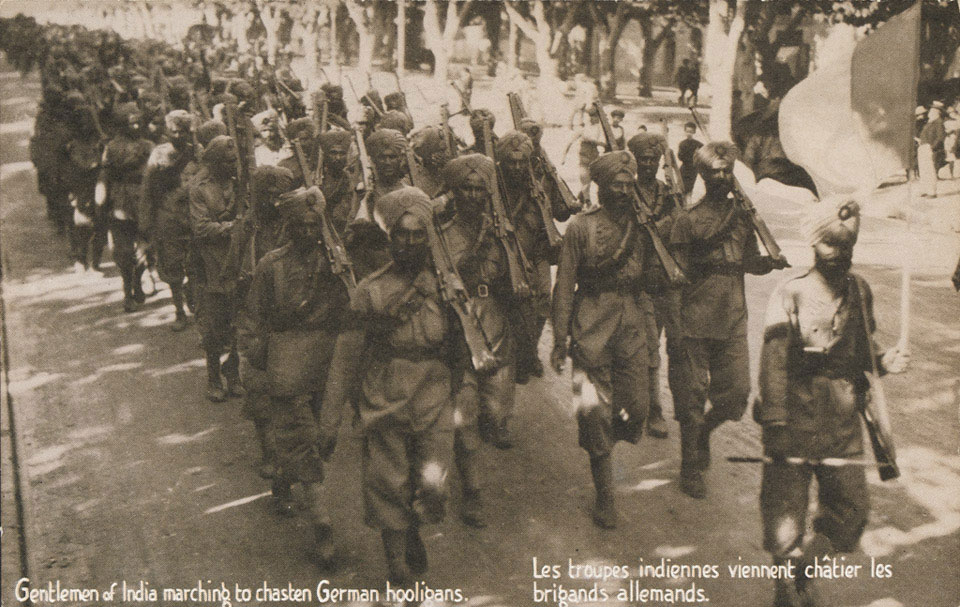
Indian Army arrives in France
These troops landed in Marseilles, France, on 26 September 1914, less than six weeks after the declaration war on Germany by the British. From there, they moved north by rail to the Ypres Salient where they were issued with the standard British Army Lee Enfield rifle. Within two weeks some elements of the India Corps moved into the Front Line. Their headquarters was located at Béthune.
The Indian troops arrived dressed in khaki drill - a lightweight tropical material - so were not best clothed for the ensuing winter. It was only by the end of 1914 that they were fully fitted out with the more suitable British Army khaki battle-dress that was made of a heavy serge material. This failure to provide adequate clothing was a reprehensible lack of foresight by the British High Command and it definitely had some affect on the morale of the Indian troops. (The word khaki is derived from the Hindi word for 'dust' or 'dusty', as found on the plains of India).
Into action
The first military engagement of the Indian troops took place south of Ypres after dark on 25 October 1914, between Wytschaete (White-sheet to the British Tommy) and Messines, where they successfully repelled a German attack. During this attack Sepoy Usman Khan earned the Indian Distinguished Service Medal.
The first offensive attack by the Indian Corps took place the next day in the same area, and over the next few days nine officers (five British and four Indian) and over 200 men were killed.
Their next engagement included an attempt to seal the breach that the Germans (under General Erich van Falkenhayn) had created in the British Line just south of Neuve Chapelle. On 28 October the Indian Corps initially succeeded in entering into the village of Neuve Chapelle itself, but, within hours, after fierce hand-to-hand fighting, was driven out by a strong German counter attack. Further fighting continued for a week with the additional loss of 25 British and more than 500 Indians killed, with 1,450 wounded.
The next major action was at a snow-clad Festubert 60km south of the Ypres Salient where, on 23 November 1914, the Germans broke into the Indian Corps trenches and hand-to-hand fighting raged; several trenches being lost to the Germans. Two Gurkha soldiers were later awarded the Indian Distinguished Service Medal for bravery in this action.
After an 'at all costs' order by the Indian Corps commander, Lt.-General Sir James Willcocks, the trenches were recaptured on 24 November and held despite further German attacks. A British officer, Lieutenant F A De Pass, and an Indian naik (corporal), Darwan Singh Nedi, were both awarded the Victoria Cross; the former posthumously.
In December 1914, in ever worsening winter conditions, the Indian Corps moved to the Givenchy area south of Neuve Chapelle. On 16 December they went forward to attempt the capture a German front trench line, but without success, losing 54 men killed. This raised the total number killed to that date to over 2,000. A second attempt was more successful, at least initially.
The Germans used various ruses to entrap the relatively inexperienced and unsophisticated Indian troops with mixed success. Amongst these were spurious white flags, indicating a willingness to surrender. Subsequently, orders were issued to the Indian Corps, from the highest levels of the British High Command that all white flags should be summarily fired upon.
With the onset of winter proper, the conditions on the battlefield progressively worsened, and the lightly clad Indian troops suffered particularly badly in the quagmire that the trenches quickly became. They even found it difficult to keep their weapons serviceable due the clogging effect of the all-pervading mud. Indeed, so bad were the conditions in the trenches that a retreat was ordered. This coincided with the firing of a mine sapped from the German lines which completed obliterated one whole company (around 200 men) of the Indian Corps, without trace.
New offensive in 1915
On 10 March 1915, elements of the Indian Corps participated in a British attempt by IV Corps (under Sir Henry Rawlinson) to break the German lines at Neuve Chapelle that was intended to capture the village, close by, called Aubers. Following on from an intensive 30-minute barrage by 345 guns, ranged by British reconnaissance aircraft, the British and Indians attacked along three kilometres of front. The water table was so high here that the Germans had partially resorted to above ground fortifications. Neuve Chapelle fell, as did four lines of the German trenches.
However, due to a transportation failure in getting the British guns moved in time to cover the advance on the Aubers sector, the troops there went in without covering fire and almost 1,000 were completely wiped out. Other equally futile attacks were ordered that day by the British 1st Army commander, General Sir Douglas Haig, with similar tragic results.
On 12 March the British and Indians repelled a German attack and almost immediately followed it with a counter attack. This was brought to a halt after two hours with very heavy losses. Haig then called up as yet uncommitted elements of the Indian Corps, and the British IV Corps, and gave them another 'at all costs' order. The Indian Corps commanders, already concerned about the wasteful losses the Corps had incurred, queried the feasibility of the order, finally cancelling it with Haig's presumably reluctant assent. However, the British IV Corps, led by their apparently unquestioning commanders, did mount an attack. But due to the state of exhaustion of the troops, from their unremitting exposure to German gunfire whilst in the reserve trenches, the British were unable to make much progress. The attack fizzled out and with it the Battle of Neuve Chapelle came to an unsatisfactory close.
At the cost of 7,000 British and 4,000 Indian troops a small salient of about 2sq. km. (1.3sq. miles) was created. Any thoughts by the Indian troops that final victory over Germany would be quick, and cheaply obtained, were firmly and finally crushed by this lesson in the realities of the Great War.
In April 1915, a joint British and Indian counter-attack near Langemarck in the Ypres Salient - site of the first two German attacks using the toxic gas chlorine dispersed from high-pressure cylinders - was launched on 24 April 1915. It went disastrously wrong. As the British and Indian infantry advanced across No Man's Land, they were mown down by artillery and machine gun fire. The attack failed even to reach the first German trench line and hundreds of the British and Indians were killed and wounded.
Despite personally-presented pleas against further attacks by General Sir Horace Lockward Smith-Dorrien, commander of 2nd Army, General John Denton Pinkstone French, commander of the British Expeditionary Force (BEF), insisted that another attack take place.
On the following morning - 25 April 1915 - the Indian Corps had its first full exposure to toxic gas warfare, when 15,000 British and Indian troops went into action with heavy artillery support. Out-gunned by the German artillery, and once again caught in withering machine-gun fire, the Indian troops in the centre faltered and went to ground in shell holes. At this judicious point the Germans released toxic gas, trapping the Indians in the shell holes and preventing any further advance. The disaster was further exacerbated by French colonial troops from Senegal refusing to undertake a diversionary attack, killing their French officers, and retreating through their own lines to run amok in the rear areas.
It was around this time that a serious decline in morale occurred in the Indian Corps. It was largely fostered by the enormous casualties that the officers and men had suffered in less than a year, exacerbated by the difficult climatic conditions of Flanders and Northern France. Moreover, the heavy losses of experienced British Indian Army officers in the fighting were keenly felt by the Indian troops. Even more so as many of their replacements did not speak the Indian soldier's languages, and had little understanding of the traditional Indian Army ways. No doubt the news of the mutiny by Indian Sikh troops in Singapore in February 1915, and the subsequent execution by shooting of 47 of them, had also unsettled the Indian troops, in particular the numerous Sikh component of the Indian Corps.
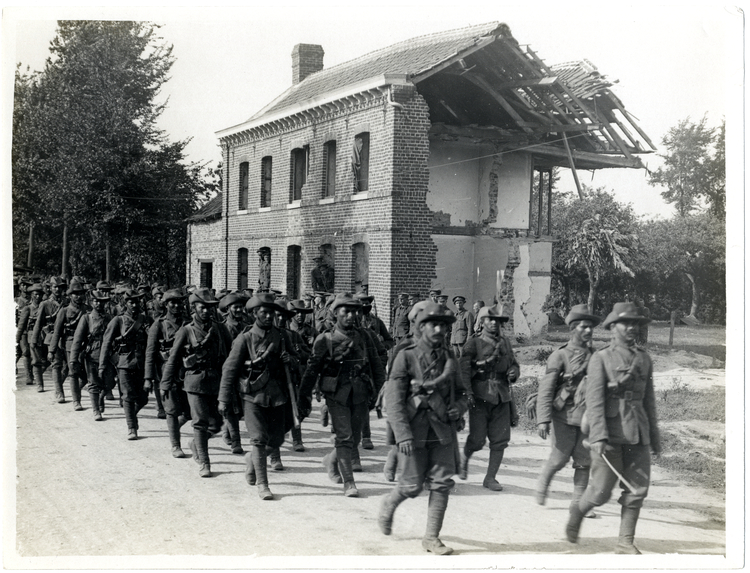
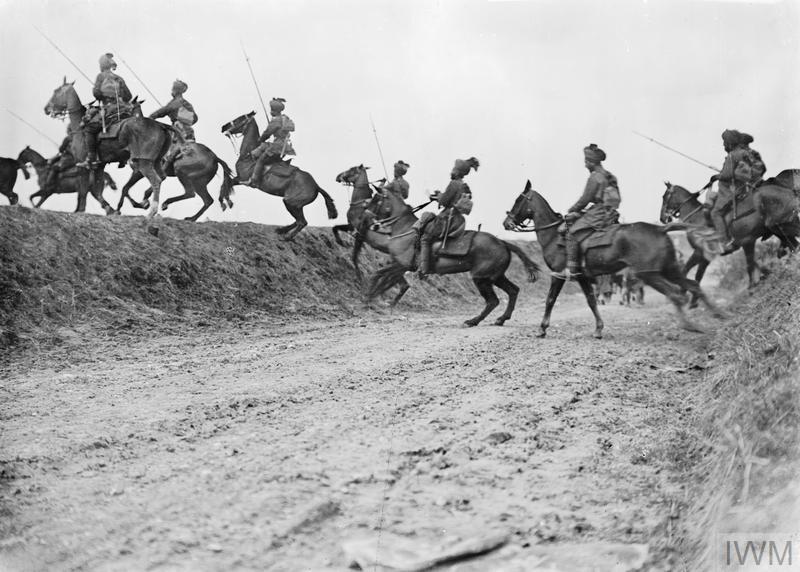
Wisely, it was decided to withdraw the Indian Corps infantry from the Western Front and relocate them in areas to which they were more suited climatically and this took place in the latter months of 1915. Two Indian Cavalry Brigades remained on the Western Front until the end of the war, both serving with distinction.
Other theatres
The other British theatres of the Great War where Indian troops served, including some of those who were withdrawn from the Western Front, were: Egypt, Palestine, Gallipoli, Mesopotamia (modern Iraq) and East Africa, as well as Aden and Bahrain. The vast majority of the troops in Mesopotamia campaign were from the Indian Army.
Finally, mention should be made of the sterling service given by the Indian Labour Corps. These men performed essential tasks behind the lines, but within the range of the enemy guns, such as baking, laundry, tailoring, etc., thus providing invaluable support to the fighting troops.
The graves of Indian Army officers, soldiers and members of the Indian Labour Corps are to be found in military and communal cemeteries all around the battlefields where the Indian Army fought. Notably at the unique Chinese and Indian Cemetery at Ayette south of Arras on the Somme. There is also an Indian Army Memorial at Souchez, northwest of Arras and at La Bombe, near Neuve Chapelle. It has an oriental-styled Indian Memorial to the Missing with 4,843 names.
A full listing of Indian Army units as at 1918
This is not an order of battle and the vast majority, of course never went to the Western Front.
Cavalry
Governor General's Bodyguard
Governor's Bodyguard, Madras
Governor's Bodyguard, Bombay
Governor's Bodyguard, Bengal
1st Duke of York's Own Lancers (Skinner's Horse)
2nd Lancers (Gardner's Horse)
3rd Skinner's Horse
4th Cavalry
5th Cavalry
6th King Edward's Own Cavalry
7th Hariana Lancers
8th Cavalry
9th Hodson's Horse
10th Duke of Cambridge's Own Lancers (Hodson's Horse)
11th King Edward's Own Lancers (Probyn's Horse)
12th Cavalry
13th Duke of Connaught's Lancers (Watson's Horse)
14th Murray's Jat Lancers
15th Lancers (Cureton's Multanis)
16th Cavalry
17th Cavalry
18th King George's Own Lancers
19th Lancers (Fane's Horse)
20th Deccan Horse
21st Prince Albert Victor's Own Cavalry (Frontier Force)
22nd Sam Browne's Cavalry (Frontier Force)
23rd Cavalry (Frontier Force)
25th Cavalry (Frontier Force)
26th King George's Own Light Cavalry
27th Light Cavalry
28th Light Cavalry
29th Lancers (Deccan Horse)
30th Lancers (Gordon's Horse)
31st Duke of Connaught's Own Lancers
32nd Lancers
33rd The Queen Victoria's Own Light Cavalry
34th Prince Albert Victor's Own Poona Horse
35th Scinde Horse
36th Jacob's Horse
37th Lancers (Baluch Horse)
38th King George's Own Central India Horse
39th King George's Own Central India Horse
40th Cavalry
41st Cavalry
42nd Cavalry
43rd Cavalry
44th Cavalry
45th Cavalry
46th Cavalry
Queen Victoria's Own Corps of Guides (Frontier Force)
(Lumsden's) Cavalry
Infantry
1st Brahmans
2nd Queen Victoria's Own Rajput Light Infantry
3rd Brahmans
4th Prince Albert Victor's Rajputs
5th Light Infantry
6th Jat Light Infantry
7th Duke of Connaught's Own Rajputs
8th Rajputs
9th Bhopal Infantry
10th Jats
11th Rajputs
12th Pioneers (Khelat-i-Gilzie Regiment)
13th Rajputs (The Shekhawati Regt)
14th King George's Own Ferozepore Sikhs
15th Ludhiana Sikhs
16th Rajputs (The Lucknow Regiment)
17th The Loyal Regiment
18th Infantry
19th Punjabis
20th Duke of Cambridge's Own Punjab Infantry
21st Punjabis
22nd Punjabis
23rd Sikh Pioneers
24th Punjabis
25th Punjabis
26th Punjabis
27th Punjabis
28th Punjabis
29th Punjabis
30th Punjabis
31st Punjabis
32nd Sikh Pioneers
33rd Punjabis
34th Sikh Pioneers
35th Sikhs
36th Sikhs
37th Dogras
38th Dogras
39th Garhwal Rifles
40th Pathans
41st Dogras
42nd Deoli Regiment
43rd Erinpura Regiment
44th Mharwara Regiment
45th Rattray's Sikhs
46th Punjabis
47th Sikhs
48th Pioneers
49th Bengalis
50th Kumaon Rifles
51st Sikhs (Frontier Force)
52nd Sikhs (Frontier Force)
53rd Sikhs (Frontier Force)
54th Sikhs (Frontier Force)
Queen Victoria's Own Corps of Guides (Frontier Force)
(Lumsden's) Infantry
55th Coke's Rifles (Frontier Force)
56th Punjabi Rifles (Frontier Force)
57th Wilde's Rifles (Frontier Force)
58th Vaughan's Rifles (Frontier Force)
59th Scinde Rifles (Frontier Force)
61st King George's Own Pioneers
62nd Punjabis
63rd Palamcottah Light Infantry
64th Pioneers
66th Punjabis
67th Punjabis
69th Punjabis
70th Burma Rifles
71st Punjabis (Punjab Christian Battalion)
72nd Punjabis
73rd Carnatic Infantry
74th Punjabis
75th Carnatic Infantry
76th Punjabis
79th Carnatic Infantry
80th Carnatic Infantry
81st Pioneers
82nd Punjabis
83rd Wallajahbad Light Infantry
84th Punjabis
85th Burman Rifles
86th Carnatic Infantry
87th Punjabis
88th Carnatic Infantry
89th Punjabis
90th Punjabis
91st Punjabis (Light Infantry)
92nd Punjabis
93rd Burma Infantry
94th Russell's Infantry
95th Russell's Infantry
96th Berar Infantry
97th Deccan Infantry
98th Infantry
99th Deccan Infantry
101st Grenadiers
102nd King Edward's Own Grenadiers
103rd Mahratta Light Infantry
104th Wellesley's Rifles
105th Mahratta Light Infantry
107th Pioneers
108th Infantry
109th Infantry
110th Mahratta Light Infantry
111th Mahars
112th Infantry
113th Infantry
114th Mahrattas
116th Maharattas
117th Mahrattas
119th Infantry (The Mooltan Regiment)
120th Rajputana Infantry
121st Pioneers
122nd Rajputana Infantry
123rd Outram's Rifles
124th Duchess of Connaught's Own Baluchistan Infantry
125th Napier's Rifles
126th Baluchistan Infantry
127th Queen Mary's Own Baluch Light Infantry
128th Pioneers
129th Duke of Connaught's Own Baluchis
130th King George's Own Baluchis (Jacob's Rifles)
131st United Provinces Regiment
132nd Punjab Infantry
133rd Regiment
140th Patiala Regiment
141st Bikanir Infantry
142nd Jodhpur Infantry
143rd Narsingh (Dholpur) Infantry
144th Bharatpur Infantry
145th Alwar (Jai Paltan) Infantry
150th Indian Infantry
151st Sikh Infantry
152nd Punjabis
153rd Punjabis
154th Indian Infantry
155th Indian Pioneers
156th Indian Infantry
Gurkha Rifles
1st King George's Own Gurkha Rifles (The Malaun Regiment)
2nd King Edward's Own Gurkha Rifles (The Sirmoor Rifles)
3rd Queen Alexandra's Own Gurkha Rifles
4th Prince of Wales's Own Gurkha Rifles
5th Royal Gurkha Rifles (Frontier Force)
6th Gurkha Rifles
7th Gurkha Rifles
8th Gurkha Rifles
9th Gurkha Rifles
10th Gurkha Rifles
11th Gurkha Rifles
Other units
Machine Gun Corps
Mountain Artillery
1st King George's Own Sappers and Miners
2nd Queen Victoria's Own Sappers and Miners
3rd Sappers and Miners
Supply and Transport Corps
Army Hospital Corps
Army Bearer Corps
Indian Medical Department
Army Remount Department
Army Veterinary Department
Indian Ordnance Department
Army Clothing Department
Military Farms
Becoming a member of The Western Front Association (WFA) offers a wealth of resources and opportunities for those passionate about the history of the First World War. Here's just three of the benefits we offer:

Identify key words or phrases within back issues of our magazines, including Stand To!, Bulletin, Gun Fire, Fire Step and lots of others.

The WFA's YouTube channel features hundreds of videos of lectures given by experts on particular aspects of WW1.

Read post-WW1 era magazines, such as 'Twenty Years After', 'WW1 A Pictured History' and 'I Was There!' plus others.


