
The .303" Vickers Machine Gun
In 1882 Hiram Maxim, an American inventor living in London, was told If you want to make a pile of money, invent something that will enable these Europeans to cut each others' throats with greater facility." Although maxim was not a gunmaker, he spent the nest two years developing a machine gun in his workshop at 87b Hatton Garden, London.
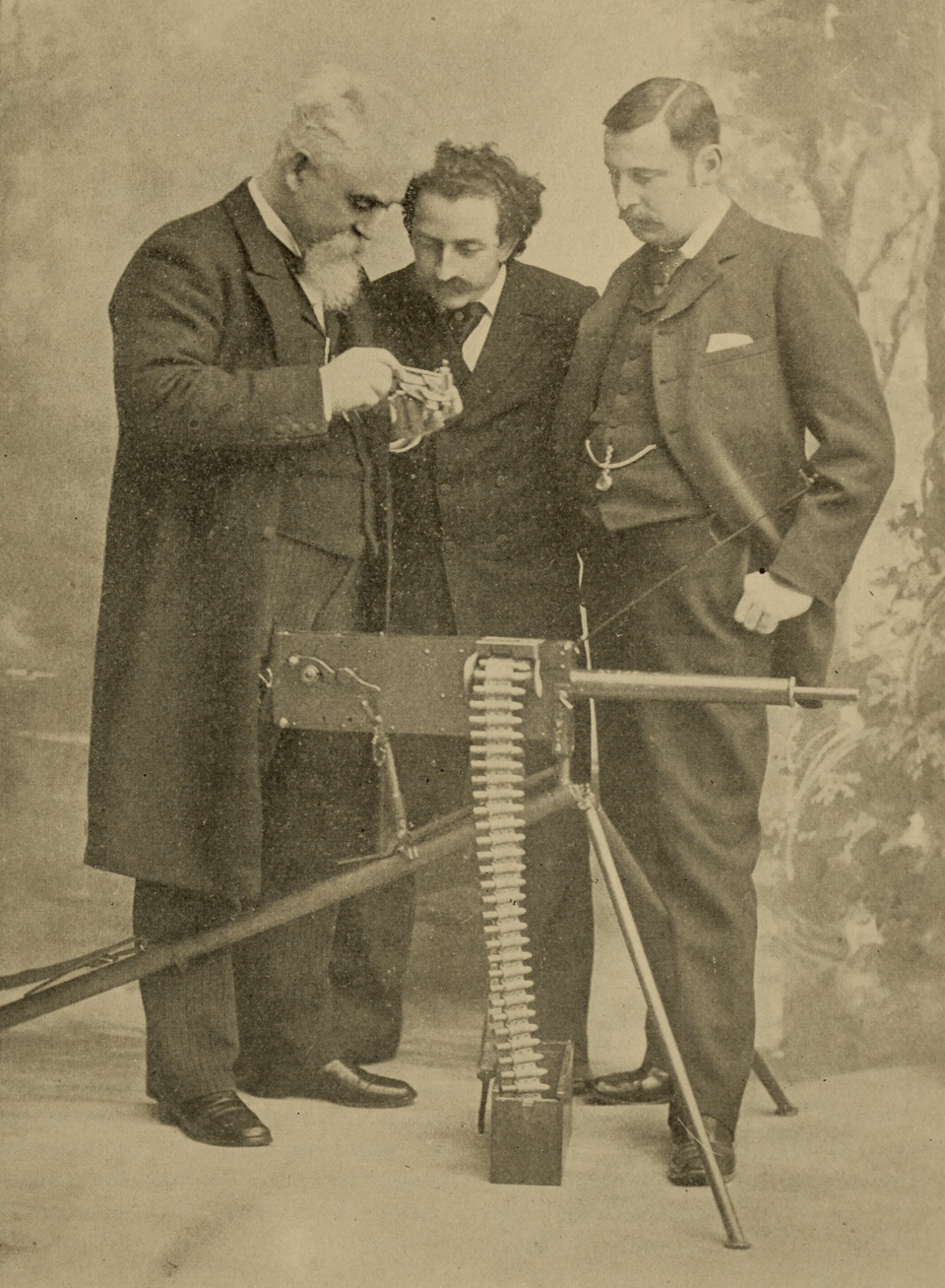
Hiram Maxim's invention was not the first machine gun to be produced. However, the earlier 19th Century machine guns such as the Gatling, the Gardner and the Nordenfelt all relied on multiple barrels to provide rapid fire. Maxim's gun was different - it utilised a single barrel.
It is said that Maxim was impressed by the energy given out by a rifle's recoil. Such energy, to his mind, was completely wasted, and he set about putting this force to some useful purpose.
The principle he devised was to allow the barrel to recoil a short distance when the gun fired. In simple terms, this movement acted on the lock (a sliding breech block), forcing it to the rear. As the lock went back it elongated a spring - the fusee spring -s which pulled it forward again. The rearward action removed the empty cartridge case from the chamber., ejected it and withdrew the next cartridge from the belt. The forward movement fed this cartridge into the chamber and fired it. The cycle then commenced again. The gun's mechanism first had to be cocked manually by pulling back a crank handle on the right hand side of the body, but once the trigger was pressed the lock went forward and the gun would continue to fire until the trigger was released or it ran out of ammunition.
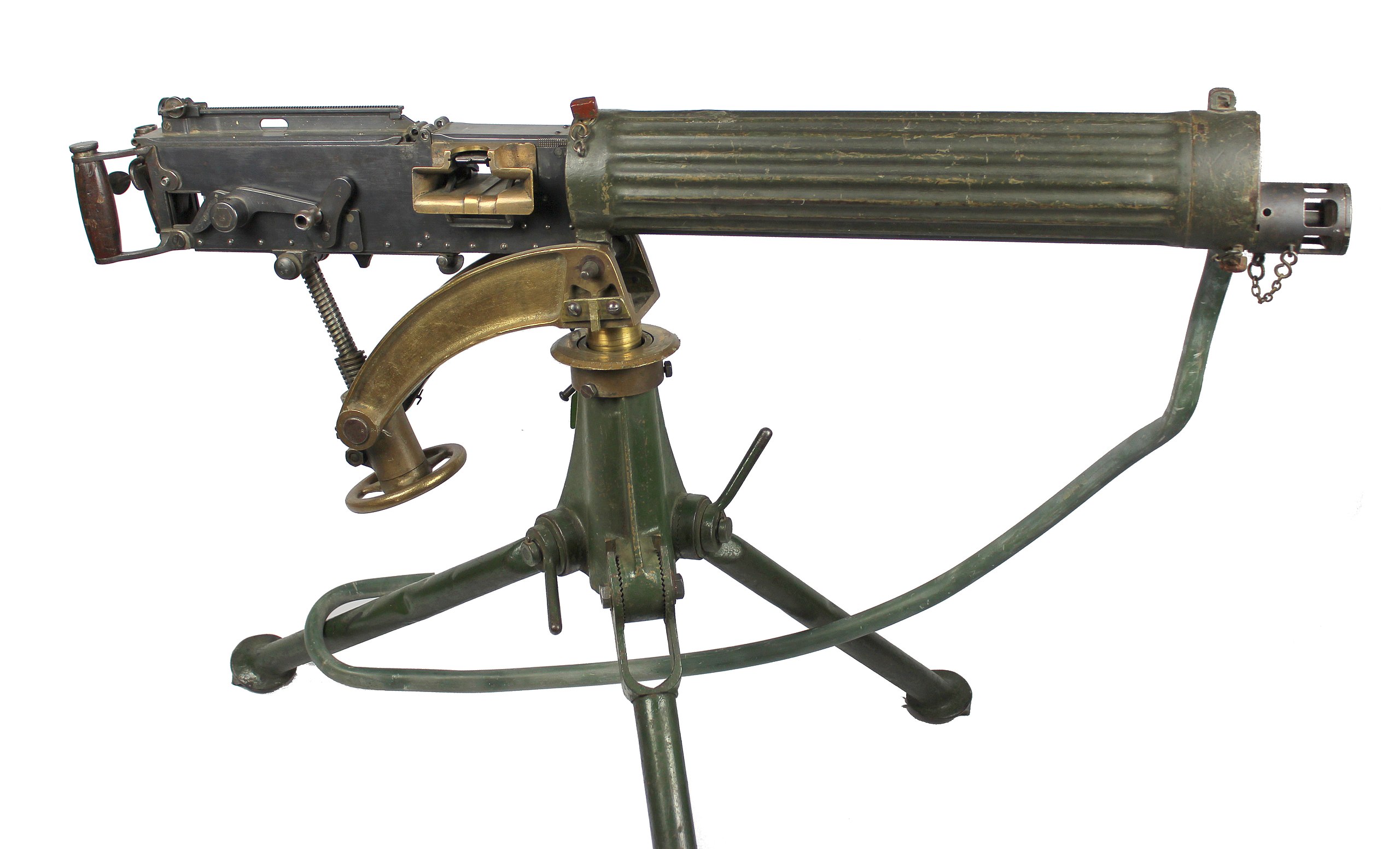
Continuous automatic fire generated tremendous heat in the barrel and Maxim overcame this problem by encasing the barrel in a water jacket, which contained about 7.5 pints. A sound idea, but after one minute's rapid fire of about 550 rounds, the water boiled and the steam so produced could give away the gun's position. It was found that by attaching a tube to a vent in the jacket and passing this tube into a can of cold water, the steam was condensed. The water-can also provided a supply to top up the jacket -there was an estimated evaporation rate of about 1.5 pints per 1,000 rounds fired.
The gun had to be held steady, and a massive tripod mount, weighing 51lbs was designed. The gun and tripod were carried separately. The tripod had a traversing head and was equipped with a wheel operated elevation screw. On later tripods a dial, graduated in degrees, was incorporated in the mounting to enable the gun to be readily laid on a particular bearing.
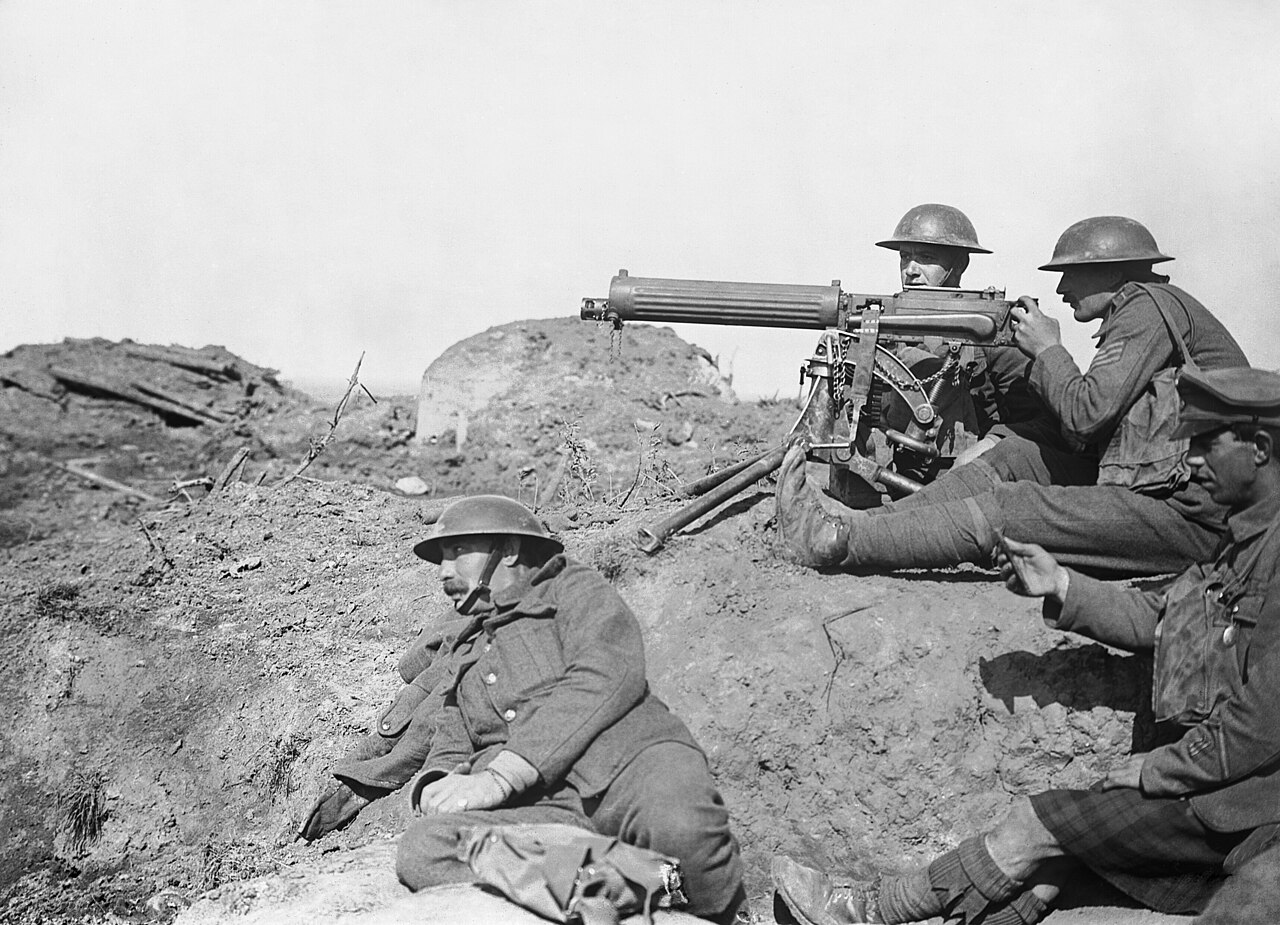
Ammunition was fed into the gun by a canvas belt with brass inserts between each cartridge. The belt held 250 rounds, and passed through the feed block from right to left. One of the problems on the Western Front was keeping belts dry and clean. If wet, they tended to swell and cause the feed mechanism to jam. Mud would also clog the gun.
The machine gun was aimed, rather like a rifle, and was fitted with a foresight and a backsight. The backsight was on a stem which, when raised, was graduated to 2,900 yards. Dual sights, like a miniature surveyor's theodolite, were also issued. These enabled the gun to be laid accurately on a bearing to bring down indirect fire on fixed lines, in much the same way that an artillery piece was laid.
The machine gunner fired from a sitting position, holding two wooden grips which were fixed at the rear of the gun. Between the grips was a thumb operated trigger with a safety bar. This bar had to be lifted up before the thumb piece could be pressed. The grips were hollow. One contained a brass oil bottle, the other an oil brush.
A variety of ancillary equipment was provided with each gun. This included spare parts, spare barrel, tools, cleaning equipment, oil cans, a 2 gallon water can, night sights, aiming posts and a slide rule. On top of all this was the ammunition - 32 belts for a two-gun section was the minimum issue, and a belt in its box weighed 221bs. Reserves of 15,000 rounds were kept in the machine gun section's ammunition cart. Given this amount of kit, as well as the gun and the tripod, one can understand why six men formed the standard machine gun team.
The latter port of the 19th Century was an ear of improving technology, which led to, amongst other things, better quality steels and more efficient engineering methods. These, together with the development of smokeless propellants in rifle calibre cartridges, assisted Maxim's work. The new propellants produced higher pressures in the bore of a gun and Maxim sought to harness this power so that a firearm could fire, eject the spent cartridge case and reload without any action by the firer.
His invention proved a success and distinguished visitors began coming to Hatton Garden for demonstrations. The influential ones included the Prince of Wales (later King Edward VII) the Duke of Cambridge and Lord Wolesely. By July 1998 Maxim had amalgamated with the armament manufacturers Vickers to form Vickers Sons & Maxim Ltd. However, before this amalgamation, he had licensed his weapon to a German weapons firm. They developed their own Maxim gun, which later evolved into the Model 1908 or Spandau (after the town where a government arms factory was situated). Thus, by Century a quirk of 19th commercialism, both Britain and Germany fought the First World War with similar machine guns, which were both developments of Maxim's idea.
The first British Maxim gun came into service in 1891, chambered for the .45" Martini-Henry round, and this was followed in 1893 by the .303" Maxim Gun. These early designs were modified and improved by Vickers until the .303" Vickers Machine Gun, Mark 1, was introduced in late 1912. This was a tripod mounted, water-cooled gun, fed by a canvas belt holding 250 rounds. It fired the standard military .303" Mark VII cartridge at an approximate rote of 550 rounds per minute.
The gun was 43" in overall length and was physically heavy - 33 lbs. The tripod weighed a further 51 lbs. Water, for cooling, added another 7 lbs. or so. The barrel, which was 28.4 inches long, was rifled with S grooves on a left-hand twist, giving one turn in 10 inches (exactly the same as in the Lee-Enfield rifle).
At the beginning of the First World War, it is understood that Britain had a mere 109 Vickers Mark I machine guns in the Army, and 2 in the Royal Navy. These were augmented by 1,846 old Maxim guns. Germany at this stage had over 50,000 Maxims. Orders were hurriedly placed with Vickers for machine guns - weekly deliveries early in the War amounted to 50, but by July 1916 this had reached 634. The production cost per gun in May 1918 was £66-15s-0d.
The Mark I Vickers was an extremely successful and efficient design. Although various subsequent Marks were produced, these were for aircraft or armoured fighting vehicles. The basic gun continued, largely unmodified, throughout both World Wars and was finally retired in 1967. That represents 55 years of hard military service, something that cannot be matched by any other similar weapon.
There is a story that, when the Vickers was declared obsolete, a farewell ceremony took place at the Small arms School at Hythe. While a gun was fired on the range, a band played "O God our Help in Ages Past". A fitting tribute to a remarkable weapon.
Becoming a member of The Western Front Association (WFA) offers a wealth of resources and opportunities for those passionate about the history of the First World War. Here's just three of the benefits we offer:

The WFA regularly makes available webinars which can be viewed 'live' from home. These feature expert speakers talking about a particular aspect of the Great War.

Featured on The WFA's YouTube channel are modern day re-interpretations of the inter-war magazine 'I Was There!' which recount the memories of soldiers who 'were there'.

Explore over 8 million digitized pension records, Medal Index Cards and Ministry of Pension Documents, preserved by the WFA.


