
The .455" Service Revolver
The revolver has been described as a weapon for quick use at close quarters. It was considered more as a defensive weapon than one of precision or for long-range work.
The earliest form of revolver appeared in the 16th Century when pistols with multiple barrels were developed. These were largely unsuccessful, mainly because of the poor methods of ignition in those early times. However, by the mid-19th century the revolver had become an efficient personal weapon and saw service in the Crimea and the Indian Mutiny.
Army regulations at the start of the First World War laid down that officers could use any make of pistol so long as it was chambered for the .455" service cartridge. The official service revolver was the Mark VI Webley, named after the Birmingham firearms manufacturers. Other popular makes were by Colt and Smith & Wesson.
The .455" round came into being in 1891 and a Mark II version was introduced in 1900. This was the round used in the First World War. The heavy, blunt-nosed lead bullet, nearly half an inch in diameter, had a muzzle velocity of 600ft per second. This combination of a massive bullet and a relatively low velocity would literally knock an adversary over when hit. As the Textbook of Small Arms points out: this is just what is wanted in an active service bullet.
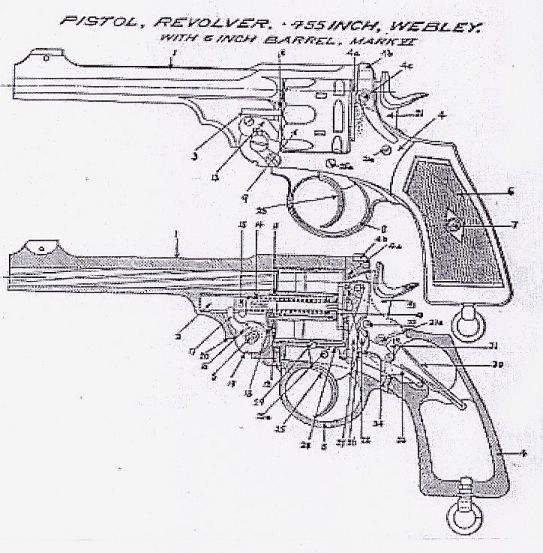
The Mark VI Webley Service Revolver was chambered for six rounds. It was a double action revolver - it could either be fired with the hammer in the uncocked position or from the cocked position. In the former, pulling the trigger cocked the hammer - useful if a quick shot was needed, but it had the disadvantage of a heavy trigger pull. Firing with the hammer cocked gave a lighter trigger pull but the hammer first had to be drawn back by the firer's thumb.
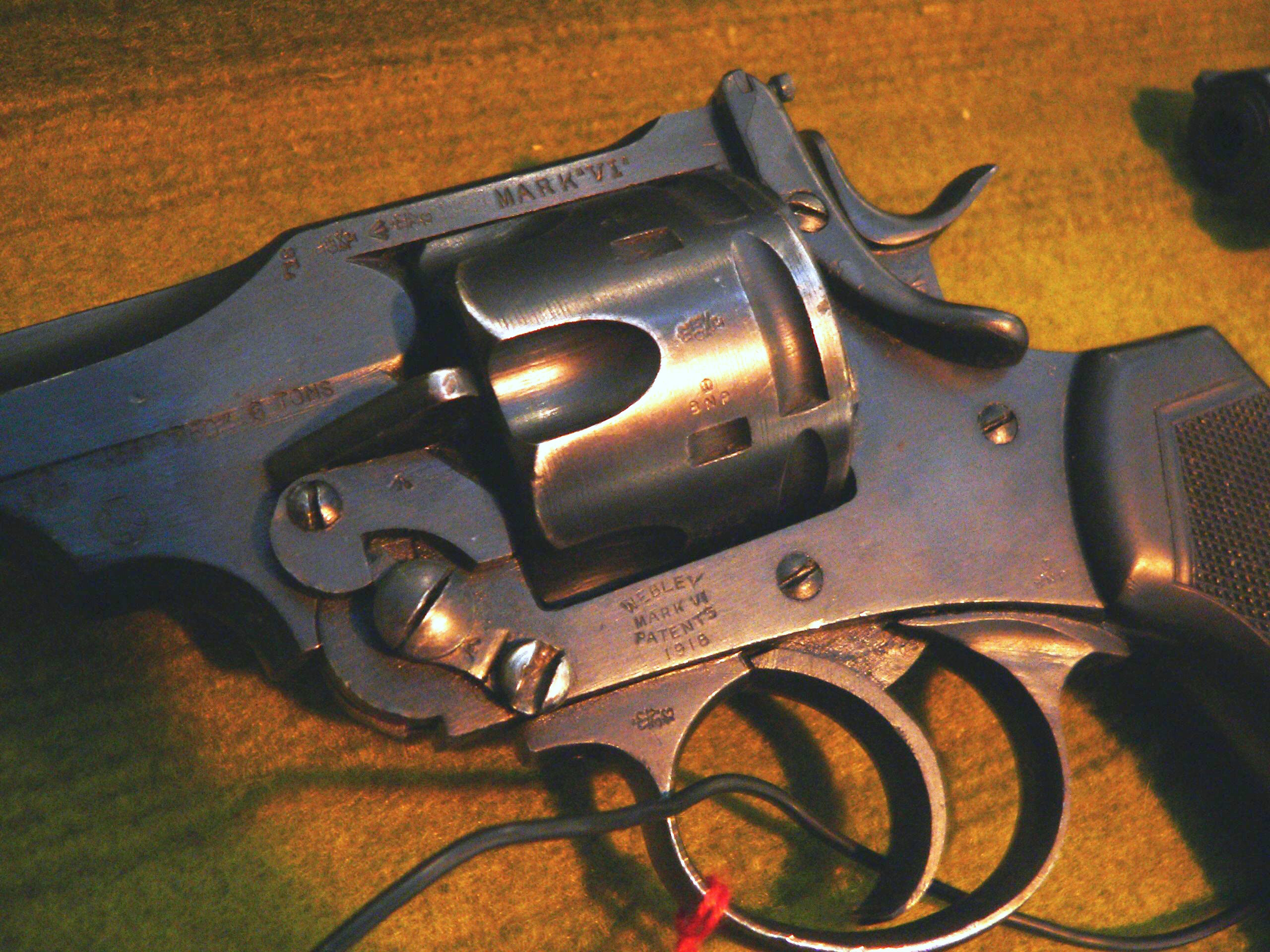
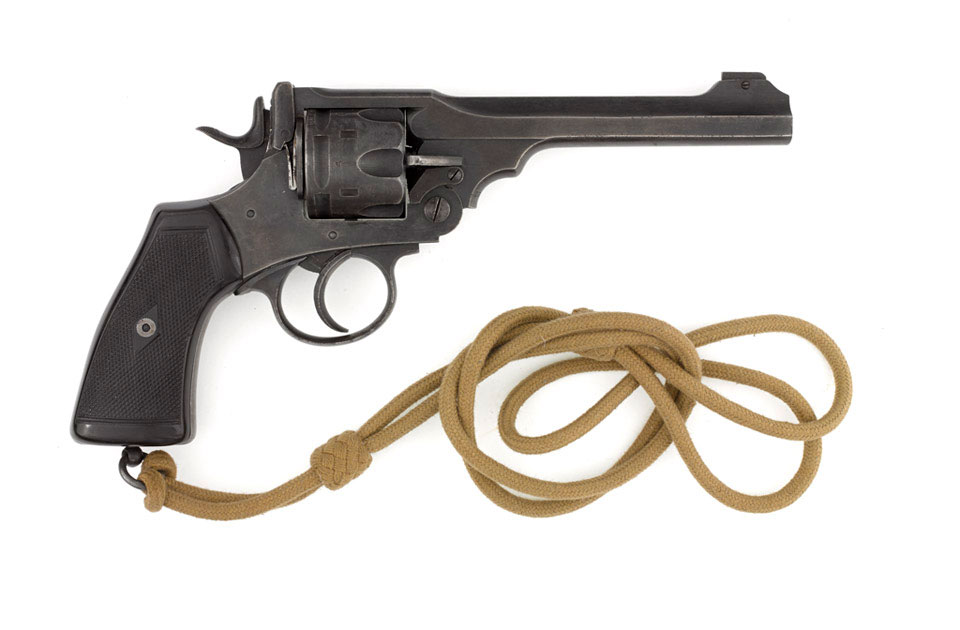
The barrel was 6" long, rifled with seven grooves, and the pistol weighed 2lbs. 6.5ozs.
Loading the service revolver was simple. A catch on the left side of the body was depressed and the barrel and cylinder would swing down. As the barrel dropped, and extractor in the centre of the cylinder would be activated, throwing out all six cartridge cases in the chambers. Another six rounds could then be loaded individually by hand, though there were various quick-loading devices, which enabled the firer to load more speedily.
Sights were basic. A '"U" backsight was fitted above the rear of the cylinder and there was a large foresight. The backsight was fixed - it could not be adjusted for different ranges. Revolvers generally have large, high foresights to compensate for the upward movement of the pistol when it recoils on firing.
The service revolver was a weapon of great strength, designed to take a lot of rough treatment without serious deterioration in its shooting qualities or its accuracy.
Although the .455" revolver was issued to officers at the beginning of the War, it was later used as a personal defensive weapon by machine gunners, signalers, tank crews, and others who would have been encumbered by a rifle when in action.
Becoming a member of The Western Front Association (WFA) offers a wealth of resources and opportunities for those passionate about the history of the First World War. Here's just three of the benefits we offer:

Identify key words or phrases within back issues of our magazines, including Stand To!, Bulletin, Gun Fire, Fire Step and lots of others.

The WFA's YouTube channel features hundreds of videos of lectures given by experts on particular aspects of WW1.

Read post-WW1 era magazines, such as 'Twenty Years After', 'WW1 A Pictured History' and 'I Was There!' plus others.


